
Cook with limited worktop space
You want to be able to set up, use and put away a stand mixer for pasta without giving up too much workspace. So don’t just look at the bowl capacity; consider how much room you’ll need while using it, too.


Start by looking at the space you have available: compare the dimensions of the exact model with the room you’ll need to use the bowl and work with the dough. Then choose based on your usual batch size and the instructions for that model. A pasta roller is only relevant if you also want to roll out the dough and the attachment is compatible with your mixer.
You want to be able to set up, use and put away a stand mixer for pasta without giving up too much workspace. So don’t just look at the bowl capacity; consider how much room you’ll need while using it, too.
You make dough regularly and want to know what the instructions for your model allow for your usual batch size. Capacity figures for cake or other types of dough don’t automatically set a limit for pasta dough.
You may want to mix and roll out dough using one powered appliance. If so, check that the attachment is compatible with the exact model and that you have room to store the accessories, too.
Choose this when: storage and a modest worktop footprint are your priorities, and you mainly want to mix dough. Kenwood lists dimensions of 33.5 × 18 × 30 cm for the Go KZM35.000GY.
The trade-off: also measure the space you’ll need to use the bowl. The listed dimensions don’t tell you how much firm pasta dough the model can handle.
Choose this when: you want to compare documented appliance dimensions and bowl capacity. Bosch lists dimensions of 266 × 266 × 277 mm (h × w × d) and a 3.8 l bowl for the MUMS2VM00.
The trade-off: Bosch lists a maximum dough quantity of 2.0 kg, but this isn’t a separately specified limit for pasta dough. Check the E-number before choosing a pasta attachment, too.
Choose this when: you want to roll out pasta sheets regularly as well as mix dough. KitchenAid lists a dough hook with the 5KSM125 and says that its separate 5KSMPSA pasta roller is suitable for its mixers.
The trade-off: the roller requires extra spending and storage space. KitchenAid also explains that the pasta dough should be kneaded briefly by hand after mixing.
| Buying concern | What should you check? | Who is this more important to? |
|---|---|---|
| Space to set up, use and store the mixer | Compare the height, width and depth of the exact model with the space you have available. Leave room to use the bowl and work with the dough, too. | I want to be able to put the mixer away after use and still have enough room to knead. Around 34% of consumers prioritise where the mixer will be placed and stored. |
| Mixing pasta dough in a suitable batch size | Look up the pasta dough instructions and permitted quantity for the exact model. Distinguish between flour weight, total dough weight and capacity for other types of dough. | If I make pasta dough regularly, I want to know whether my usual batch size is within the model’s instructions. Around 33% of consumers prioritise dough preparation. |
| Rolling out pasta with an attachment | Check the full model number, connection and box contents. Also decide whether you only want to mix, or want to roll out the dough as well. | I want to make pasta sheets without a separate powered appliance, provided the attachment fits my mixer. Around 20% of consumers prioritise adding a pasta roller. |
| Clarity about accessories and buying | Compare what’s included with the exact model and check the seller’s terms. An optional accessory may require extra spending and storage space. | I want to know in advance which parts are included and who to contact if something develops a fault. Around 13% of consumers prioritise peace of mind when buying. |
The bowl capacity and general dough figures don’t automatically tell you how much firm pasta dough a specific model can handle.
Check the instructions and usage limits for the exact model. Don’t apply figures for cake or bread dough directly to pasta dough.
Mixing, rolling out and cutting are different tasks. Bosch pages also don’t clearly define whether the MUZ5PP1 attachment is compatible with the MUM Series 2.
Compare the box contents and ask the manufacturer to confirm compatibility with the full model or E-number.
You’ll also need room for the bowl, ingredients and working with the dough. With the KitchenAid method described, you also knead the dough briefly by hand after mixing.
Plan the full process on your worktop, then compare the appliance’s dimensions.
The Go range is worth considering if you have limited space to set up or store a mixer. Kenwood lists the dimensions of the KZM35.000GY and says it comes with a dough hook.
The MUM Series 2 MUMS2VM00 has listed dimensions, a 3.8 l bowl and a dough hook, making it possible to compare its size and batch capacity with your needs.
The Artisan 5KSM125 is an option if you’re looking for a mixer with a dough hook and may want to add a compatible pasta roller later.
This selection features Joybuy stand mixers with a dough hook. They vary in bowl capacity and stated usage features, so you can compare them with your available workspace and batch size.
 Image unavailable
This could suit you if you’re looking for a stand mixer with a dough hook and the bowl capacity works for your usual batch sizes.
The product name lists 1000 W and a 5.5 l bowl. The product information gives a maximum dough quantity of 1.7 kg; this isn’t a separately specified limit for pasta dough.
 Image unavailable
An option to compare if the listed dimensions suit your workspace and you’ve also considered the recommended usage time.
The product name lists a 6 l bowl, 6 speeds, a dough hook and a 450 W motor. The stated dimensions are 40.7 × 26.8 × 33.2 cm. According to the usage information, the mixer shouldn’t run continuously for more than 6 minutes without a break.
 Image unavailable
This could be worth considering if you’re looking for a stand mixer with a dough hook and the listed dimensions suit your worktop and storage space.
The product information lists a 4 l bowl, 6 speeds plus pulse and dimensions of 33.5 × 18 × 30 cm. The maximum dough quantity is listed as 1.4 kg; this isn’t a separate limit for pasta dough.
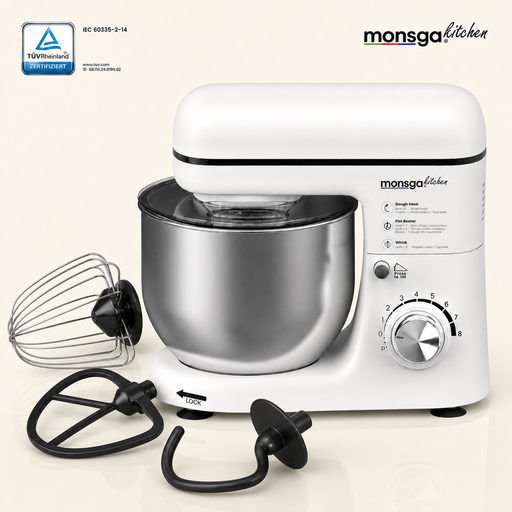 Image unavailable
An option if you’re looking for a stand mixer with a dough hook and kneading at a low to medium speed suits the way you work.
The product name lists a peak power of 1000 W, a 5.0 l bowl and 8 speeds. The usage information recommends a low to medium speed for kneading dough.
No. Bosch lists a bowl capacity and a general maximum dough quantity for the MUMS2VM00; KitchenAid gives maximum quantities by ingredient or preparation for its models. Don’t treat these figures as directly comparable tests for pasta dough. Check the instructions for the exact model.
In its pasta dough instructions, KitchenAid recommends mixing briefly with the flat beater first, then kneading for two minutes with the dough hook on speed 2. Knead the dough by hand for another 1–2 minutes, then leave it to rest for 10–15 minutes. This is the manufacturer’s advice for that method, not a universal programme for other mixers.
For the 5KSMPSA, KitchenAid recommends using a cleaning brush, then wiping the roller with a dry cloth. Follow the instructions supplied with other attachments.
No. According to ACM ConsuWijzer, your statutory guarantee rights apply alongside any seller or manufacturer guarantee. If a product develops a fault earlier than you could reasonably expect under normal use, the seller is responsible for providing a solution under the applicable terms.
For a standard online consumer purchase, ACM ConsuWijzer says you generally have a statutory cooling-off period of up to 14 days after delivery, subject to legal exceptions. Check the terms for handling and returning the appliance.