
Home cooks with limited worktop space
You want to make pasta dough, but need to use the mixer on a small worktop or put it away afterwards. Both the overall dimensions and the space needed to reach the bowl matter.


Start by measuring the available space, including the room you need to use the bowl and add ingredients. Then compare the included mixing attachments and the quantities specified for the exact model. A larger bowl or pasta roller is only worth considering if it suits your portions and plans.
You want to make pasta dough, but need to use the mixer on a small worktop or put it away afterwards. Both the overall dimensions and the space needed to reach the bowl matter.
You usually make one recipe at a time and want mixing tools that suit those quantities, rather than automatically opting for the largest bowl.
You want to mix the dough and perhaps add a powered roller later. If so, check that it’s compatible with the exact mixer model and whether the attachment is available separately.
First, measure the available space and the room you’ll need while using the mixer. Then compare the mixing attachments and model-specific quantities with your recipe. Only then decide whether a larger bowl or pasta attachment would be useful for you.
| What to consider | What to look for when buying | Who should consider this? |
|---|---|---|
| Pasta dough and mixing tools | Check which mixing beater and dough hook are included, and which quantities the manual gives for your exact model. A general dough capacity is not a separate test for pasta dough. | If I want to mix pasta dough without using a maximum for other types of dough as a benchmark, I check the attachments and my recipe. Around 34% of consumers put dough suitability first. |
| Worktop and storage space | Measure the width and depth of the space, and allow room to add ingredients and use the bowl. | If my worktop is small, I want to know whether the mixer will fit and whether I can access it while it’s in use. Among consumers who prioritise space, the figure is around 33%. |
| Rolling out dough with an attachment | Check the attachment code, its compatibility with the full mixer model and whether the roller is included with the mixer. | If I also want to roll out pasta mechanically, I look for a roller that fits the mixer I’ve chosen. Around 20% of consumers give this option their highest priority. |
| Total purchase cost and terms | Compare what’s included, which attachments you may need to buy separately and the seller’s terms for the specific purchase. | If I want to understand the cost of the complete set, I include separate attachments in my comparison. Around 13% of consumers prioritise the total purchase cost. |
A tilt-head mixer also needs space to open the head and access the bowl and mixing tools.
So measure both the storage space and the space available while you’re using it.
A stated maximum for dough doesn’t automatically tell you how much pasta dough you can make or how it will mix for your recipe.
Check the manual and the quantities for the exact model. Don’t treat a general maximum as an independent test with firm pasta dough.
A dough hook mixes dough; a roller is for the next step. They don’t do the same job.
Check what’s in the box and the roller’s product code before comparing the complete set. A compatible attachment may need to be bought separately.
Additional cover is separate from the seller’s legal obligations if a product is faulty.
Check what rights and terms the extra cover provides, and contact the seller about any problems with a product.
The Kenwood Go KZM35.000GR is worth including in your comparison if storage space and dimensions are important factors.
The Bosch Serie 2 MUMS2VM00 offers a different combination of dimensions and bowl capacity to compare with compact models.
The 3,3 L 5KSM3311X range is worth comparing if you make small batches or are considering a compatible pasta roller.
These stand mixers have a dough hook or are listed as suitable for pasta dough. Compare the bowl capacity and other specifications with the space and portion sizes that matter to you.
 No image available
The product name lists a dough hook and pasta as an application, so you can compare this model for mixing pasta dough.
The name lists a 5 L bowl, 10 speeds and a 400 W motor.
 No image available
The product name lists a dough hook and pasta as an application. Compare the stated bowl capacity with the space you have available.
The name lists a 6 L bowl, 6 speeds and a 450 W DC motor.
 No image available
This model is worth comparing if you’re looking for a Kenwood Go for a kitchen with limited worktop or storage space.
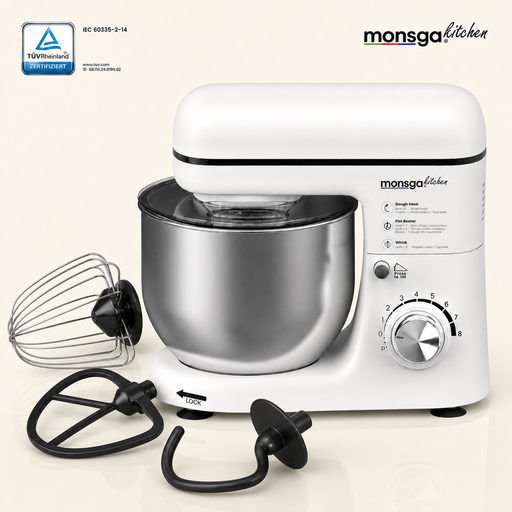 No image available
The product name lists a dough hook. Compare the stated settings with the instructions for the dough you want to make.
The name lists a 5,0 L stainless steel bowl, 8 speeds and 1000 W peak power.
No, not if you only want to mix the dough. KitchenAid describes rolling it out by hand and with a pasta roller. If you want to use a powered roller, check that it’s compatible with the exact mixer model and check the attachment’s product code.
In its pasta dough instructions, KitchenAid Netherlands recommends mixing the ingredients with the flat beater for about 30 seconds on speed 2, then kneading with the dough hook for two minutes on speed 2, before briefly kneading the dough by hand. For a different brand or model, follow its own manual and recipe.
No. According to the Dutch government, there is no fixed statutory guarantee period in the Netherlands; if a product is faulty, you should contact the seller. A manufacturer’s guarantee or additional cover is separate from this.
According to the Dutch government, consumers buying online from a business generally have a 14-day cooling-off period. Check the applicable terms and any exceptions for your specific purchase.
Electrical equipment covered by the applicable EU rules must carry the CE marking before it is placed on the market. The marking is a declaration by the manufacturer, not an independent quality mark or proof that a specific item on sale has been checked.