
Making small lunch portions
You occasionally make fresh pasta for one or a few lunch boxes and want to know whether a machine can handle your small amount of dough. A stated bowl capacity or maximum capacity won’t answer that question.


If you usually make one or a few lunch portions, focus on whether the machine can handle your small quantity of pasta dough and whether it comes with a suitable dough hook. A larger bowl or stated maximum capacity doesn’t prove that it can; for larger batches or machine-rolling, the permitted quantity for your recipe and compatibility with separate pasta attachments matter more. A mixer won’t take care of resting and rolling the dough for you, and cooked pasta needs to be cooled and stored safely.
You occasionally make fresh pasta for one or a few lunch boxes and want to know whether a machine can handle your small amount of dough. A stated bowl capacity or maximum capacity won’t answer that question.
You want to roll or cut pasta more often, as well as mixing and kneading the dough. So you’re comparing attachments compatible with your model against rolling the dough by hand.
You prepare several meals at once and compare the permitted dough load with the space needed for the machine. Safely cooling and storing cooked pasta is also part of your plan.
A good fit if: you mainly mix dough for one or a few lunch boxes from time to time. Check whether the manufacturer supports the smallest quantity in your recipe.
The trade-off: a high stated maximum capacity doesn’t tell you how the machine handles a small portion; you can also roll the dough by hand.
A good fit if: you make fresh pasta regularly and want to roll or cut it with a machine after kneading.
The trade-off: a connection point doesn’t mean a roller is included or that every attachment fits every model.
A good fit if: you make several lunch portions at once or prepare other larger quantities of dough.
The trade-off: stated maximums for yeast dough aren’t confirmed limits for pasta dough; also consider how much space the machine needs.
| What to consider | What should you check? | Who does this matter most to? |
|---|---|---|
| Mixing small portions | Check the manual or ask the manufacturer about the minimum quantity for your recipe, and see which dough hook is included. | If I’m making dough for one or a few lunch boxes, I want to know whether the manufacturer says the machine can handle my small portion. Around 40% of consumers prioritise mixing small portions. |
| Load for larger batches | Check the manual for the permitted quantity for your type of dough, and measure the space the machine will take up. | If I regularly prepare several lunches at once, I want to match the amount of dough to what the exact model can handle. Around 30% of consumers make batch size and dough load their main consideration. |
| Rolling or cutting | Check the full model code, compatibility, connection and box contents for the roller or cutter you want. | If I make fresh pasta more often, I want to know whether I can roll or cut it with a machine after kneading. Around 20% of consumers prioritise a compatible pasta attachment. |
| Space and ease of use | Measure the available worktop or storage space, and check the cleaning instructions for the bowl and attachments. | For a machine I use occasionally, it matters whether I can position, clean and store it easily. Around 10% of consumers focus mainly on space, cleaning or the overall purchase cost. |
A manufacturer’s stated capacity for yeast dough doesn’t tell you how much of another, potentially firmer recipe the machine can handle. Nor does a maximum tell you whether it will mix a small portion properly.
Check the manual or ask the manufacturer about the permitted quantity for your pasta recipe. Don’t choose based only on a high capacity figure.
After kneading, the dough still needs to rest and be rolled out. Optional attachments aren’t automatically included in the box.
Check the box contents and compatibility with the full model code. Rolling the dough by hand is still an option.
A compatible pasta roller or cutter you want may need to be bought separately and will take up extra storage space.
Voedingscentrum advises cooling cooked leftovers quickly and storing them in a sealed container. Don’t leave them out of the fridge for more than two hours.
Plan how you’ll cool and refrigerate the pasta, and how you’ll keep it chilled when taking it with you, separately from your choice of mixer.
ACM ConsuWijzer explains that the warranty period stated by the manufacturer doesn’t automatically determine the limits of your legal rights against the seller.
Keep your proof of purchase and, if a product develops a fault, consult ACM ConsuWijzer’s information about your legal guarantee and the seller’s responsibilities.
The Serie 2 and Serie 4 models reviewed differ in factors including bowl capacity and stated dough capacity.
The Artisan 5KSM125 we reviewed is worth considering if you’re looking for a dough hook and may want to use pasta attachments later.
The Titanium Chef Baker KVC85.004BK is an expandable option if you also prepare other recipes.
The Assistent Original AKM6230 is worth considering if you regularly make larger quantities of dough.
The SMF03DGEU we reviewed is worth considering if a dough hook and the option to add attachments are important to you.
These product picks are intended for mixing or kneading pasta dough; check the ingredients, quantities and attachments for each model to make sure they suit your recipe.
 No image available
Worth comparing if you’re looking for a stand mixer for dough; check whether the included attachments are suitable for your pasta recipe.
The product name lists 1000W, planetary mixing action, a 5.5L bowl and several attachments. The product description gives a maximum dough capacity of 1.7 kg; check which type of dough and conditions of use this applies to.
 No image available
Worth considering if you’re comparing a machine with a dough hook and a larger bowl for dough preparation; bowl capacity alone doesn’t tell you whether it can handle small portions well.
The product name lists a 6L bowl, six speeds, a tilt-head design and a 450W motor. The instructions advise against using the machine continuously for more than 6 minutes without a break.
 No image available
Worth considering if you’re looking for an appliance that, according to its product name, kneads dough and lets it rest automatically; check whether the programmes suit your recipe.
The product name lists a 5L capacity and the ability to knead up to 2.5 kg of dough. The product description mentions an automatic resting period for certain programmes; this doesn’t confirm a minimum quantity for pasta dough.
 No image available
Worth comparing if you’re looking for a machine with a dough hook; check whether the recommended speed is suitable for your pasta recipe.
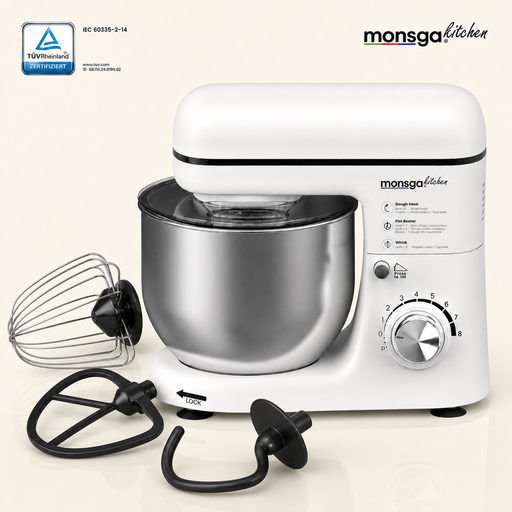
The product name lists 1000W peak power, a 5.0L bowl, eight speeds and a dough hook. The usage information recommends a low to medium speed for kneading.
No, you can also roll out the dough by hand after kneading and resting it. KitchenAid describes both methods in its own pasta dough instructions; if you’re considering a mixer attachment, first check that it’s compatible with the full model code.
According to KitchenAid’s own method, first mix the ingredients with the flat beater, then knead with the dough hook for two minutes on speed 2. KitchenAid then recommends kneading by hand for 1 to 2 minutes and letting the dough rest for 10 to 15 minutes. These are the manufacturer’s instructions for this method, not a universal setting for other mixers or recipes.
Voedingscentrum advises keeping cooked pasta in the fridge for no more than two days. Cool leftovers quickly, store them in a sealed container, don’t leave them out of the fridge for more than two hours, and set your fridge to 4 °C. If you can’t keep your lunch chilled, plan ahead for how to keep it safely cool.
According to ACM ConsuWijzer, ordinary online product purchases generally come with a statutory cooling-off period of up to 14 days after delivery, with some exceptions. Before buying, check the seller’s information and the conditions that apply to returns.
No. ACM ConsuWijzer explains that the Dutch statutory guarantee doesn’t have a fixed two-year period; what matters is how long you could reasonably expect the product to last with normal use. The seller is responsible for providing an appropriate solution if a product is faulty; a manufacturer’s warranty is separate.