
Baker with limited worktop space
You want to make batter and other baking mixtures regularly, but first need to check whether the appliance, bowl and operating space will fit in your kitchen.


A stand mixer is worth considering if you regularly make other baking mixtures as well as pancake batter, and have room for the appliance, bowl and space to operate it. For a small amount of batter made only occasionally, a hand mixer or a hand mixer with a bowl and stand may suit your available space better. Also consider how much washing-up is involved and whether the mixer can handle thin batter.
You want to make batter and other baking mixtures regularly, but first need to check whether the appliance, bowl and operating space will fit in your kitchen.
You mainly make thin batter from time to time and want to weigh up whether a stand mixer takes up more space and creates more washing-up than it saves.
You’d like to mix hands-free sometimes, but also want to be able to use the mixer without its stand.
Best for: regular mixing, whisking or kneading if you have a dedicated spot and enough room for the bowl and arm to move freely.
Trade-off: the machine, bowl and attachments all take up worktop and storage space.
Best for: switching between hands-free mixing and using the mixer on its own.
Trade-off: you’ll also need to store the bowl and stand; Kenwood lists a 3-litre bowl for the Chefette Lite HMP32.A0WH.
Best for: making batter occasionally and using as little permanent worktop space as possible.
Trade-off: you’ll need to hold the mixer yourself or mix by hand, rather than using a fixed bowl and controls.
Start by considering how much space you have and how often you make other baking mixtures. Then check whether the mixer can handle thin batter and how many parts you’ll need to wash after use.
| What to consider | What to look for when buying | Who is this important for? |
|---|---|---|
| Will the mixer fit when in use and in storage? | Measure the available width, depth and height, and leave room to add ingredients and remove the bowl. Bosch lists dimensions of 266 × 266 × 277 mm (h × w × d) for the MUMS2EW00; Kenwood lists 38 × 23 × 30 cm for the Go KZM35.000RD. | If I have limited worktop space, I want to know whether I can position the bowl and operate the mixer without everything feeling cramped. This is the top priority for around 33% of consumers who prioritise space. |
| Is it suitable for thin pancake batter? | Check which whisk or beater is included and look for information about mixing thin batter. The Consumers’ Association describes a separate test for pancake batter; the test method alone does not provide a model-specific result. | If I mainly want to use the mixer for thin batter, I want to know whether this reflects my most important task. This is the top priority for around 27% of consumers who prioritise mixing batter. |
| Washing up and storage | Check the cleaning instructions for each part and compare how many accessories you’ll need to put away after a small mixing task. | After making a small batch, I don’t want to wash and store more parts than necessary. This is a top priority for around 20% of consumers. |
| Will you be doing other baking too? | Check which attachments you’ll actually use. Bosch lists a whisk, beater and dough hook for the MUMS2EW00; Kenwood lists a K-beater, whisk attachment and dough hook for the Go KZM35.000RD. | If I regularly make other baked goods as well as pancake batter, a stand mixer with suitable attachments may be worth considering. This is the top priority for around 20% of consumers who prioritise other baking. |
When information conflicts, the model number and features such as power or bowl capacity can be confused.
Check the full model number and compare the key details with the manufacturer’s information. If anything is unclear, ask the seller to explain.
The width, depth, bowl and space needed for the moving arm also determine whether you can use the mixer on your worktop.
Measure the available space and room to operate the mixer before choosing a specific model.
Compatibility can depend on the exact mixer and attachment models. KitchenAid, for example, says its ice-cream maker attachment does not fit the 3.3-litre KSM3311 with a tilt-head.
Check both model numbers for compatibility before buying an extra attachment.
Kenwood describes the Go KZM35.000RD as a stand mixer with a compact design. The Chefette Lite HMP32.A0WH is a different option that can also be used as a hand mixer.
The Serie 2 MUMS2EW00 has published dimensions and attachments you can compare with your available space and baking needs.
KitchenAid documents a tilt-head mixer with a 3.3-litre bowl, which may be a useful reference if you’re looking for a smaller bowl.
The HR7962/21 from the 7000 Series is a kitchen machine with a bowl and several accessories, for those planning to prepare other things too.
This selection includes hand mixers, including models with a bowl or extra attachments, as well as stand mixers for batter and other baking.
 No image available
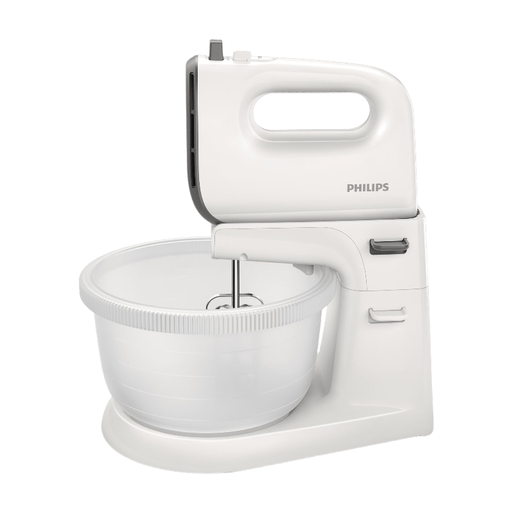
A hand mixer with a bowl stand for anyone who’d also like to mix hands-free.
3-litre bowl; six speeds; 450 W; beaters and dough hooks.
 No image available
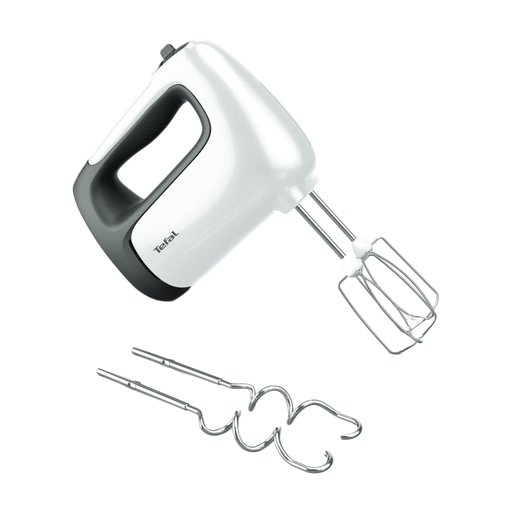
A hand mixer for anyone who wants to use a separate bowl and compare storage requirements.
450 W; five speeds; stainless steel blending foot. The blending foot has sharp blades, so take care when using, assembling and cleaning it.
 No image available
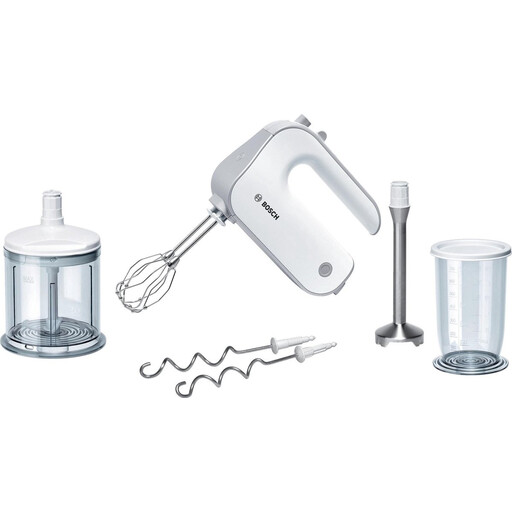
A hand mixer set for anyone who wants to mix thin batter with beaters without a permanent kitchen machine.
500 W; five speeds; turbo setting; beaters, dough hooks and XL chopper.
 No image available
A stand mixer for anyone who wants to make other baking mixtures too and has room for a larger bowl.
6-litre bowl; six speeds; stated dimensions 40,7 × 26,8 × 33,2 cm; whisk, dough hook and beater.
 No image available
A stand mixer for anyone who regularly makes batter and other baked goods and can compare its stated dimensions with their available space.
4-litre bowl; six speeds; pulse function; stated dimensions 33,5 × 18 × 30 cm; whisk, K-beater and dough hook.
Not if bread dough isn’t what you’ll be making. The Consumers’ Association describes mixing thin pancake batter as a separate test task; the test method itself doesn’t provide a result for each model.
Measure the available width, depth and height, and check that you can remove the bowl and operate the arm. Compare this space with the stated dimensions of the exact model; the external dimensions alone don’t guarantee a usable set-up.
It depends on the model and the part. Bosch lists dishwasher-safe accessories for the MUMS2EW00, while the Consumers’ Association warns that accessories aren’t always dishwasher-safe. Follow the instructions for each part.
The Netherlands Food and Consumer Product Safety Authority states that CE marking is mandatory for electrical products. Electrical equipment with a rated AC voltage of 50–1000 V must also meet the requirements of the Low Voltage Directive. Check the documentation for the specific product; these general rules don’t prove that a particular item complies.
No. According to the Government of the Netherlands, there is no fixed statutory guarantee period in the Netherlands: you’re entitled to a product that works as it should, and the seller is your point of contact if something goes wrong. A manufacturer’s guarantee or paid-for extended cover doesn’t replace this right.