
Organiser of larger baking sessions
Wants to mix and pour enough batter for each batch. Match your portions to the usable space in the bowl; the nominal capacity is not a proven maximum for pancake batter.


Choose a stand mixer based on how much batter you need to mix per batch, the space available on your workshop table and the whisk supplied. A larger nominal bowl capacity can help you compare planned quantities, but it does not tell you how much thin pancake batter you can mix in it. For smaller batches, a hand whisk may be enough: a basic Dutch recipe recommends mixing with a whisk or mixer.
Wants to mix and pour enough batter for each batch. Match your portions to the usable space in the bowl; the nominal capacity is not a proven maximum for pancake batter.
Needs a mixer that fits among participants, bowls and ingredients. Also measure the space needed to fit and remove the bowl.
Look for a suitable whisk and consider changing and cleaning bowls and attachments between preparations.
Start with portion size and the worktop space available, then check the whisk, access to the bowl and how easy it is to clean.
| What to consider | What should you check? | Who is this important for? |
|---|---|---|
| Amount per mixing batch | Compare the stated bowl capacity and check the manual for filling limits when mixing liquid batter. | If I want to mix a lot of batter per batch, I’ll match my portions to the usable bowl space. Around 36% of consumers put the amount per batch first. |
| Ability to mix batter | Check whether a suitable whisk is included; if this is a deciding factor, look for a test of the specific model with thin batter. | I want to mix thin batter with a whisk, rather than judge the result from wattage alone or a general claim about dough. Around 29% of consumers give mixing performance top priority. |
| Space on the workshop table | Measure the space available and check that you can easily reach the bowl and controls in your chosen setup. | If the worktable is already crowded, I want to know whether the mixer will fit and whether I can reach the bowl. Around 21% of consumers prioritise where the mixer will go and access to the bowl. |
| Cleaning and accessories | Check which bowls and attachments are included, and read their cleaning instructions. | For back-to-back sessions, I want to know how much work is involved in changing and cleaning the equipment, and whether I’ll actually use the extra parts. Around 14% of consumers prioritise cleaning and the value of the accessories. |
A bowl’s nominal capacity does not prove how much thin pancake batter you can mix. The maximum quantities Bosch gives are for cake batter and yeast dough, not pancake batter.
Plan your portions and check the manual for the exact model for guidance on liquid mixtures.
If the usable filling space is smaller than your portion, you may need to mix in more batches and spend longer cleaning up.
The Dutch Consumers’ Association uses a whisk when testing food processors. A general power rating or claim about dough does not, by itself, tell you how well a specific model mixes thin pancake batter.
Check whether a whisk is included and look for a test result for the specific model if mixing performance is a deciding factor.
According to the Dutch government, an additional warranty you buy is on top of your statutory rights; the terms and conditions will explain whether it offers extra benefits.
Read the statutory and additional terms separately, and check the situation separately if you’re buying for business use.
Bosch lists a 3.9-litre bowl for the MUM58359, along with a whisk, beater and dough hook, as well as other accessories.
Kenwood describes the Go KZM35.000GY as a compact setup with a 4-litre bowl and front-mounted controls.
Philips lists a 5.5-litre bowl for the 7000 Series HR7962/21, with a whisk and splash guard, plus a blender and meat mincer.
KitchenAid lists two bowls, a wire whisk and several mixing attachments for the Artisan 5KSM175PSECA.
These stand mixers are for anyone who wants to make batter in a mixing bowl. Compare the stated bowl capacity, included attachments and worktop space required with the batches you plan to make at your workshop.
 Image unavailable
The product information lists a flat beater for mixing.
The nominal bowl capacity is 5,5 litres; this is not a guaranteed amount of pancake batter. According to the product information, the bowl and accessories are not dishwasher-safe.
 Image unavailable
The product information lists a whisk, K-beater and dough hook for different mixing tasks.
The stated bowl capacity is 6,70 litres; this is not a guaranteed amount of thin pancake batter. According to the product information, children under 8 must not use the appliance; older children may use it only under close supervision and after instruction.
 Image unavailable
The stated dimensions are 33,5 × 18 × 30 cm and the controls are at the front; compare these measurements with your workspace.
The bowl has a nominal capacity of 4 litres. The product information lists a whisk, K-beater, six speeds plus pulse and a rotating splash guard. According to the product information, children must not use the appliance.
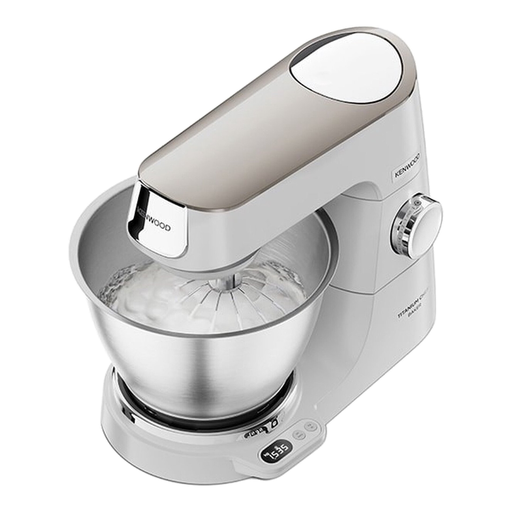 Image unavailable
The product information lists built-in scales for weighing ingredients directly into the bowl.
A gentle mixing function is also mentioned; this is not a test result for this specific model with thin pancake batter.
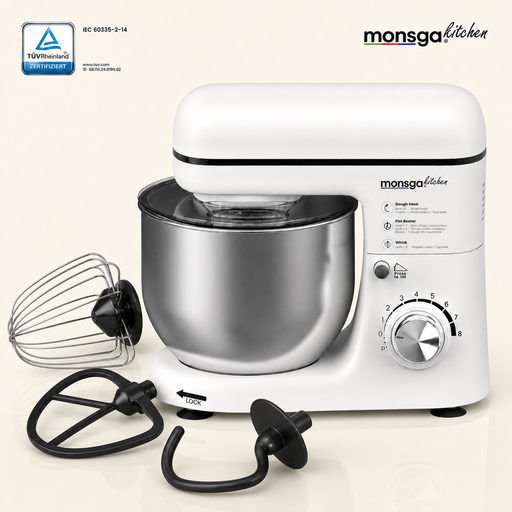 Image unavailable
The product name lists a whisk and a 5,0-litre bowl; the bowl capacity is not a guaranteed amount of pancake batter.
The product information lists a tilting head and splash guard.
No, you don’t always need a stand mixer. A basic Dutch recipe shows how to whisk or mix the batter until smooth. A mixer can be handy if you prefer using one or make batter repeatedly.
Check whether the exact version includes a whisk and follow the model-specific manual for cleaning the bowl and attachments. Don’t assume something is dishwasher-safe based on its material or information about another model.
The Netherlands Nutrition Centre advises against tasting raw batter because raw eggs and flour may contain harmful bacteria. This is food safety advice, not a statement about a mixer’s performance.
According to the Netherlands Food and Consumer Product Safety Authority (NVWA), if you offer unpackaged food to consumers as a provider, you must follow the rules on providing information about allergens present. The NVWA also requires food businesses to register. Whether a particular private or commercial workshop falls under these rules depends on the activity.
According to the Dutch government, consumers are entitled to a product that works properly, and there is no fixed statutory warranty period in the Netherlands. If a product is faulty, contact the seller; a manufacturer’s warranty or an additional warranty you’ve bought is on top of your statutory rights. Check the terms separately if you’re buying for a business.