
Bakers using whole nuts
You want to chop the nuts to your preferred size first, then mix the crust. The Dutch Consumers’ Association distinguishes between chopping with a food processor and baking with a stand mixer.


A stand mixer is suitable for mixing pre-chopped nuts with the other ingredients for a crust. To chop whole nuts, a food processor or a demonstrably compatible chopping attachment is a better choice. Choose the mixing attachment and bowl to suit your recipe and planned portions. If you’re selling your baking, make sure you also provide allergen information and check the school’s policy.
You want to chop the nuts to your preferred size first, then mix the crust. The Dutch Consumers’ Association distinguishes between chopping with a food processor and baking with a stand mixer.
You want to match the recipe quantity to the bowl and the mixing attachment supplied, for example when making several crusts or other bakes.
You need to organise ingredient and allergen information carefully when selling your baking. The Netherlands Food and Consumer Product Safety Authority (NVWA) provides guidance on allergens when selling food; the Netherlands Nutrition Centre advises taking children’s dietary restrictions into account.
Choose this option: if the nuts have already been chopped and you want to mix the ingredients, especially if you also use the mixer for other baking.
Bear in mind: a mixing attachment is not the same as a nut chopper. Check the bowl and accessories supplied with the exact model.
Choose this option: if chopping whole nuts is the main task.
Bear in mind: a separate attachment means extra cleaning and is only an option if the manufacturer confirms it’s compatible with your mixer.
Choose this option: if you’re making one small batch for sale and the nuts are already chopped.
Bear in mind: you avoid buying an appliance, but you’ll need to do the mixing yourself.
| What to consider | What should you check? | Who is this important for? |
|---|---|---|
| Allergens and cleaning | Check the ingredients and school policy. See which parts the manufacturer says can be cleaned, and arrange allergen information in advance. | If I sell baked goods, I want to manage ingredients and cleaning carefully. Around 29% of consumers put allergens and ease of cleaning first. |
| Chopping whole nuts | Check whether the nuts have already been chopped and whether a food processor or compatible chopping attachment is available. | If whole nuts still need chopping, I want to know which appliance can do the job. Around 29% of consumers make chopping nuts their top priority. |
| Mixing the crust | Check whether a mixing attachment or similar beater is included and whether it’s suitable for your recipe. | When the nuts are already chopped, I want to combine the crust ingredients. This is the top purchasing concern for around 24% of consumers. |
| Portions and space | Compare the quantity in each batch with the capacity for that preparation, and consider how much worktop space you have available. | If I’m making several portions, I want to know whether the bowl and appliance suit my recipe and kitchen. Around 18% of consumers prioritise portions, space or use after purchase. |
Mixing and chopping nuts are different tasks. A standard mixing attachment is not a proven substitute for a nut chopper.
First, work out whether the nuts have already been chopped. If not, check whether you have a food processor or whether the manufacturer lists a suitable chopping attachment for your exact mixer model.
A separate chopper or attachment means extra cleaning.
The bowl’s capacity doesn’t automatically tell you how much of your particular nut crust you can mix in one go.
Compare the quantity of ingredients in each batch with the capacity the manufacturer specifies for that preparation.
If a recipe won’t fit into one batch, you may need to mix it in several rounds.
Nuts remain an ingredient in the crust, and other ingredients may also contain allergens. Cleaning doesn’t replace the information you need to give visitors.
Keep a record of the ingredients in each bake, clean any equipment you’ve used, and decide in advance how visitors will be given allergen information.
Kenwood lists a 4-litre bowl and K-beater for the KZM35.000RD. For the Titanium Chef Baker KVC65.001WH, the brand specifies a 5-litre bowl and an integrated weighing function.
Bosch lists a 3.9-litre bowl and an integrated scale for the MUM5XW20. The brand also describes the separate MUZ45XTM1 grinder, which can be used for nuts, among other things.
KitchenAid lists a 4.7-litre bowl for the Artisan 5KSM125EER, along with a mixing attachment, whisk and dough hook.
The stand mixers below are intended for mixing crust ingredients; chopping whole nuts is a separate task.
 No image available
A stand mixer for combining crust ingredients. Use the bowl capacity as a starting point when planning portions.
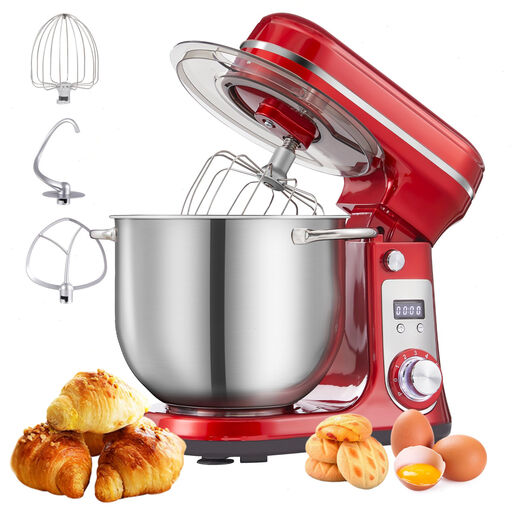
The product name specifies a 5.5-litre bowl and 11 speeds.
 No image available
A stand mixer for combining crust ingredients. Check that the capacity suits the quantity in your recipe.
The product name specifies a 6-litre bowl, six speeds and a pulse setting.
 No image available
A stand mixer for combining crust ingredients. Choose a preparation that suits your recipe and the space available.
The product name specifies a 5.5-litre bowl, 11 speeds and five presets.
 No image available
A stand mixer for combining crust ingredients once the nuts have been chopped.
 No image available
A stand mixer for combining crust ingredients. Check the specification and accessories supplied with the model.
Don’t assume you can just because it has a mixing attachment. A stand mixer is mainly designed for mixing, kneading and whisking, while a food processor is designed for chopping. If you’re considering a separate chopping or grinding attachment, check that the manufacturer says it’s suitable for your exact model.
When selling to consumers at an event in the Netherlands, the NVWA requires information about allergens present. For unpackaged baked goods, you can provide this information in writing or, subject to the NVWA’s conditions, verbally. Check other ingredients for allergens too, and ask the school about its food or treat policy.
The NVWA says that a food safety plan is required for those who prepare and sell food at markets or events several times a year. Don’t assume that the same specific plan requirement automatically applies to a one-off sale. Food must still be handled safely and hygienically.
Follow your model’s instructions for cleaning and thoroughly clean equipment that comes into contact with food. Keep a record of the ingredients in each bake and give visitors appropriate allergen information. Cleaning alone won’t make a bake containing nuts nut-free.