What should you look for when choosing?
Start with the beater and method you’ll use for your tart case. Then match the batch size to your recipe, and factor in storage space and how you’ll use the machine after your gathering.
| What to consider |
What should you check? |
Who should pay particular attention? |
| Mixing pastry for the tart case |
Check whether a flat beater or suitable beater is included, and follow the method in your recipe. |
If I mainly want to combine butter and flour carefully, I’ll check the beater and the method in the recipe first. Around 36% of consumers give pastry texture top priority. |
| Quantity per batch |
Work out the quantity from your recipe and compare it with the capacity specified by the manufacturer for the exact model and type of dough. |
If I’m baking for a group, I want to know how many pastry cases I need and whether my recipe quantity will fit in one batch. Around 29% of consumers prioritise batch size. |
| Cost and storage space |
Measure your worktop and storage space, and check the machine’s dimensions and weight. |
If I’ll need to put the machine away after this gathering, I’ll consider the cupboard space and cost. Around 21% of consumers prioritise this balance of storage space and cost. |
| Other baking tasks and cleaning |
Check which whisk, beater, dough hook and splash guard are included, and which parts the manufacturer says are dishwasher-safe. |
If I want to use the machine for other bakes later, I’ll look at the attachments and cleaning requirements. Around 14% of consumers make reusability their main priority. |
Joybuy product picks
These product picks are stand mixers with a specified beater for baking. For each exact version, check whether the supplied flat beater or K-beater suits the method for your tart case.
 Image unavailable
AUCMA stand mixer, 5 L, 10 speeds
The product description lists a flat beater for mixing; check whether it suits your shortcrust pastry recipe.
The title specifies a 5 L bowl, 10 speeds and a 400 W motor.
View at Joybuy
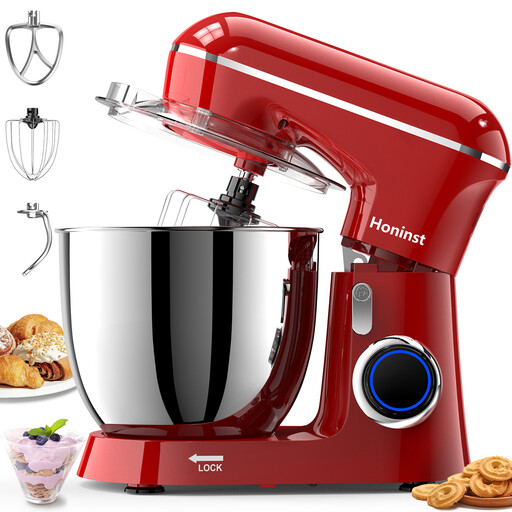 Image unavailable
Honinst stand mixer, 6.5 QT, 10 speeds
The description lists a flat beater alongside a dough hook and whisk; check which attachment your pastry recipe calls for.
The product information specifies a tilting head and a splash guard.
View at Joybuy
 Image unavailable
Kenwood Chef XL KVL4110, silver
The product description lists a K-beater for batters; check whether this attachment is suitable for the mixing steps in your tart-case recipe.
A whisk and dough hook are also listed as included accessories.
View at Joybuy
 Image unavailable
Kenwood Go KZM35, grey
The product description lists a K-beater; compare this with the attachment and method specified in your recipe.
The version described has a 4 L bowl and six speeds.
View at Joybuy
 Image unavailable
Monsga SM100, 1000 W Peak
The product description lists a flat beater; check whether it’s suitable for mixing flour and butter according to your recipe.
The product title specifies a 5.0 L bowl and eight speeds. The description also lists a dough hook, whisk and splash guard.
View at Joybuy
Frequently asked questions
Is a dough hook the most important attachment for a tart case?
Not necessarily: KitchenAid Netherlands’ mushroom and leek galette recipe uses a flat beater to combine the flour and butter. Choose the attachment and mixing time specified in your recipe; a dough hook for prolonged kneading has a different purpose.
How can you tell if the bowl is big enough?
First, compare the quantity in your own recipe with the capacity specified by the manufacturer for the exact model and type of dough. Bowl capacity in litres and specifications for cake or yeasted dough don’t automatically tell you how much pastry the bowl can handle.
How should you store the tart until your coffee morning?
Follow the storage advice for the ingredients and finished tart. The Netherlands Nutrition Centre advises setting your fridge to 4 °C and not leaving highly perishable food out of the fridge for more than two hours, so plan for chilling and transport too.
Do you need to tell guests about allergens?
If you sell or serve non-prepacked tart in a situation where the rules for non-prepacked food apply, information about any allergens present must be available. The NVWA explains when information must be provided in writing or, subject to certain conditions, verbally. Agree with the organiser how the tart will be served, and check the ingredients.
Do you need a food safety plan if you sell food repeatedly at an event?
According to the NVWA, anyone who prepares and sells food at markets or events several times a year must have an HACCP food safety plan. A one-off coffee morning does not, by itself, meet the condition for repeated sales.


