
Home baker making savoury tarts
You want to mix butter and flour gently, stopping as soon as the pastry comes together. Choosing the right attachment and a low speed setting matters more than simply opting for a high wattage.


For leek tart pastry, choose a stand mixer with a suitable flat beater and a low speed setting, so you can stop as soon as the dough comes together. Then match the stated dough capacity and the space available to the number of tarts you make; you won’t necessarily need a larger bowl or extra features. Before buying, also check the product information for the exact version to make sure it meets the applicable CE marking and food-contact requirements.
You want to mix butter and flour gently, stopping as soon as the pastry comes together. Choosing the right attachment and a low speed setting matters more than simply opting for a high wattage.
You may be making more than one tart or dish. So compare the stated dough capacity with the quantities in your recipes, rather than looking only at the bowl capacity.
You want to use a mixer without it taking up a lot of worktop space all the time. That means its dimensions and how easy it is to store may matter more than extra features.
For pastry, the right attachment and gentle mixing are key. Then make sure the batch size suits the space you have in your kitchen.
| What to consider | What should you check? | Who will this matter most to? |
|---|---|---|
| Gentle mixing for pastry | Check whether a flat beater or suitable mixing attachment is included, and which low speed your recipe recommends. | When I mix flour and butter for pastry, I want to stop as soon as the dough comes together. Around 36% of consumers give dough control top priority. |
| Batch size | Work out how much flour and dough you make at a time, then compare this with the stated capacity for the exact model. | When I’m baking for family, I want to know whether my recipe will fit in one batch or whether I’ll need to split it up. Around 29% of consumers prioritise batch size. |
| Worktop space and storage | Measure the available height, width and depth, and leave enough room to operate the mixer while it’s in use. | When space is limited in my kitchen, I want to know where the mixer can go and whether I can put it away after use. Around 21% of consumers give space top priority. |
| Extra features and future use | Think about whether you’ll bake more often after the occasion, and check which bowls and attachments come with the exact version. | I want to choose features that suit what I’ll actually make after the occasion, not just one tart. Around 14% of consumers focus mainly on how they’ll use the mixer in future. |
A bowl’s capacity isn’t the same as the amount of flour or dough a manufacturer specifies for a model. These measurements aren’t interchangeable.
Start with the quantities in your own recipe, then check the capacity stated for the exact version.
If the batch capacity is too small, you may need to mix the dough in several batches. A larger mixer may also take up more space.
A KitchenAid recipe for savoury tart starts with a flat beater to mix the flour and butter. That’s a different step from kneading bread dough.
Check which attachment your recipe recommends, and follow the instructions for your mixer and dough.
Box contents vary between versions. According to the Dutch government, an extended warranty only adds rights if it offers more than the rights you already have.
Check the list of included parts and the terms of any additional warranty for the exact version.
Kenwood offers both a compact Go mixer and the more fully equipped Titanium Chef Baker. The right choice depends on batch size, available space and whether you’ll use the extra features.
According to Bosch, the Bosch MUMS2VM00 has a 3.8-litre bowl and a patisserie set for mixing, whisking and kneading.
The KitchenAid Artisan 5KSM125EMH may suit you if you bake other things as well as savoury tarts.
These stand mixers are options to compare for their mixing attachments, batch sizes and extra features for tart pastry and other baking. For the exact version, check which parts are included and whether the product information meets the applicable requirements for sale and food contact in the Netherlands.
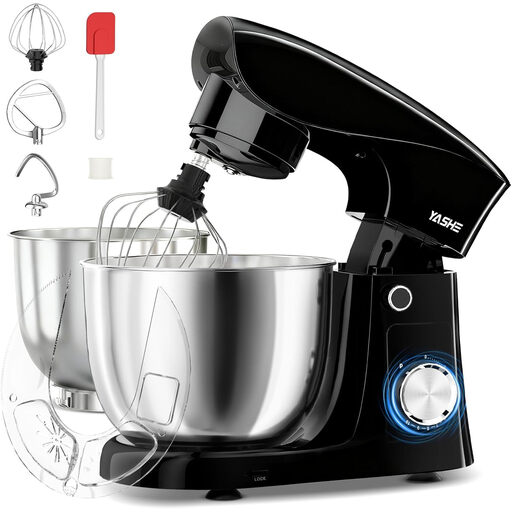 No image available
Could suit you if you’re making several things in a row and want to use different mixing attachments.
The product description lists 4.5 and 5-litre bowls, a beater and 10 speeds. The product name mentions a dough hook and tilt head.
 No image available
Worth considering if you’re looking for a beater for tart pastry and also make other baked goods.
The product description lists a 5-litre bowl, a beater, whisk and dough hook, as well as 10 speeds and a pulse function.
 No image available
Could suit a smaller kitchen if the stated dimensions fit your worktop or storage space.
The product description lists a 4-litre bowl, a K-beater, dough hook and whisk. Its stated dimensions are 33,5 × 18 × 30 cm; the mixer has 6 speeds and a pulse function.
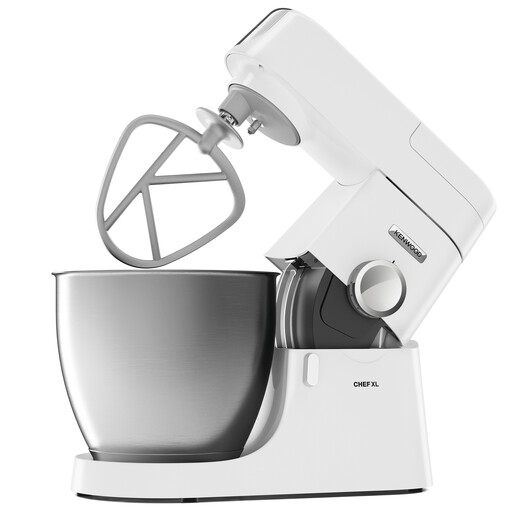 No image available
Could suit you if you want to mix, whisk and knead other things as well as making tart pastry.
The product description lists a 6.7-litre bowl, a K-beater, whisk and dough hook. Compare its capacity with the quantities in your own recipes.
 No image available
An option to compare if you need a flat beater for mixing flour and butter.
The product information lists a 5.0-litre bowl, a flat beater, dough hook and whisk, as well as 8 speeds.
Not always. A KitchenAid recipe for savoury tart starts by using the flat beater to mix flour and butter, then uses the dough hook later in that particular recipe. Follow the recipe and your mixer’s instructions; kneading bread dough is a different task.
You can’t tell from the bowl capacity alone. Compare your recipe with the capacity stated by the manufacturer for the exact model: bowl capacity in litres, dough in kilograms and flour in kilograms are different measurements. Make several batches if needed.
Fit the bowl and suitable attachment according to the instructions, start at the speed recommended by your recipe, and stop when the dough has reached the consistency described. Check the cleaning instructions for each model and part; don’t assume every attachment is dishwasher-safe.
You may do. According to the Dutch government, there’s no fixed statutory warranty period in the Netherlands: you’re entitled to a product that works properly, and the retailer is your point of contact if it doesn’t. Whether repairs are free depends, among other things, on the product, how long you could reasonably expect to use it and the cause of the fault.
According to the Netherlands Food and Consumer Product Safety Authority, CE marking is compulsory for electrical products. Parts intended to come into contact with food are also subject to the applicable food-contact materials rules. Check the information for the specific version; meeting the legal requirements in principle doesn’t prove that a particular product listing complies with them.