
Running several baking rounds
You want to make enough dough for each round and switch bowls efficiently. Compare your batch size with the instructions for the exact model, rather than relying on bowl capacity alone.


Start with the recipe: for cookie-style dough, a flat beater or K-beater is the place to start, while a whisk is designed for whipping air into mixtures. Then weigh the batch for each round and check the instructions for the exact model; bowl capacity and maximum quantities for other preparations don’t tell you how much hazelnut dough you can mix. If you’re serving food to consumers during the workshop, also check the rules on allergen information and food safety separately.
You want to make enough dough for each round and switch bowls efficiently. Compare your batch size with the instructions for the exact model, rather than relying on bowl capacity alone.
You’re looking for an attachment suited to cookie-style dough or light sponge batter. The Consumentenbond distinguishes between food mixers for baking, while KitchenAid describes its flat beater as suitable for cookie mixtures.
You want to clean equipment thoroughly between participants and recipes. If you serve food to consumers, the Netherlands Food and Consumer Product Safety Authority (NVWA) also sets out requirements for allergen information and food safety.
First decide which attachment suits the texture of the recipe, then weigh the batch for each round. If the equipment will be shared, also consider cleaning and how food will be served during the workshop.
| What to consider | What to look for | Who is this important to? |
|---|---|---|
| The right attachment | Dough texture, whether a flat beater or K-beater is included, and the model instructions. | If I mainly make cookie-style dough, I want an attachment that’s suited to it. Around 36% of consumers give choosing the right attachment top priority. |
| Batches and rounds | Weigh the dough for each round and check what any stated maximum applies to; also see whether an extra bowl is included. | If I’m planning several workshop rounds, I want to know how to organise batches and bowl changes. Around 29% of consumers prioritise batch size and workflow. |
| Cleaning and allergens | Check how to clean the bowl and attachments according to the manual, and how to keep recipes separate. | When sharing equipment, I want to handle hazelnuts and different recipes carefully. Around 21% of consumers give cleaning and allergen management top priority. |
| Workspace and attachments | Check the model’s dimensions and which attachments and bowls are included. | If my worktop space is limited, I want to know in advance which parts I’ll need for the recipe. Around 14% of consumers prioritise workspace and included attachments. |
Bowl capacity and maximum quantities for other preparations don’t automatically tell you how much hazelnut biscuit dough the model can handle in one round.
Weigh a recipe-sized batch and check it against the instructions for the exact model. Plan extra mixing rounds if needed.
Mixing cookie-style dough and whipping up a light sponge batter are different tasks, and don’t necessarily call for the same attachment.
First decide on the texture the recipe should have, then choose a suitable attachment according to the model instructions.
The NVWA points out that allergens can be transferred unintentionally during food preparation. Simply wiping the bowl is therefore no guarantee that it’s safe for someone with a nut allergy to use for the next recipe.
Take care to assess cleaning procedures and how recipes are kept separate. If you serve food to consumers, also follow the relevant NVWA guidance on allergens and food safety.
The MUMS2VM00 is worth comparing if you’re making weighed batches and looking for a relatively compact set-up.
The Artisan 5KSM125EER is worth considering if you’ll be mixing cookie-style dough as well as whipping up light mixtures.
The Titanium Chef Baker XL KVL85.004SI is worth comparing if your workflow would benefit from having two bowls.
The SMF05RDEU is another option to compare if you’re weighing up the different beaters supplied.
These Joybuy products are stand mixers for baking. Compare the stated bowl capacity, attachments and any second bowl for each model; bowl capacity isn’t a proven maximum for your recipe.
 No image available
The product information lists biscuits and cakes among its uses; check that the included attachment suits the texture of your recipe.
The stated bowl capacity is 5.5 l; the product name also mentions 11 speeds.
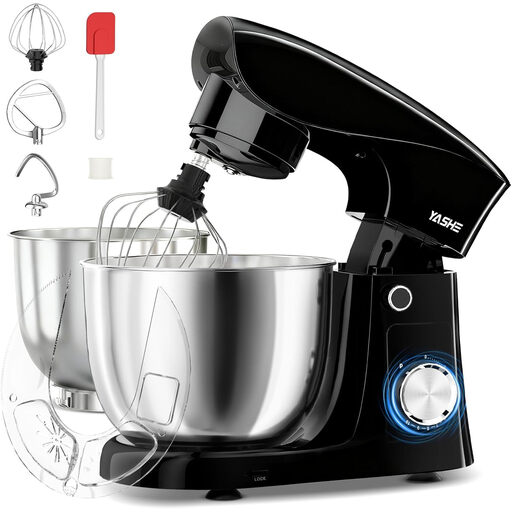 No image available
Two bowls may suit a workflow that involves changing bowls between rounds. Check the bowl capacity and which attachment is right for your recipe.
The product name lists a dough hook.
 No image available
The product name lists a beater; check that it’s suitable for your recipe and batch size.
The product name lists a power rating of 600 W, a dough hook and a whisk. The product description states a maximum operating time of 30 minutes.
 No image available
The product listing mentions a beater for batter; check which attachments are included with this version for your recipe.
The product name lists a power rating of 400 W and a black finish.
 No image available
This model may suit your criteria for biscuit batter. Before buying, check which attachments are included with this version and what batch size the manual allows.
It depends on the texture of the recipe. KitchenAid recommends the flat beater for cookie-style dough, while the Consumentenbond’s buying advice points to using a whisk for light sponge batter. So first decide which preparation the workshop involves.
No. Kenwood says the K-beater shouldn’t touch the sides of the bowl. If needed, scrape the mixture down with a spatula, making sure to stop the machine first.
For a consumer purchase, the Dutch government says statutory rights apply, with no fixed statutory warranty period in the Netherlands; any manufacturer’s warranty is in addition to these rights. If you’re buying for a business or workshop, check the terms for your intended use.
If you serve unpackaged food to consumers, the NVWA requires you to provide information about allergens present and to specify which nut is used. The NVWA also says that businesses preparing, processing or selling food need an HACCP food safety plan or the relevant hygiene code. The exact requirements depend on how the food is served; buying a mixer doesn’t determine them.