
Biscuit baker
You mainly make firm hazelnut biscuit dough and want to know whether the model comes with the right beater.


For firm hazelnut biscuit dough, a suitable flat beater or mixing hook is a sensible starting point. For a light sponge cake base, you’ll need a whisk instead. Then check which attachments come with the exact model, whether its capacity suits your recipe and whether you have room to store the mixer in your kitchen.
You mainly make firm hazelnut biscuit dough and want to know whether the model comes with the right beater.
You mean a light sponge cake base, so you’re looking for a mixer that can whisk, not just handle dough.
You bake at the weekend and want to put the mixer away afterwards, so its external dimensions matter as well as the bowl capacity.
First decide whether you’re making firm biscuit dough or whisking a light sponge cake base. Then compare the attachment you need, the size of your recipe and how much space the machine takes up.
| What to consider | What should you check? | Who is it most important for? |
|---|---|---|
| Attachment for biscuit dough | Check whether the model comes with a flat beater or suitable mixing hook, and follow the instructions for use. | If I’m making firm biscuit dough, I want a suitable attachment that comes with this model. Around 34% of consumers put the right mixing attachment for biscuit dough first. |
| Whisk for sponge cake | Decide which recipe you’re making and check whether a whisk is included with the exact model. | For a light sponge cake base, I want to be able to whisk eggs, not just mix dough. The ability to whisk is the main reason for buying for around 20% of consumers. |
| Storage space | Compare the height, width and depth with the space available, and allow room to use the machine. | I want to put the mixer away in a cupboard after baking, so its external dimensions need to fit the space I have. Storage space is the top consideration for around 20% of consumers. |
| Portion size and capacity | Compare your recipe with the capacity specified for the exact model and type of dough. | When making several batches, I want to know how much of my recipe the model can handle without confusing litres with kilograms. Portion size is the main priority for around 13% of consumers. |
| Cleaning and support | Read the cleaning instructions for each part and compare any extended warranty with your statutory rights. | After baking, I want to know which parts are easy to clean and where to go for support. Maintenance and service come first for around 13% of consumers. |
Firm biscuit dough and a light sponge cake base call for different preparation methods. An attachment that’s suitable for whisking ingredients until light isn’t necessarily the best choice for firm dough.
First decide which recipe you’re making, then check which attachment comes with the model you’ve chosen.
A stated quantity of cake batter or yeast dough applies to that specific type of mixture; bowl capacity in litres is a different measurement altogether.
Only compare quantities on a like-for-like basis, and check the stated capacity for the type of dough you’re making.
Model numbers can vary between versions. The Kenwood listing we reviewed is for the KZM35.000GY, while the Joybuy listing we found is for the KZM35.000RD. For KitchenAid, the models are 5KSM125EER and 5KSM125EMH.
Before buying, check the full model number and what’s included in the box.
A manufacturer’s warranty or paid-for extended warranty is separate from your statutory rights against the seller.
Before taking out extra cover, compare its terms and exclusions with your statutory rights.
The MUMS2EW00 and MUM58L20 offer different bowl capacities and attachments to compare.
The Go KZM35.000GY is worth comparing if storage space is a priority.
The Artisan 5KSM125EER is worth comparing if you’re looking for different attachments for baking.
The Bake Partner QB525838 is worth comparing if you’re considering using the mixer for more than just mixing.
Joybuy product picks for stand mixers for hazelnut baking.
 No image available
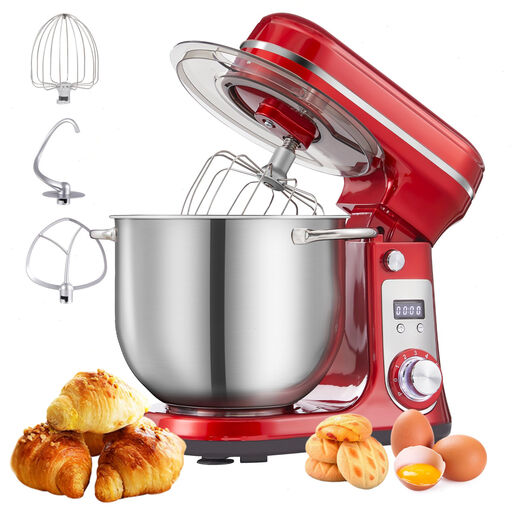
The product name mentions biscuit-making; check which mixing attachment comes with this model for your dough.
The product name specifies a 5,5 l bowl and 11 speeds.
 No image available
The product name describes this as a stand mixer; check which mixing attachment comes with this model for firm biscuit dough.
The product name specifies a 6 l capacity, six speeds, a timer and a pulse setting.
 No image available
The listed K-beater is worth considering for firm biscuit dough.
The product information specifies a 4 l bowl, a K-beater, whisk and dough hook, and a maximum dough capacity of 1,4 kg. Kenwood recommends washing the attachments by hand; according to Kenwood, the bowl is dishwasher-safe.
 No image available
The listed flat beater is worth considering for firm biscuit dough; check whether it comes with this model.
The product information specifies a recommended bowl capacity of 5 l, eight speeds, a flat beater, dough hook and whisk.
It could mean either. For firm biscuit dough, a flat beater is a sensible starting point; a light sponge cake base calls for eggs to be whisked until light instead. Decide which recipe you’re making before choosing an attachment.
Don’t assume a mixer can grind ingredients just because it comes with a beater. In a KitchenAid recipe, hazelnuts are roughly chopped separately and then added to the mixture. If you want to grind nuts, check whether your exact model has a suitable attachment.
Follow the instructions for each model and part. For the Go, Kenwood recommends switching off and unplugging the machine, wiping it with a damp cloth, and preferably washing the K-beater, whisk and dough hook by hand. According to Kenwood, the bowl is dishwasher-safe.
No. According to the Dutch government, there is no fixed statutory guarantee period in the Netherlands: you can expect a product to last as long as is reasonable for that product. A manufacturer’s warranty or paid-for extended warranty is separate; if a product is faulty, contact the seller.
Electric stand mixers must meet the applicable safety requirements; CE marking is compulsory for electrical products. Parts intended to come into contact with food are also subject to the applicable food-contact material regulations. CE marking alone is not proof that a product has been independently tested.