
Vandaag of morgen in huis

Kwaliteit gegarandeerd

Welkomstaanbiedingen ontgrendelen: GRATIS bezorging | Tot 80% korting | Gratis 30 dagen JoyPlus-proefperiode
Download de app
A good stand mixer can take the heavy lifting out of kitchen tasks, from kneading bread dough to whipping egg whites. But the market is saturated with models making all sorts of promises. Many people fall for marketing traps and end up with an appliance that gathers dust in a cabinet after just a few months. Before you buy a stand mixer, it's wise to know what to look for to avoid a bad purchase.
As a Joybuy Product Recommendation Officer, I'll filter the information for you. Below, we'll discuss the most common pitfalls and the specifications that truly matter.
Manufacturers use clever marketing to promote their products. Pay attention to the following three points to avoid wasting money on an underperforming appliance.
Focus on the specifications that determine performance and durability. These are the three most important points to check before purchasing a stand mixer for dough or other preparations.
Look beyond the wattage. A motor with a direct drive, like those in many KitchenAid mixer models, transfers power directly to the attachment. This is more efficient and quieter than a belt drive. A motor power starting from 800 watts is a good baseline for most tasks, but for a serious dough mixer, a model with a robust motor (AC or DC) and metal gears is essential. This ensures consistent torque, even when processing stiff dough.
A heavy, stable machine is a good machine. A die-cast metal housing vibrates less and stays firmly on the countertop. The mixer with bowl should have a stainless steel bowl. This is durable, hygienic, and doesn't absorb odours or colours. Also, check the material of the standard included accessories (dough hook, whisk, flat beater). Stainless steel is the most durable choice.
The size of the mixing bowl determines how much you can prepare at once.
To help you with your choice, we have selected a few models that suit different user profiles. These recommendations are based on objective product specifications.
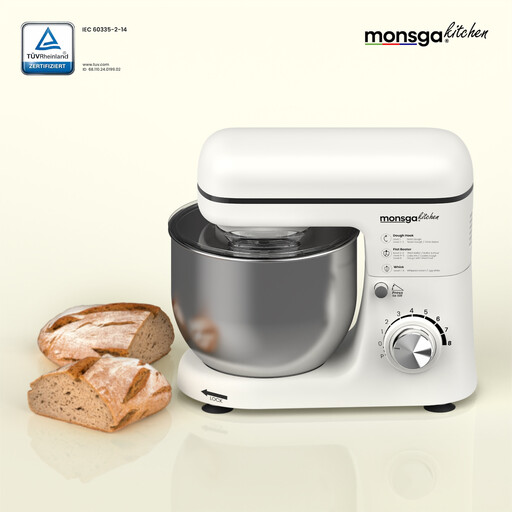
Why This Fits Their Persona: Ideal for those starting out with baking who want a reliable machine without paying a premium. This mixer offers a good balance of functionality and price for weekly use.
This model focuses on the basics: a 1000W motor and a stainless steel bowl, without making you pay for unnecessary extras. It avoids the pitfall of a weak plastic construction.
The 5-litre stainless steel mixing bowl provides ample space for most recipes. The tilt-head design makes it easy to change accessories.
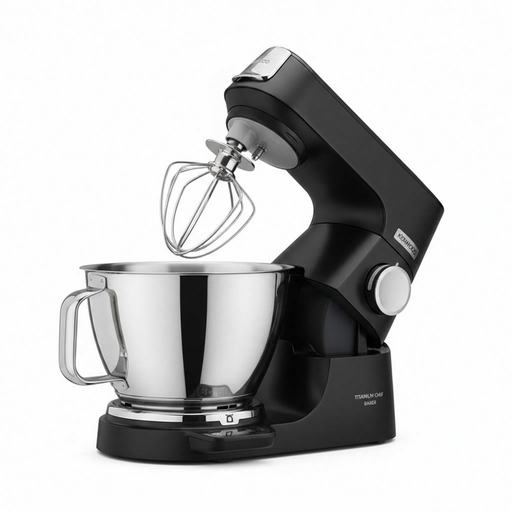
Why This Fits Their Persona: For the serious home baker who invests in quality, durability, and precision. This Kenwood stand mixer is built for performance and intensive use.
This machine focuses on what matters: a powerful, smart motor and a robust aluminium housing. The integrated scale is a functional addition, not a gimmick.
The 1200W motor intelligently adapts to the task. The integrated scale and the extra mixing bowl (DuoBowl) make the baking process more efficient.
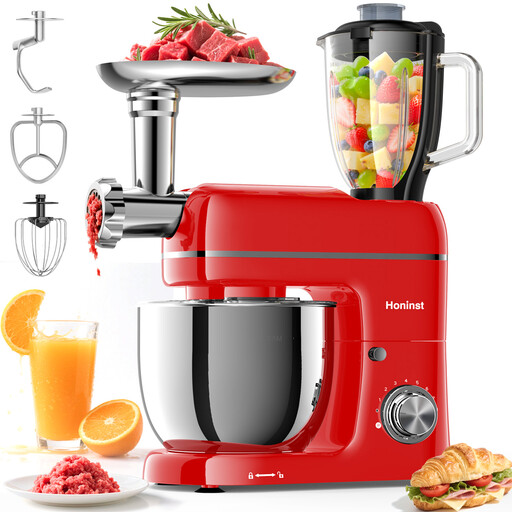
Why This Fits Their Persona: Perfect for the home cook who wants maximum functionality from a single appliance. This machine combines a stand mixer with a meat grinder and blender, ideal for saving counter space.
Instead of an overload of useless gadgets, this model offers three fully-fledged functions (mixing, grinding, blending) powered by a strong motor, thus delivering on the "all-in-one" promise.
The 1300W motor is powerful enough for all functions. The large 6.15-litre bowl (6.5 QT) is suitable for large batches, from ground meat to smoothies.
We have compiled a complete, up-to-date list of products that fully meet these strict selection criteria and safety regulations.
Here are answers to some questions that are often asked when buying a stand mixer.
A power rating of 800 to 1200 watts is a good guideline for most household tasks, including a mixer for baking. However, don't get fixated on this number. A Bosch stand mixer or Kenwood with an efficient 1000-watt motor can be more powerful than an unknown brand with an inefficient 1500-watt motor. The build quality and drive system type are better indicators of performance.
No, not every stand mixer is suitable for this. For kneading heavy dough, you need a machine with a strong motor that delivers high torque, metal gears, and a heavy, stable base that doesn't "walk" across the counter. Models specifically marketed as a dough kneading machine are typically the safest choice for this purpose.
Most stainless steel mixing bowls and stainless steel accessories (whisk, dough hook) are dishwasher-safe. For coated accessories, hand washing is often recommended to extend the life of the coating. The machine's housing should never be submerged in water; wipe it down with a damp cloth. Always consult the manufacturer's manual for specific cleaning instructions.
