
Bakers with limited worktop space
You want to mix batter or biscuit dough, but need to be able to put the machine away after baking and have enough room to remove the bowl.


Choose a stand mixer that fits your worktop and can handle the quantity and consistency of your gingerbread mixture or biscuit dough. Measure the space needed to raise the head, too, and compare your batch with the manual and the attachments supplied. Bowl capacity alone doesn’t tell you how much dough you can mix.
You want to mix batter or biscuit dough, but need to be able to put the machine away after baking and have enough room to remove the bowl.
You may make firm dough and want to check the permitted quantity and the right attachment, rather than relying on the wattage alone.
You usually make smaller quantities and want the bowl and attachment to work well for those portions, too.
First, measure the space where you’ll use and store the mixer, including the room needed to raise the head, if applicable. Then work out the quantity and consistency of your recipe, and check which attachment and batch limit apply to the exact model.
| What to consider | What to check | Who should consider this? |
|---|---|---|
| Space and storage | Measure the width, depth and height, and check there’s enough room above the mixer to raise the head fully. | I want to put the mixer away after use and still have enough room to use it; around 36% of consumers prioritise space. |
| Firm dough | Compare the weight of your batch with the limit in the manual and check which attachment is included. | When I make firm biscuit dough, I want to know how much the model can handle; around 29% of consumers prioritise dough mixing. |
| Small batches | Check the bowl capacity and see whether the manual specifies a minimum mixing quantity. | I usually make small recipes and don’t want to choose a larger bowl than I need; around 21% of consumers focus mainly on small batches. |
| Cleaning and parts | Check the cleaning instructions and confirm that extra bowls and attachments are compatible with the exact model. | I want parts that are easy to clean and to be able to find compatible replacements later; around 14% of consumers prioritise maintenance and servicing. |
A mixer with a tilt head also needs space above it so you can reach the bowl and attachment.
Measure the space where you’ll use it and check that the head can open fully there.
The bowl capacity in litres doesn’t automatically tell you how much firm dough the model can mix. Your recipe batch and the manual for the specific model are what matter.
Compare the weight of your batch with the permitted quantity for the exact model.
A bowl or attachment may be designed for one specific model or bowl size.
Check the compatibility information for the full model number before choosing an extra part.
If a part doesn’t fit, you may still need to buy one that’s compatible with your specific model.
The Go range is worth considering if limited worktop and storage space are important factors.
The 5KSM3311X is an option if you’re looking for a mixer with a smaller bowl.
The MUM5XW20 could be a good fit if you’d like built-in scales and have room for its stated dimensions.
This selection includes stand mixers for batter and dough. Check the dimensions, included attachments and permitted quantity for each model. A stated bowl capacity doesn’t prove that a mixer will fit on your worktop or suit your batch of dough.
 No image available
An option to compare if you’re looking for a stand mixer for batter or dough. Check in advance that the model and the attachments you need are suitable for your recipe.
The product name lists a 5.5 L bowl, a metal construction, a 4.5-inch LED touchscreen and 11 speeds.
 No image available
This stand mixer is worth comparing for batter and dough; make sure the quantity you choose is within the limits in the model’s manual.
The product information lists a 5.5 L bowl, 11 speeds and five preset programmes.
 No image available
Worth including in your comparison if you’re looking for a mixer with several listed attachments; check the space you’ll need and the batch limit for your recipe.
The product name lists a 6 L bowl, six speeds, a dough hook, whisk and beater. The description mentions a pulse function and dimensions of 40.7 × 26.8 × 33.2 cm. According to the stated instructions, don’t use the mixer for more than 6 minutes continuously without a rest.
 No image available
This model is worth comparing if a more compact stand mixer is important to you. Remember to measure the space needed to use and store the machine, too.
The product information lists a 4 L bowl, six speeds, a pulse function, K-beater and dough hook. The stated maximum dough capacity is 1.4 kg; the dimensions are 33.5 × 18 × 30 cm.
 No image available
This stand mixer is worth comparing for batter and dough; check whether the stated bowl capacity and included attachments suit the way you’ll use it.
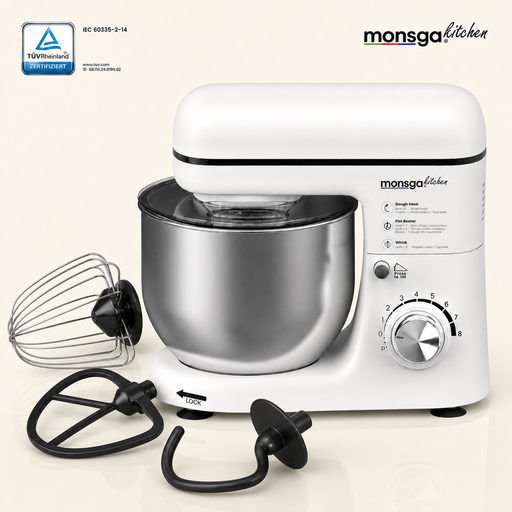
The product name lists a 5.0 L bowl and eight speeds. The product information mentions a dough hook, flat beater and whisk.
Follow your recipe and the manual for your exact mixer. KitchenAid uses a flat beater with a flexible edge in its recipe for speculaas biscuits; that recipe doesn’t determine which attachment is suitable for every mixer or type of dough.
Check the manual for your specific model to find out how to attach the bowl and accessory, what quantity is permitted and which parts can be cleaned. Also measure the space needed to use the machine; the height of the mixer when closed doesn’t give you the full picture.
Electrical appliances must meet the applicable safety requirements, and electrical products must carry CE marking, according to the Netherlands Food and Consumer Product Safety Authority. Parts intended to come into contact with food must also comply with the relevant food-contact rules. These general rules don’t confirm that an individual product on sale complies with them.
If a product is faulty despite being used normally, the seller is responsible for the statutory guarantee, according to ACM ConsuWijzer. Online purchases also generally come with a cooling-off period of up to 14 days after the product is delivered, although applicable exceptions may affect this.