
Baker making a large batch for the family
You’d prefer to mix the planned amount of dough in one go and have room for a larger bowl. Compare the recipe weight with the manufacturer's capacity for the right type of mixture.


Choose based on the weight of the recipe per batch and the texture of the dough, not just the bowl capacity or the power. A KitchenAid Netherlands recipe for gingerbread uses a flat beater and adds the flour gradually. Also compare the manufacturer's capacity for the right type of mixture and the attachments supplied with the exact model. A larger bowl may suit a big batch, while a more compact mixer could work well if you mix the dough in several batches. Check the safety information for the specific product listing too.
You’d prefer to mix the planned amount of dough in one go and have room for a larger bowl. Compare the recipe weight with the manufacturer's capacity for the right type of mixture.
Your main considerations are a suitable attachment and a mixing method that works for firm gingerbread dough, even if the batch isn’t particularly large.
You’d prefer a mixer that’s easier to place and store, and can mix several batches if needed.
First, consider the amount of dough per batch and choose a suitable attachment. Then compare the capacity specified for the exact model and the space the mixer will take up.
| What to consider | What should you check? | Who should prioritise this? |
|---|---|---|
| Amount per batch | Weigh the recipe and compare it with the capacity limit for the right type of mixture and exact model. Bowl capacity in litres isn’t a dough limit. | For a family celebration, I’d prefer to mix the planned amount in one go and can make room for that. Around 36% of consumers therefore prioritise the amount per batch. |
| Attachment for firm dough | Check whether a flat beater or suitable beater is included, and follow the instructions for your mixer and recipe. | For firm biscuit dough, I focus on using the right attachment and a controlled mixing method. Around 29% of consumers give suitable mixing of firm dough top priority. |
| Placing and storing the mixer | Measure the available width, depth and height, and allow for the space needed to use the mixer. | If my kitchen has little cupboard space, I’d rather mix several batches than have a mixer that’s awkward to store. Around 21% of consumers prioritise space and storage. |
| What's included and after-sales support | Compare the bowls and attachments supplied, and find out who to contact if something goes wrong. | I want to know exactly which parts are included and what I can do if there’s a fault. Around 14% of consumers give the package contents and after-sales support top priority. |
Manufacturers sometimes specify different capacities for mixtures such as cake batter and dough. These figures don’t tell you how much gingerbread dough your recipe can handle in one go.
Weigh the recipe and check the capacity limit for the exact model and the right type of mixture before adding everything at once.
A KitchenAid Netherlands recipe for gingerbread uses a flat beater and adds the flour gradually. That doesn’t automatically mean another hook or mixer is suitable for the same method.
Check which attachment comes with your model and follow the instructions for your mixer and recipe.
According to the Dutch government, your statutory rights apply alongside any manufacturer's warranty; in the Netherlands, there is no fixed statutory time limit.
If there’s a fault, contact the retailer and keep your purchase and product details.
The Dutch models mentioned come in different bowl sizes, making them worth comparing if you’re choosing between a compact mixer and one for larger batches.
The MUM58200 is a mid-sized model with separate stated limits for different mixtures.
The 5KSM175PSEFL mentioned may be worth considering if the included flat beater and extra bowl are important to your choice.
The Assistent Original Jubilee Silver has a different design to consider if you regularly make large quantities.
This selection includes stand mixers with bowls ranging from 4.3 to 5.5 litres. Check the load capacity of the exact model for your recipe, and review the applicable CE information and the suitability of the bowl and attachments for food contact on the specific product listing.
 No image available
The bowl capacity may be useful if you want to make a larger batch; check the maximum load for your recipe.
The product title lists a 5.5-litre bowl, 11 speeds and a 4.5-inch LED touchscreen.
 No image available
The product description mentions a preset programme for biscuits; check the instructions for that programme and your recipe.
The product title lists a 5.5-litre bowl and 11 speeds. The product description mentions five preset programmes.
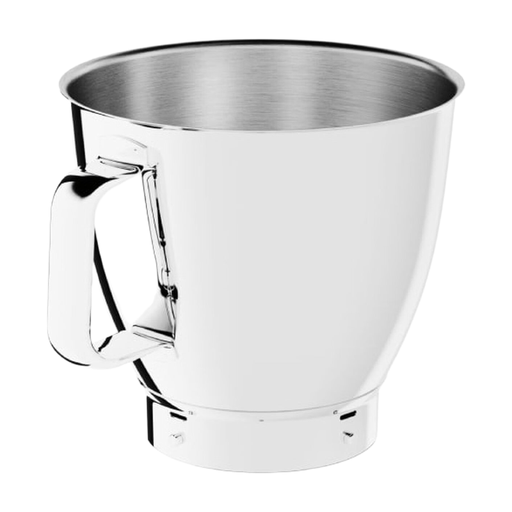 No image available
Check which attachments are included with this model and whether there’s a suitable one for your recipe.
The product title lists a 700 W motor and a 4.3-litre stainless steel bowl.
 No image available
The product description mentions a whisk, beater and dough hook; check which one suits the mixing stage in your recipe.
The product title lists a 5.5-litre bowl and 1000 W of power. Power alone doesn’t determine whether a recipe load is suitable.
 No image available
The dough hook and beater mentioned may be useful for different mixing stages; follow the instructions for your recipe.
The product title lists a 5-litre bowl, 10 speeds and a 400 W motor. The product description mentions a dough hook, whisk and beater.
No. Bowl capacity isn’t a limit for firm dough. Weigh your recipe and compare it with the figure for the right type of mixture in the manual for the exact model.
A KitchenAid Netherlands recipe uses a flat beater, adds the flour gradually and reduces the speed while doing so. Follow the instructions for your mixer and recipe; this method isn’t a capacity test for other models.
Contact the retailer. According to the Dutch government, your statutory rights apply alongside any manufacturer's warranty, and there is no fixed statutory time limit in the Netherlands. What you can reasonably expect from the product and the cause of the fault are among the factors that matter.
No. CE marking is mandatory for electrical products covered by the relevant rules. The Netherlands Food and Consumer Product Safety Authority describes CE as the manufacturer's declaration that the product meets the applicable requirements; a CE mark is not an independent performance test.
Yes. The applicable Dutch rules on food contact materials apply to parts intended to come into contact with food. Check the information for the specific bowl and attachments supplied.