
Spiced biscuit dough baker
You want to mix butter, sugar and flour with an attachment suited to biscuit dough. KitchenAid Netherlands uses a flat beater in a speculaas recipe.


First, choose a stand mixer with a flat beater or similar attachment that suits your gingerbread recipe. Then check that the machine will fit on your shared worktop, with enough room to lift the head. A compact model may be easier to store, while a larger bowl can come in handy for bigger batches. Bowl capacity or wattage alone won’t tell you how well a mixer will handle your recipe.
You want to mix butter, sugar and flour with an attachment suited to biscuit dough. KitchenAid Netherlands uses a flat beater in a speculaas recipe.
You want to set the mixer up, use it and then put it away again. So compare its dimensions and weight, and allow for the space needed to lift the head.
You share the bowl, sink or worktop with others and want to know how the attachments are removed and cleaned. Follow the instructions for the specific model.
Start with the attachment for your dough, then measure the available space and finally check the batch-size and cleaning instructions for the model you’re considering.
| What to consider | What should you check? | Who is this most important for? |
|---|---|---|
| Suitable mixing attachment | Check whether a flat beater or similar K-beater is included, and follow the recipe instructions for quantity and speed. | If I’m making biscuit-style gingerbread dough, I want an attachment suited to mixing. Around 29% of consumers put suitable mixing first. |
| Worktop space and storage | Compare the width, depth, height and weight. Also measure the space needed to lift the head. | If I share a worktop with others, I want to be able to move or store the mixer after use. Around 23% of consumers prioritise worktop and storage space. |
| Cleaning | Check the cleaning instructions for each part and whether the accessories are dishwasher-safe. | If others need the bowl after me, I want to know how quickly I can clean it and the attachments. Around 18% of consumers say cleaning time is their main consideration. |
| Batch size | Compare the weight of your recipe with the model’s stated capacity for that type of dough; bowl capacity is not the same as dough capacity. | If I sometimes bake a larger batch, I want to know how much dough the mixer can handle. Around 18% of consumers prioritise batch size. |
| Noise | If noise is a deciding factor, look for a comparison of models tested under similar conditions. | If I bake while others are using the kitchen, I want to know how much noise the mixer makes. Around 12% of consumers prioritise noise. |
A capacity figure for another type of dough or the motor’s power won’t necessarily tell you how the mixer will handle your recipe.
First choose a suitable mixing attachment, then compare the model’s stated capacity with the quantity and type of dough in your recipe.
A mixer with a tilt-head also needs space above the bowl. This can make it difficult to use beneath a cupboard or awkward to move after use.
Measure both the space where you’ll mix and the storage space, and check that the head can open fully in both places.
Cleaning instructions for the accessories don’t automatically apply to the bowl, motor housing or parts from another model.
Check the manual for the exact model before use, and don’t treat the motor housing as a removable attachment.
Kenwood lists a 4 l bowl for the Go KZM35.000GY and a 5 l bowl for the kMix KMX750AWH. These are different options to compare by dimensions and batch size.
According to Bosch, the Bosch MUM58231 is a MUM5 model with a 3,9 l stainless steel bowl, a beater and a dough hook included.
According to KitchenAid, the KitchenAid Artisan 5KSM125EER has a tilt-head, a 4,7 l stainless steel bowl, a flat beater, a whisk and a dough hook.
According to Bourgini, the Elements Kitchen Chef 4,5L, article 22.9062.00.00, comes with a beater, whisk and dough hook.
According to their product information, the stand mixers below have attachments for mixing or whisking. Compare the type of attachment, stated capacity and cleaning instructions with your gingerbread recipe and kitchen space.
 No image available
The included beater is described as suitable for mixing batter.
The product information lists a 5 l bowl, 10 speeds, a pulse function and a splash guard.
The product title lists a power rating of 400W.
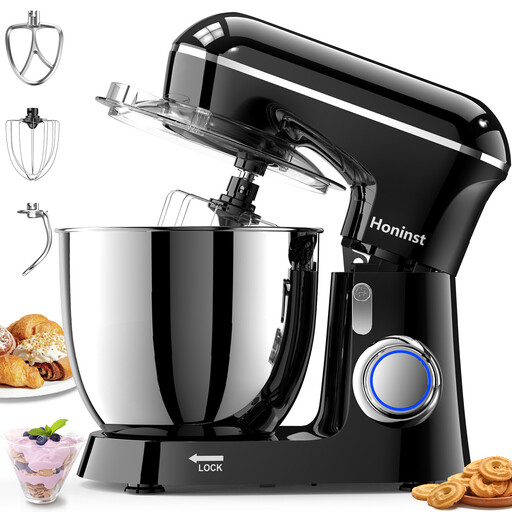 No image available
The product information lists a beater for mixing and a tilt-head.
According to the product information, this model has a 6.5QT stainless steel bowl, a splash guard and three attachments: a beater, whisk and dough hook.
 No image available
The K-beater is a mixing attachment; compare the stated dough limit with your recipe.
The product information lists a 4 l bowl, 6 speeds and a maximum dough quantity of 1,4 kg.
The stated dimensions are 33,5 × 18 × 30 cm and the weight is 6,3 kg.
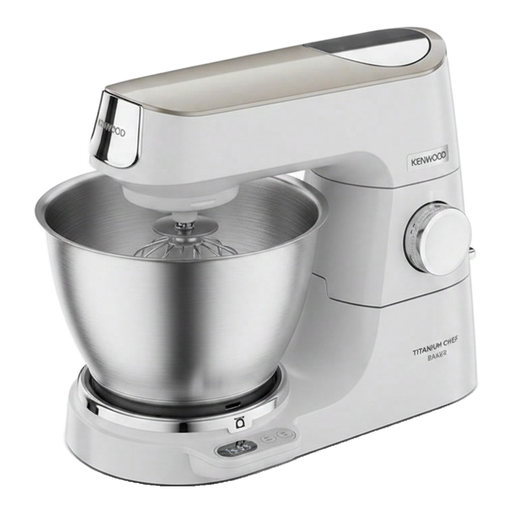 No image available
The product information lists a K-beater for mixing; check that the available capacity suits your recipe.
According to the product information, this model has a 5 l stainless steel bowl, variable speed and a pulse function.
The stated dimensions are 39,5 × 22,5 × 31,5 cm and the weight is 12,68 kg.
 No image available
The product information lists a flat beater for biscuit-style batter and a dough hook for other doughs.
The product title lists a 5.0L stainless steel bowl, 8 speeds and 1000W Peak. The product information describes the attachments as dishwasher-safe.
For biscuit-style gingerbread dough, a flat beater is a good place to start: KitchenAid Netherlands uses one in recipes for speculaas and spiced biscuits. Follow the instructions for your specific recipe or model; a dough hook isn’t automatically more suitable just because the dough feels firm.
Don’t force a K-beater against the side of the bowl. Kenwood warns that contact could damage the bowl or attachment; stop the mixer before scraping down the sides with a spatula.
Read the manual for your specific model. For the Elements Kitchen Chef, Bourgini advises, among other things, checking the mains voltage against the rating plate, not immersing the appliance and keeping the cord away from water. Instructions can vary by model.
According to the Dutch government, when you buy as a consumer, you’re entitled to a product that works properly, and the seller must provide a solution if it doesn’t. The Netherlands does not have a fixed statutory warranty period of two years; a manufacturer’s warranty is in addition to your statutory rights.
According to the Dutch government, for many applicable distance purchases from a business, you have a 14-day cooling-off period. Its guidance explains that buying online from a private individual does not count as a distance purchase; check the circumstances and terms of sale.