
Yeasted doughnut baker
You want to knead classic doughnuts for lunch, and need to match the dough hook, dough limit and proving time to your recipe. For one doughnut recipe, Albert Heijn Allerhande recommends kneading with dough hooks.


Choose a mixer to suit your recipe: mixing or whisking is enough for pourable batter, while classic yeasted dough needs a suitable dough hook. Then compare the recipe weight with the limit for that specific mixture; bowl capacity in litres is no substitute. A mixer takes care of kneading, but not proving or frying, as the Albert Heijn Allerhande recipes show.
You want to knead classic doughnuts for lunch, and need to match the dough hook, dough limit and proving time to your recipe. For one doughnut recipe, Albert Heijn Allerhande recommends kneading with dough hooks.
You’re making pourable batter for baked doughnut bites and want to know whether a stand mixer offers more than a whisk. In the Albert Heijn Allerhande recipe we consulted, the batter is mixed with a whisk.
You want to reduce the number of mixing batches, so you’re comparing the recipe weight, stated capacity and available worktop space. Bosch and Kenwood list different capacities for specific models.
Choose this if: you’re making baked doughnut bites; the Albert Heijn Allerhande recipe we consulted uses a whisk to mix the batter.
Bear in mind: a stand mixer takes up worktop space and means extra washing-up, while an ordinary whisk may be all you need for this mixing step.
Choose this if: you want to knead the dough in a machine. Check that the model has a dough hook and that its dough limit suits your recipe. The Albert Heijn Allerhande recipe we consulted makes 15 portions using 400 g of flour.
Bear in mind: the mixer takes care of kneading, but not proving, shaping or frying; the recipe includes two proving periods.
| What to consider | What should you check? | Which consumers is this most relevant to? |
|---|---|---|
| Attachment for your recipe | Check that the right dough hook, mixing attachment or whisk is included. | I mainly make classic doughnuts and want to know whether the dough hook suits my recipe. Around 36% of consumers prioritise choosing the right attachment. |
| Capacity for your lunch batch | Add up the weight of the ingredients for each mixing batch and compare it with the dough limit for the exact model. Compare batter separately against a batter limit. | For a shared lunch, I want to make my calculated batch without unnecessary extra mixing rounds. Around 28% of consumers prioritise batch capacity. |
| Planning and workspace | Check your recipe’s preparation time, the model’s dimensions and the space needed to put the bowl in place and remove it. | I want to fit the mixer into my kitchen and leave enough time for the steps after kneading. Around 18% of consumers prioritise planning and workspace. |
| Cleaning and future use | Check the cleaning instructions for each part and consider whether you’ll also use the mixer for other batters or doughs. | I don’t want to be left with awkward parts to clean after lunch, and I want to keep using the mixer afterwards. Around 18% of consumers prioritise cleaning and use beyond lunch. |
Pourable batter made with baking powder and kneadable yeasted dough need different mixing methods and attachments.
Choose your recipe first, then check which attachments and capacity you’ll need.
The stated limit can vary depending on the type of mixture. For example, Bosch lists separate maximum capacities for cake batter and yeasted dough for the MUM58200.
Compare the weight of your mixture with the limit for the same type of mixture on the exact model.
Classic doughnuts still need to be proved, shaped and fried, even if the mixer does the kneading.
Plan around your chosen recipe, and allow for the mixer only for the mixing or kneading step.
The MUM58200 is worth comparing if you make both batter and yeasted dough.
The Go KZM35.000GY and Chef XL KVL4100S are separate models to compare; their stated bowl and dough capacities differ.
The Artisan 5KSM125EMH is an option if you want one mixer for mixing, whisking and kneading.
The SMF03DGEU is worth considering if design is also a factor for you.
This selection focuses on stand mixers for mixing batter and/or kneading dough. Check which attachments and capacities suit your recipe for each version.
 No image available
The product information says it can mix and knead dough and cake batter.
The title specifies a 5.5 L bowl, 11 speeds, a metal construction and a 4.5-inch LED touchscreen.
 No image available
The title lists a dough hook, mixing beater and whisk for different mixing and kneading tasks.
A 5 L stainless steel bowl and 600 W power are specified.
 No image available
The title lists a mixing beater, whisk and dough hook for batter and dough.
The title specifies a 5 L bowl and 400 W power.
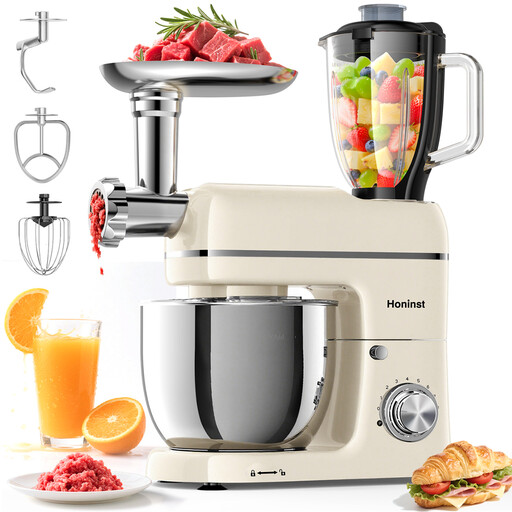 No image available
The title lists a dough hook, beater and whisk for different mixing and kneading tasks.
The title specifies a 6.5 QT bowl and attachments for tasks including mincing and blending.
 No image available
The K-beater, whisk and dough hook are suited to mixing, whisking and kneading.
The product information specifies a 4 L bowl, a dough capacity of up to 1.4 kg and dimensions of 33.5 × 18 × 30 cm.
Follow your recipe: classic yeasted doughnuts are kneaded with dough hooks, while the recipe we consulted for baked doughnut bites uses a whisk to mix the batter. These are different methods.
Allow time for the steps after mixing, too. The Albert Heijn Allerhande recipe we consulted for 15 classic doughnuts specifies 30 minutes’ preparation and 2 hours’ waiting time, including two proving periods; the doughnuts then still need to be fried. This timing applies to that recipe.
Voedingscentrum advises against tasting raw batter or dough, as raw eggs and flour may contain harmful bacteria. Take extra care if young children, pregnant people, older people or anyone with a weakened immune system will be eating with you.
When you buy as a consumer, the product must do what you could reasonably expect it to do. According to the Dutch government, there is no fixed statutory two-year warranty period in the Netherlands; if a product is faulty, the retailer is your point of contact. An additional warranty may give you extra rights.