
Batch baker
You’re making several trays for your coffee morning and want to know how much dough the machine can really handle in one go.


First, compare the weight of your recipe with the dough or flour limit for the exact model: a larger bowl doesn’t prove that the machine can handle a larger batch of dough. If you only make focaccia occasionally, a recipe that uses resting and folding may work just as well without a mixer. For regular, larger batches, it may be worth considering a machine with a suitable, clearly stated dough limit. Manufacturer specifications aren’t an independent test using your recipe.
You’re making several trays for your coffee morning and want to know how much dough the machine can really handle in one go.
You’d like a machine to do the mixing regularly, but also want to know which attachments and method suit your recipe.
You’re weighing up whether a mixer is worth the expense and storage space when focaccia is only on the menu now and then.
Best for: anyone who regularly makes large batches and can compare their recipe weight with the model’s limit. Ankarsrum states a maximum of 5 kg of dough for the Assistent Original 6230.
Bear in mind: this is a manufacturer’s specification, not a test using your focaccia recipe. Also check that the recommended method suits you.
Best for: anyone making batches that fall within the limit for their chosen model. Bosch states a maximum of 1.9 kg of yeast dough for the MUM5XW00; KitchenAid states a maximum of 1 kg of flour for the Artisan 5KSM175PS.
Bear in mind: flour weight and dough weight are different measures. Making several batches also means extra mixing and cleaning.
Best for: anyone looking for a large bowl. Kenwood states that the Chef XL KVL4110S has a capacity of 6.7 litres.
Bear in mind: bowl capacity doesn’t confirm how much focaccia dough the model can handle; check the manual for the exact model.
Best for: anyone who makes focaccia occasionally and would rather start with a recipe that uses hand-mixing, resting and folding. King Arthur Baking describes this kind of method.
Bear in mind: you’ll do the mixing and folding yourself and follow the timings and steps in your chosen recipe.
| What to consider | What to look for when buying | Who this matters to |
|---|---|---|
| Dough batch per mix | Compare the total dough weight with a limit stated in kg of dough; compare flour weight only with a limit stated in kg of flour. | If I want to bake several trays at once, I want to know whether all the dough will fit in one batch. Around 36% of consumers prioritise a suitable dough batch per mix. |
| Less work and mixing method | Check that the right dough hook is included and that the recommended method suits your recipe. | If I make dough regularly, I want to do less by hand without choosing an unsuitable attachment. Around 29% of consumers put saving effort and having a suitable mixing method first. |
| Whether a mixer is worthwhile | Consider how often you’ll use the mixer for other recipes as well, compared with using a recipe that relies on resting and folding. | If I only bake focaccia occasionally, I want to know whether I’ll use the mixer often enough for other recipes too. Around 21% of consumers prioritise weighing up a mixer against baking without one. |
| Space and cleaning | Measure the space available and check the dimensions of the exact model, along with which parts need cleaning and storage. | If I have limited worktop space, I want to know in advance where the machine and separate attachments will go and how to clean them. Space and cleaning are decisive for around 14% of consumers. |
Bowl capacity, the permitted amount of yeast dough and the maximum amount of flour are different specifications. Only the relevant limit for the exact model can help you work out whether your recipe will fit in one batch.
Compare your recipe with the correct model-specific limit, and keep the units separate.
A batch above the applicable limit could mean extra mixing and cleaning.
A recipe with resting and folding stages can be made without a stand mixer. You don’t necessarily need a mixer for this recipe.
If you don’t have many other mixing tasks, try a recipe specifically designed for hand-mixing and folding first.
You’ll need to clean and store the machine and its separate parts after use.
The NVWA distinguishes, among other things, between offering or selling food and between occasional and regular sales. Allergen information is also relevant when food is offered by a business.
Establish who is offering the food, whether it is being sold and how often. Then check which NVWA guidelines apply to the situation.
The Assistent Original 6230 is an option for anyone who regularly wants to make larger batches of dough.
The MUM5XW00 is designed for anyone looking to compare a stated yeast dough limit and integrated weighing.
The Artisan 5KSM175PS could suit you if you want to use a mixer with a dough hook for other recipes too.
The Chef XL KVL4110S is an option for anyone considering a large mixing bowl.
The Joybuy products below are stand mixers for anyone who wants to mix dough mechanically. Before making one large batch, compare your recipe with the limit for the exact model.
 Image unavailable
An option for anyone who wants to mix dough mechanically with the included dough hook.
5-litre bowl; 10 speeds; 600 W; includes dough hook, mixing beater, whisk and splash guard. The product description states a maximum operating time of 30 minutes.
 Image unavailable
A food processor for anyone who wants to mix and knead dough mechanically. Check the limit for this exact model against your recipe.
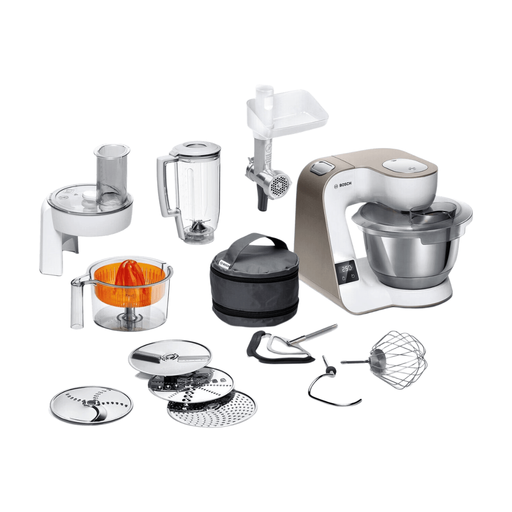 Image unavailable
An option for anyone who wants to prepare dough mechanically and is looking for a food processor for a range of recipes.
1000 W.
 Image unavailable
An option for anyone who wants to use a dough hook to mix dough mechanically.
5-litre bowl; 10 speeds; 400 W; includes dough hook, whisk and mixing beater.
 Image unavailable
An option for anyone who wants to mix and knead dough as well as prepare other recipes.
6-litre bowl; 6 speeds; 450 W; includes dough hook, whisk and mixing beater.
No, not for every recipe. The King Arthur Baking recipe uses hand-mixing, then develops the dough through resting and folding. If you use this method, follow the timings and steps in your chosen recipe.
Compare the total dough weight with a limit stated in kilograms of dough, or compare the flour weight alone with a limit stated in kilograms of flour. Bosch states a maximum of 1.9 kg of yeast dough for the MUM5XW00; KitchenAid states a maximum of 1 kg of flour for the relevant Artisan models. Don’t use the bowl capacity in litres as a substitute for these limits.
It depends on the situation. According to the NVWA, registration and a food safety plan are required if food is sold several times a year. If it’s sold just once a year, registration isn’t required according to the step-by-step guide. Don’t automatically apply this to your coffee morning: first establish whether food is being sold and how often.
The NVWA states that providing allergen information is a legal requirement when a business offers food to consumers. For unpackaged products, the NVWA describes providing written information and, under certain conditions, verbal information. Record the ingredients and potential allergens in the focaccia and toppings; the requirements that apply depend on the organiser’s circumstances.
For a consumer purchase in the Netherlands, what you can expect from a product depends, among other things, on the product and its normal use; there is no fixed statutory guarantee period. According to the Dutch government, if a product is faulty, the seller—not the manufacturer—is your point of contact for a solution.