
Baking for a large group
You want to make several trays of focaccia and, above all, need to know how much dough fits in one batch.


First, work out how much flour and total dough your recipe requires for all your guests, then compare those quantities with the limit for the exact model. Bowl capacity in litres alone doesn’t tell you how much yeast dough the machine can handle. Bosch Netherlands lists a maximum of 1.9 kg of yeast dough for the MUM5XW40, while KitchenAid Netherlands specifies a maximum of 1 kg of flour for certain models, including some Artisan models. Choose a more compact machine if you’re happy to make several batches; a higher dough capacity is mainly relevant if you regularly make large quantities of dough at once.
You want to make several trays of focaccia and, above all, need to know how much dough fits in one batch.
You’re making focaccia for a gathering and also want to consider whether a more compact, versatile machine might come in handy later.
You often knead bread or pizza dough, so you pay attention to the limits, operating instructions and care requirements for the exact model.
Choose this when: your recipe falls within the limit for the exact model, or you’re happy to make the dough in several batches. Kenwood lists a maximum of 800 g of flour for bread dough with the GO.
Consider: Kenwood specifies a minimum 15-minute rest between heavy loads for this model.
Choose this when: you want to whisk or mix as well as make focaccia, and your recipe quantity is within the limit for the specific model.
Consider: Bosch lists a maximum of 1.9 kg of yeast dough for the MUM5XW40; KitchenAid specifies a maximum of 1 kg of flour for certain models, including the Artisan 5KSM175PS. These figures use different units of measurement and aren’t directly comparable.
Choose this when: you often make large quantities at once. Kenwood lists a dough capacity of 2.42 kg for the Chef XL KVL4100S; Ankarsrum says the Assistent Original AKM6230 can process 5 kg of dough.
Consider: these are manufacturer specifications, not independent focaccia tests; also check the dimensions of the version you choose.
| What to consider | What should you check? | Who is this important for? |
|---|---|---|
| Batch capacity | Work out both the flour and total dough quantities, then compare each with a model limit stated in the same unit. | I want to knead enough dough for all my guests in one go and avoid extra batches. For around 36% of consumers who prioritise batch capacity, this would be their main concern. |
| Kneading load | Check the dough hook, maximum load, speed and any operating or rest-time instructions for the exact model. | I want to knead yeast dough in line with my machine’s instructions, even when making several batches. Around 29% of consumers would make kneading load their main priority. |
| Versatility and space | Check which accessories come with the version you’re considering and make sure its dimensions suit your worktop or storage space. | I want to use the machine for other baking tasks after the gathering and have room for it at home. For around 21% of consumers, versatility versus size would be the deciding factor. |
| Purchase and service | Check what’s included in the package you’ve chosen and who to contact if something goes wrong. | I want the purchase to suit how often I bake and to know who to turn to if there’s a problem. Around 14% of consumers would prioritise cost and service. |
A bowl’s capacity in litres doesn’t tell you how much yeast dough a specific model can process. Bosch lists a maximum of 1.9 kg of yeast dough for the MUM5XW40; the 2.7 kg figure on the same product page is for cake batter.
Compare your recipe’s dough weight with the limit for the right type of dough, using the same unit.
Manufacturers may state limits for different models as flour weight or total dough weight. These figures don’t describe the same quantity.
Note both weights from your recipe and compare each only with a model limit given in the same unit.
The Consumers’ Association (Consumentenbond) describes stand mixers with a dough hook as suitable for prolonged kneading of heavy bread dough. According to the organisation, food processors are mainly designed for other kitchen tasks and light dough.
For focaccia, choose a machine based on its kneading function and permitted dough load, not just its long list of features.
A manufacturer’s guarantee doesn’t replace your statutory rights. The Dutch government states that there’s no general statutory two-year guarantee period in the Netherlands, and that the retailer must provide a solution if there’s a problem with the product.
Check what any extra guarantee covers and contact the retailer if there’s a fault.
The MUM range includes models with a dough hook. According to Bosch Netherlands, the MUM5XW40 has a 3.9-litre bowl, scales and a timer.
The GO is an option for smaller batches of dough, while the Chef XL KVL4100S is a larger model.
The Artisan tilt-head model is designed for mixing, whisking and kneading with the accessories supplied with the version you choose.
The Assistent Original AKM6230 is an option if you regularly process larger quantities of dough.
The SMF05BLEU is a planetary mixer with a dough hook, suited to those who also consider other mixing tasks and design.
These products are worth considering if you’re looking for a stand mixer for preparing dough. For each version, check the limit for the exact type of dough and which accessories are included.
 No image available
The product name describes it as a dough mixer; compare the limit for the exact version with the quantity in your recipe.
Listed features: 5.5L bowl, 11 speeds and a 4.5-inch LED touchscreen.
 No image available
If you’re considering this model for focaccia, check which of the five presets suit the way you plan to use it.
Listed features: 5.5L bowl, 11 speeds and five presets.
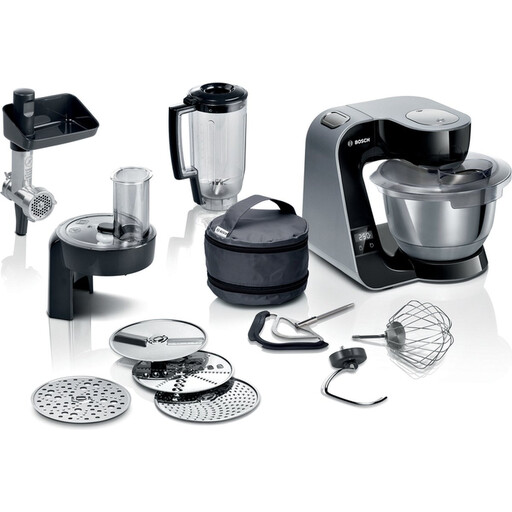 No image available
If you want to use this version for focaccia, check that the instructions for the exact MUM5XC4E model allow yeast dough and confirm which dough hook is included.
Listed features: 1000W, black.
 No image available
This model may be worth considering if you also want to use it for other baking tasks; stick to the stated dough limit for your recipe.
Listed features: 5.5L bowl and 1000W. The product information states a maximum dough capacity of 1.7 kg.
 No image available
If you choose this mixer for dough, check the specified operating time and allow for any required rest between kneading sessions.
Listed features: 6L bowl, 6 speeds, tilt head and 450W. The product instructions state that the mixer can run for a maximum of 6 minutes at a time before it needs to rest.
First, scale your recipe to make the number of trays you want, then compare the flour and total dough quantities with the limits for the exact model. KitchenAid Netherlands’ focaccia recipe uses 500 g of flour for six portions; this is an example recipe, not a fixed portion size for your gathering.
No, follow the instructions for the exact model. For yeast dough, KitchenAid recommends speed 2 with the dough hook; Kenwood specifies speeds 1–2 for 5 minutes for bread dough with the GO. Don’t automatically apply one brand’s instructions to another model.
Check the manual to see which parts of your version are dishwasher-safe, and stick to the stated load and rest time. Kenwood specifies a minimum 15-minute rest between heavy loads for the GO; this instruction doesn’t automatically apply to other stand mixers.
Online purchases generally come with a statutory 14-day cooling-off period after delivery, subject to applicable exceptions. Separately, you’re entitled to a product that meets reasonable expectations in the Netherlands; if there’s a fault, the retailer is your point of contact. The Dutch government states that there’s no general fixed statutory guarantee period of two years.