What should you look for when buying?
Start by weighing your recipe and checking the flour and dough limits for the exact model. Then consider whether the mixing method, preparation time, available space and cleaning requirements suit the way you’ll use it.
| What to consider |
What to look for |
Who it matters to |
| Batch capacity |
Compare both the total dough weight and the amount of flour with the limits for that exact model. |
If I want to make one large batch for lunch, I check that my recipe falls within both of the model’s limits. Around 29% of consumers say batch capacity is their main consideration. |
| Handling sticky dough |
Check which dough attachment is included and which speed settings are recommended for the model. |
If I want to knead focaccia dough, I want to know which attachment and method to use with my mixer. Around 24% of consumers prioritise dough handling. |
| Lunch planning |
Allow for the proving stages and baking time in your own recipe, as well as any time needed to make multiple batches. |
If lunch needs to be ready at a set time, I plan backwards from then, including every step from mixing onwards. Around 18% of consumers prioritise planning ahead for lunch. |
| Worktop space |
Compare the dimensions of the exact model with the space available, and leave room to operate the mixer. |
If my worktop is short on space, I want to know whether the mixer will fit there and can be put away after use. Around 18% of consumers prioritise the space it takes up. |
| Cleaning and aftercare |
Read the cleaning instructions for each part and check the model’s service and spare parts information. |
If I want to tidy up quickly after kneading, I want to know how much cleaning the parts require. Around 12% of consumers say cleaning and aftercare are their main consideration. |
Joybuy products
These Joybuy products are for anyone looking to mix or knead dough using a stand mixer or dough maker. Check the capacity, included parts and instructions for the exact model before comparing it with your focaccia recipe.
 No image available
HAUSWIRT M5 Max stand mixer
May be worth considering if you’re looking for a stand mixer with a dough hook for yeast dough.
Bowl capacity: 5,5 l. 11 speeds and a 4,5-inch LED touchscreen.
According to the product information, the bowl and accessories must be washed by hand.
View at Joybuy
 No image available
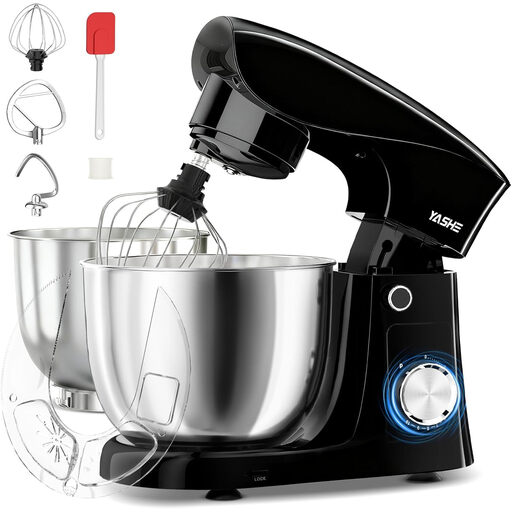
YASHE SM-2548A stand mixer
May suit you if you’re looking for a stand mixer with a dough hook and two bowls.
Tilt-head design. The product name lists two bowls; check the product information for the capacity of each bowl.
View at Joybuy
 No image available
AUCMA 5 l, 10-speed stand mixer, 400 W
May be worth considering if you’re looking for a stand mixer with a dough hook and adjustable speed settings.
Bowl capacity: 5 l. 10 speeds, a pulse function and a 400 W motor.
According to the product information, don’t use it for more than 6 minutes at a time without a break.
View at Joybuy
 No image available
AUCMA 6 l, 6-speed stand mixer, 450 W
May be worth considering if you’re looking for a stand mixer with a dough hook and other mixing accessories.
Bowl capacity: 6 l. 6 speeds and a 450 W motor. The product name lists a dough hook, whisk and beater.
View at Joybuy
 No image available
Bear Intelligent Dough Maker, 2,5 kg dough
May be worth considering if you’re looking for a machine that kneads dough automatically and has a resting function.
The product name lists automatic kneading, a resting function and a dough capacity of 2,5 kg.
View at Joybuy
Frequently asked questions
Is a stand mixer with a dough hook better suited to focaccia dough than a food processor?
For longer kneading, the Dutch Consumers’ Association recommends a stand mixer with a dough hook for bread dough. A food processor is mainly designed for slicing, grating and chopping; with either appliance, check the model limits and your recipe.
Can I start making focaccia later if I use a mixer?
Not necessarily: mixing is only one step in the process. KitchenAid’s focaccia recipe has two proving stages after mixing, so plan backwards from lunchtime using the timings and steps in the recipe you’re following.
Which speed and kneading time should I use?
Follow the instructions for your exact mixer. KitchenAid recommends speed 2 for yeast dough in its mixers, but the brand’s general kneading instructions and focaccia recipe give different kneading times. So don’t assume the recipe’s timing applies to every model.
What warranty applies to a stand mixer I buy in the Netherlands?
In addition to any manufacturer’s warranty, you’re covered by the statutory guarantee: when used normally, the product must meet what you could reasonably expect from it. According to the ACM, there is no fixed general time limit for this in the Netherlands; if a product is faulty, contact the seller.
Which product regulations apply to an electric stand mixer in the Netherlands?
The Netherlands Food and Consumer Product Safety Authority states that CE marking is mandatory for electrical products where this requirement applies. Parts that come into contact with the dough must meet the applicable requirements for food-contact materials. CE marking is not an assessment of kneading performance, nor does it by itself confirm that every individual part is suitable for food contact.


