
Workshop host preparing several batches
You want participants to be able to mix batter one batch after another. Batch size, access to the bowl and cleaning between batches all factor into your choice.


Choose a stand mixer for fairy-cake batter based on how much batter you make per workshop session and whether it comes with a whisk or flat beater suited to your recipe. Then compare the space it needs and the cleaning instructions for each part. Bowl capacity alone won’t tell you how much batter your recipe can mix effectively.
You want participants to be able to mix batter one batch after another. Batch size, access to the bowl and cleaning between batches all factor into your choice.
You’ll be using the mixer in a shared or small workspace. Check both its dimensions and the space needed to use the bowl and mixer head.
You’re not buying the mixer just for fairy cakes and want to know which attachments come with the exact model.
First, work out how much batter you’ll make per batch and which attachment your recipe calls for. Then check that you can access the bowl in your workspace and find out how to clean the parts between batches.
| What to consider | What to look for | Who it matters to |
|---|---|---|
| Batter attachment | Check whether a whisk or flat beater is included and whether the instructions say it’s suitable for your recipe. | If I’m making fairy-cake batter, I want an attachment that suits the recipe; around 33% of consumers put the right batter attachment at the top of their list. |
| Batch size | Weigh or measure a planned batch and compare it with the capacity information for the specific model; bowl capacity alone doesn’t show how much batter can be mixed effectively. | If you want to mix the right amount for each participant or group, batch size is especially important. Around 27% of consumers name batch size as their main consideration. |
| Cleaning between batches | Check the cleaning instructions for the bowl, whisk and beater separately; dishwasher-safe claims apply only to the parts specified. | If I’m hosting several batches in a row, I want to know in advance how to clean the parts safely. Around 20% of consumers prioritise ease of cleaning. |
| Workspace | Compare the external dimensions with your table and leave room to add ingredients and use the bowl or mixer head. | On a small or shared worktable, it’s not just the space taken up by the mixer that matters, but also access to the bowl; around 20% of consumers name workspace as their top priority. |
The stated bowl capacity isn’t the same as a proven usable quantity for your batter. A large bowl doesn’t guarantee that small batches will mix well either.
Compare the amount in your recipe with the information for the exact model, and check separately whether it can handle small batches.
Cleaning instructions can vary from one part to another; one dishwasher-safe accessory doesn’t mean the whole set is dishwasher-safe.
Before use, check the instructions for the bowl, whisk and beater separately. Switch off and unplug the machine before adjusting or cleaning an attachment.
KitchenAid Netherlands lists a 4.7-litre bowl for the KitchenAid 5KSM125, while a Joybuy listing for the 5KSM125EMH states 4.8 litres. So check the exact version and included parts before comparing specifications.
When making your choice, use the details for the precise model and variant you’re considering.
The MUMS2EW00 is worth comparing if you’re looking for a beater-mixer and whisk for making several batches in a row.
The Go KZM35.000GY is worth considering if you want to compare compact mixers with a K-beater.
The Dutch Artisan 5KSM125 is worth looking at if you want to compare a beater, whisk and dough hook.
The black KitchenBrothers model with article number KB1000790 is worth comparing if a timer and several attachments are important to you.
These models are aimed at mixing batter for successive workshop batches. For each model, check the batch size, attachments and conditions of use to make sure they suit the way you work.
 No image available
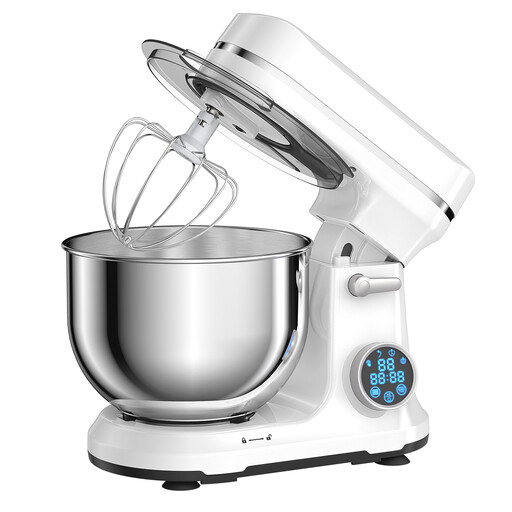
The product description mentions mixing and a planetary mixing system; check that the machine is suitable for the batch size in your recipe.
The product name states 5 l, 11 adjustable speeds and 1200 W. The description mentions a stainless steel bowl, with the bowl and attachments being dishwasher-safe.
 No image available
The product description mentions a mixing beater for batter; check that the included attachments suit your recipe and workshop batches.
The description states that it has a 5 l stainless steel bowl, 10 speeds and a splash guard. The product name specifies a 400 W motor.
 No image available
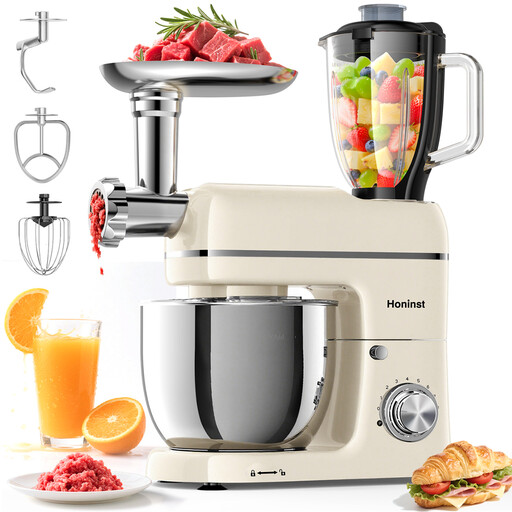
The product name mentions a beater and whisk; the description limits intended use to domestic settings, which is important to consider for a workshop.
The product name states 6.5 QT and 8 speeds. The description mentions a tilting head and safety lock.
 No image available
The description mentions mixing and an included whisk; check that the method and recommended operating time suit your workshop sessions.
The product name states a capacity for 2.5 kg of dough. The instructions generally recommend no more than 15–20 minutes of continuous use, with the motor allowed to cool down between uses.
 No image available
The product description mentions a K-beater; compare the dimensions with your workspace and check that the box contents suit your recipe.
The description states that it has a 4 l bowl, 6 speeds, a pulse function and dimensions of 33.5 × 18 × 30 cm. It also mentions a whisk and dough hook.
Start by following your recipe. KitchenAid describes the flat beater as suitable for cake batter; a whisk is designed to incorporate air as you beat ingredients. The Consumentenbond distinguishes the dough hook, which is for kneading bread dough for longer periods.
Switch off and unplug the machine before adjusting or cleaning an attachment. Then check the manual for each part: one dishwasher-safe accessory doesn’t mean the whole set is dishwasher-safe. Kenwood Netherlands gives the same advice if an attachment is hitting the bowl.
No. According to ACM ConsuWijzer, the statutory guarantee depends on what you could reasonably expect from the product and has no fixed time limit. Check the terms of any manufacturer’s guarantee and the conditions of use separately as well.
If you prepare, process or sell food as a food business, the NVWA requires an HACCP food safety plan; following an applicable approved hygiene code may be one way to meet this requirement. A workshop isn’t automatically a food business just because of its name: first establish what the activity involves and whether you fall under that business classification. Electrical kitchen appliances must meet product safety requirements, and parts that come into contact with food are subject to food contact material rules.