What should you look for when buying?
Start with the weight and ingredients of the dough you usually make, then check the limit the manufacturer gives for that type of dough. Next, consider the space available, cleaning and potential noise in your shared kitchen.
| What to consider |
What should you check? |
Who is this important for? |
| Dough capacity and kneading limits |
Compare the dough weight in your recipe with the limit for the correct model. Distinguish between flour weight, yeasted dough weight and bowl capacity; follow the manual for speed and kneading time. |
If I switch between recipes, I want to know which batch size is within the stated limit. Around 29% of consumers put dough capacity first. |
| Worktop and storage space |
Measure the space available, including room to remove the bowl and attachment; compare the dimensions of the exact model. |
If I need to put the machine away after baking, I also need to make room for the bowl and separate attachments. Around 23% of consumers put storage space first. |
| Cleaning between users |
Check the cleaning instructions for each part and agree who will clean the bowl, attachment and worktop. If anyone has allergies, take an appropriate cleaning routine into account. |
If other people use the kitchen after me, I want to be able to clean the bowl and work area thoroughly. Around 18% of consumers put cleaning between users first. |
| Noise when sharing the kitchen |
Look for a noise assessment for the exact model and only compare measurements taken at a similar load and using a similar method. |
When other people are at home, I take potential noise into account alongside batch size and space. Around 18% of consumers put noise first when buying. |
| Service, parts and running costs |
Check which attachments come with the model, where replacement parts are available and what an extended warranty adds to your statutory rights. |
If I plan to use the machine often, I want to know which parts are included and where to go if something goes wrong. Around 12% of consumers put service and running costs first. |
Stand mixers and dough makers at Joybuy
This selection includes stand mixers and an automatic dough maker for home use, with a focus on kneading attachments, capacity and cleaning in a shared kitchen. The Netherlands Food and Consumer Product Safety Authority (NVWA) says CE marking is compulsory for electrical products, including kitchen appliances. Check the marking on the specific model before considering an offer as a buying option.
 No image available
Bosch MUMS2AW00 stand mixer
An option to include in your comparison if a dough hook and a stated maximum dough capacity matter to you.
The product information lists a 5.5-litre bowl, a dough hook and a maximum dough capacity of 1.7 kg. This figure has not been separately verified for enriched dough.
The accessories are described as dishwasher-safe.
View at Joybuy
 No image available
AUCMA tilt-head stand mixer 6 L
An option to compare if you’re looking for a 6-litre bowl and a dough hook.
The product information lists six speeds, a tilt-head design, a dough hook, a whisk and a beater.
Bowl capacity alone does not tell you the maximum amount of enriched dough the mixer can handle; check the permitted batch size for this model.
View at Joybuy
 No image available
Bear automatic dough maker 5 L
An option to compare if you want an automatic kneading function and a stated dough capacity.
The product name lists a maximum dough capacity of 2.5 kg and a 5-litre bowl. This capacity has not been separately verified for enriched dough.
The removable bowl and stirring paddle must be washed by hand.
View at Joybuy
 No image available
Kenwood Go KZM35, grey
An option to compare if you make smaller batches and want to put the machine away after use.
The product information lists a 4-litre bowl, a dough hook and a maximum dough capacity of 1.4 kg. The model measures 33.5 × 18 × 30 cm; the bowl and attachments are described as dishwasher-safe.
The stated dough capacity has not been separately verified for enriched dough.
View at Joybuy
 No image available
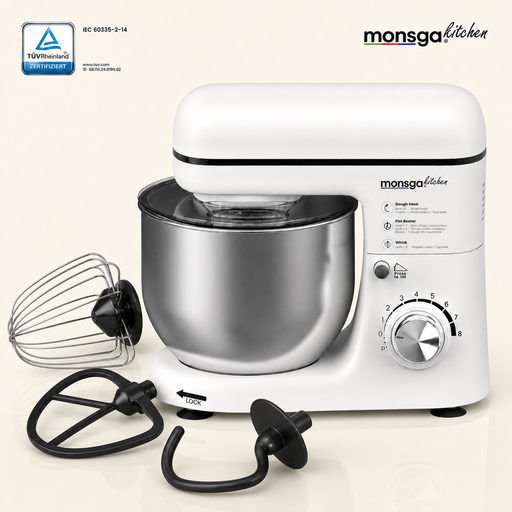
MONSGA SM100 stand mixer 5 L
An option to compare if you’re looking for a dough hook and dishwasher-safe accessories.
The product information lists a 5-litre stainless steel bowl, eight speeds, a dough hook and a splash guard. Bowl capacity alone does not determine which batch size is suitable.
Check the permitted amount for the exact model before choosing a recipe.
View at Joybuy
Frequently asked questions
Can I use the stated bread dough capacity for brioche without making any adjustments?
No, not without checking the definition and instructions for the exact model. Bosch gives capacity in kilograms of yeasted dough, while KitchenAid lists a limit in kilograms of flour for the 5KSM175PS range. In the test mentioned above, the Consumers’ Association used light white bread dough, not brioche.
How should I use and clean a mixer in a shared kitchen?
Follow the kneading method, speed and duration in the manual for your model. KitchenAid recommends speed 2 for yeasted dough in its mixers; don’t automatically apply this advice to other brands. Clean the bowl, attachments and work area between users, and follow the cleaning instructions for each part, especially if someone needs to take allergens into account.
Do I need an extended warranty to have statutory rights in the Netherlands?
No, you don’t need an extended warranty to have statutory rights. According to the Dutch Government, there is no fixed statutory warranty period in the Netherlands; if a product is faulty, the retailer is your point of contact. Compare an extended warranty based on its additional cover and terms.
Which product safety rule applies to an electrical kitchen appliance sold in the Netherlands?
The Netherlands Food and Consumer Product Safety Authority (NVWA) says CE marking is compulsory for electrical products, and kitchen appliances are classed as electrical appliances. Check the marking and safety information for the specific model; a shop listing alone does not prove that the individual appliance meets the requirements.


