
Yeasted doughnut baker
You’re following a recipe for kneadable dough and want to check whether the dough hook and capacity are suitable for the quantity and kneading time. Rutger bakt suggests kneading by hand or with a stand mixer.


For runny, cake-style doughnut batter, choose a mixer with a suitable mixing attachment. For kneadable yeasted dough, you’ll need a dough hook, and the permitted dough load must be suitable for your recipe. Compare the quantity per batch with the specifications for the exact model. If you’re making a small batch just once, consider mixing or kneading by hand: Rutger bakt’s doughnut recipe suggests both options.
You’re following a recipe for kneadable dough and want to check whether the dough hook and capacity are suitable for the quantity and kneading time. Rutger bakt suggests kneading by hand or with a stand mixer.
You’re making several batches and comparing the stated quantity of batter or dough per batch, rather than just the bowl capacity. Kenwood and Bosch list separate capacities for different types of dough and batter.
You’re weighing up the space you’ll need against how often you’ll use the mixer after the potluck. The Consumentenbond describes stand mixers as appliances for mixing, kneading and whisking; think about which tasks you regularly do yourself.
Start with the type of recipe, then check the capacity per batch. For a small, one-off batch, mixing by hand may be enough.
| What to consider | What to look for | Who is this important for? |
|---|---|---|
| Attachment for your recipe | Work out whether you’re mixing cake-style batter or making kneadable yeasted dough, then check for the matching mixing attachment or dough hook. Rutger bakt describes yeasted doughnut dough that can be kneaded. | I want to choose an attachment based on my recipe, not just because I’m making doughnuts. For around 36% of consumers, having the right attachment for the recipe comes first. |
| Quantity per batch | Compare the weight and type of your recipe with the capacity stated for that dough or batter. Kenwood and Bosch list quantities for specific models. | If I’m making several batches, I want to know how much I can make at a time. For around 29% of consumers, the quantity per batch is their main concern when buying. |
| Use after the potluck | Consider whether you’ll want to use the mixer for other baking as well, and check which attachments for those tasks are included. | I want to know whether the appliance will still suit my baking habits after this occasion. For around 21% of consumers, expected future use comes first. |
| Space and cleaning | Measure the space available and check the cleaning instructions for the bowl and attachments; don’t assume every part can be cleaned in the same way. | With limited kitchen space, I want to know in advance where the mixer can go and how to clean it after use. For around 14% of consumers, space and cleaning are their main concerns when buying. |
A bowl’s capacity in litres doesn’t tell you how much batter or dough the mixer can handle according to the manufacturer. With enriched dough, the Kenwood Go also has usage limits and rest breaks.
Weigh your recipe and compare it with the capacity for the right type of dough on the exact model. If necessary, plan to mix in several batches and follow the recommended rest time.
The Go range is worth considering if space is limited; the kMix range has its own specifications for bowl and dough capacity.
Bosch describes the MUM5 MUM58L20 as coming with attachments for whisking, mixing and kneading.
The Artisan 5KSM125EMH is worth considering if you also want to mix and whisk for other baking, as well as making doughnuts.
According to Bourgini, the Elements Kitchen Chef 4.5L has a bowl and three standard mixing attachments.
This selection focuses on stand mixers for mixing doughnut batter and, where stated in the product information, kneading dough too. Check the attachments and specifications for each model to see whether they suit your recipe.
 Image unavailable
The product name lists a mixing attachment and dough hook for mixing and kneading.
The product name also lists a 5 L stainless steel bowl, 10 speeds and 600 W.
 Image unavailable
The product information lists a beater for batter and a dough hook for kneading.
The product name lists a 5 L bowl, 10 speeds and a tilting head.
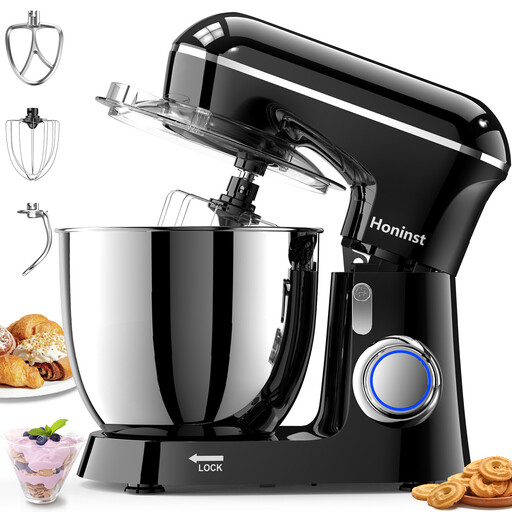 Image unavailable
The product name lists a dough hook, whisk and beater for different mixing tasks.
The product name lists a 6.5 QT bowl and 10 speeds; compare the capacity with your recipe.
 Image unavailable
The product information lists a K-beater, whisk and dough hook; check what quantities your exact recipe and model can handle.
 Image unavailable
The product name lists a dough hook, while the product information lists a flat beater and whisk for mixing and kneading.
The product name lists a 5,0 L bowl and 1000 W peak power; peak power on its own doesn’t tell you how much dough the mixer can handle.
Voedingscentrum advises against it: raw eggs and flour can contain harmful bacteria. Wash your hands after touching raw batter and bake the doughnuts thoroughly. Extra care is needed with raw batter, particularly for pregnant people and anyone with a weakened immune system.
Follow the instructions for the exact model. For enriched dough, Kenwood specifies speeds 1–2 and 5–10 minutes of kneading for the Go, with at least 15 minutes’ rest between heavy loads; these usage limits don’t automatically apply to other mixers.
If a product is used normally and doesn’t meet what you could reasonably expect, the seller is responsible for providing an appropriate solution free of charge, according to ACM ConsuWijzer. Dutch statutory guarantees don’t have a fixed time limit and are separate from any manufacturer’s warranty.
According to the Dutch Food and Consumer Product Safety Authority, anyone selling food at a market or event must follow rules on safe and hygienic preparation, sale and storage. These sales rules don’t automatically apply to a potluck where participants share food and nothing is sold.