
Vandaag of morgen in huis

Kwaliteit gegarandeerd

Welkomstaanbiedingen ontgrendelen: GRATIS bezorging | Tot 80% korting | Gratis 30 dagen JoyPlus-proefperiode
Download de app
A stand mixer with a dough hook can make kneading bread dough, pizza dough and pasta dough much easier. However, not every stand mixer is suitable for heavy or frequent use. For example, a high wattage figure on the box does not necessarily indicate the machine’s actual kneading capacity.
The main pitfalls usually come down to three points:
If you mainly make bread, pizza or brioche, your requirements will differ from those of someone who mostly prepares cake batter and whipped cream. So start by considering your recipes and how often you will use the machine.
For a mixer for bread dough, torque, overload protection and the permitted dough weight are more important than maximum wattage alone. A compact electric mixer with a lower stated power rating may be suitable for smaller portions, while a more powerful model offers greater reserve for firm dough.
Pay attention to the difference between:
According to the Monsga SM100 product description, the peak power is 1,000 watts and the nominal power is 600 watts. The AUCMA models state 400 and 450 watts respectively. That does not automatically make them unsuitable; the recommended dough quantity and operating time remain decisive.
A 5-litre stand mixer is often sufficient for everyday baking in a smaller household. A 6-litre stand mixer provides more room for larger portions, but also requires more worktop space.
Always check:
The Monsga SM100 is described as having a 6-litre bowl, but a recommended usable capacity of 5 litres. This is a useful distinction. The Bear Intelligent Dough Maker is stated to have a maximum dough capacity of 2.5 kg. Do not exceed such limits: an overfilled bowl puts strain on the motor and may cause splashing.
A good mixer with a dough hook should be able to run smoothly at a low speed. For dough, low to medium speeds are generally more practical than starting directly at the highest setting. For cake batter or whipped cream, you will need a whisk or flat beater.
Also check:
A stated noise level can help when comparing models, but your experience will also depend on the recipe, the surface and the speed. Monsga states a maximum of 75 dB; AUCMA gives 68–72 dB at a distance of one metre. These figures come from the product descriptions and do not guarantee that every user will experience the same noise level.
The recommendations below are based on verifiable product specifications such as bowl capacity, speeds, accessories and stated motor power. Brand information about performance is presented as information from the product description.

Why it suits this profile: The 5-litre bowl and ten speeds suit beginners who regularly make cake batter, biscuit dough or smaller batches of bread.
The product description states a 400-watt nominal motor, a 5-litre bowl and a separate dough hook. This makes the basic specifications clearer than a high peak-power figure alone.
Ten speeds plus pulse, stainless steel bowl, dough hook, whisk, beater and splash guard.
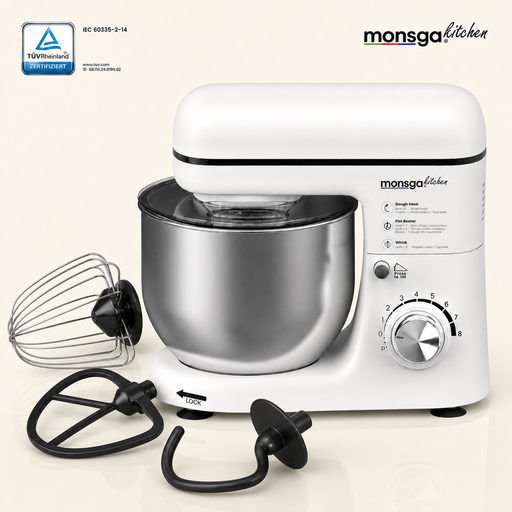
Why it suits this profile: This model is aimed at home bakers who knead, whisk and mix several times a week and value added convenience when using the machine.
The product description distinguishes between 1,000 watts of peak power and 600 watts of nominal power. It also lists 5 litres as the recommended usable capacity of the 6-litre bowl.
Eight speeds, tilting head, stainless steel bowl, Teflon-coated dough hook according to the product description, and dishwasher-safe accessories.
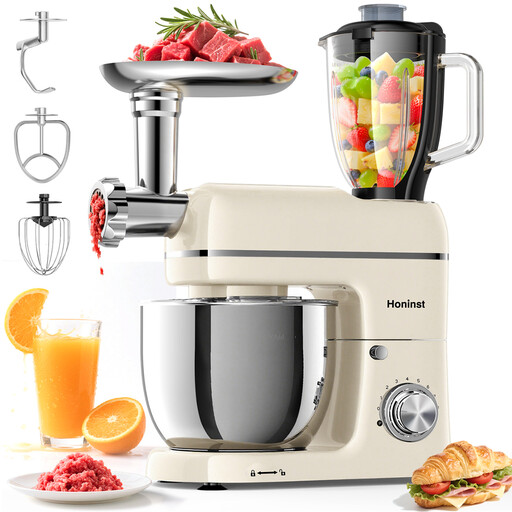
Why it suits this profile: Suitable for households that want to grind meat or prepare smoothies and sauces using additional attachments, as well as knead dough.
The product description states a 6 QT bowl, eight speeds plus pulse, and a safety switch when the head is raised. However, check in advance which accessories you actually need.
According to the product description, a meat grinder, blender, dough hook, whisk and beater are included; the motor is rated at up to 1,300 watts.
Place the stand mixer on a flat, stable worktop and lock the bowl and dough hook into place before starting. When working with heavy dough, use a low to medium speed and follow the maximum quantity stated in the manual.
Also pay attention to the recommended operating time. For the AUCMA model, it is stated that the appliance should not be used continuously for longer than six minutes without a break. Allow the motor to cool down if the casing becomes unusually hot or the machine switches itself off.
Accessories must be compatible with the specific model. For example, a separate KitchenAid 5K452DH dough hook is intended for KitchenAid mixers and is not automatically suitable for other brands. Never clean the motor unit under running water, and unplug the appliance before changing attachments.
We have compiled a complete, up-to-date list of products that fully meet these strict selection criteria and the applicable European safety regulations.
Yes, provided the dough hook, motor and maximum dough capacity are suitable for your recipe. Bread dough is heavier than cake batter. Start at a low speed and do not exceed the stated quantity.
For smaller households, 5 litres is often practical. If you make larger quantities of bread, pizza or biscuits, you may want to consider a 6-litre model. Always check the usable capacity, as the full bowl capacity is not the same as the maximum amount of dough.
Consumption depends on the nominal power and how long the machine is used. A 600-watt machine running for twenty minutes uses less energy than a 1,000-watt model used for an extended period. Short mixing times, the correct speed and avoiding overloading the motor can all help to keep consumption down.
