
Workshop host running several rounds
You make batter for successive groups and need to match the bowl and changeover time to your recipe. The stated bowl capacity alone won’t tell you how much crêpe batter you can practically mix per round.


Start with the mixing attachment and the amount of batter you make per round; the stated bowl capacity does not guarantee a usable quantity of crêpe batter. A compact machine may suit smaller batches and limited worktop space, while two bowls or a larger set-up can be useful if you want to alternate between preparations. Check the instructions for the exact model, and bear in mind that the available information does not provide comparable test results for these machines with crêpe batter.
You make batter for successive groups and need to match the bowl and changeover time to your recipe. The stated bowl capacity alone won’t tell you how much crêpe batter you can practically mix per round.
You want to leave space for participants. Compare the dimensions, and consider how much room you’ll need to remove the bowl and operate the machine.
You use different recipes and want to remove any residue carefully between preparations. Professional food preparation may also be subject to hygiene rules; Ondernemersplein explains the requirements that apply.
First, compare your batter and portions per round with the guidance for the model. Then check whether the set-up suits the space available and how to clean the parts between preparations.
| What to consider | What should you check? | Who should prioritise this? |
|---|---|---|
| Mixing thin batter | Check which mixing attachment comes with the exact model and what the manual says about thin batter. The Consumentenbond uses a whisk in its test of thin pancake batter; this is a test method, not a guaranteed result for every model. | If I mainly want smooth crêpe batter, I look at the attachment and at test information for the exact model. Around 31% of consumers make mixing performance their top buying priority. |
| Batter per round | Compare the quantity in your own recipe with the model instructions. The Consumentenbond recommends checking the bowl size; capacity filled to the brim is not a guaranteed usable volume for thin batter. | If I want to prepare several portions at once, I need to know how much space my recipe requires in practice. Around 25% of consumers make the quantity per round their main priority. |
| Cleaning between preparations | Check the cleaning instructions for each bowl and attachment, and find out which parts are dishwasher-safe. Professional food preparation may be subject to hygiene requirements, depending on the circumstances. | When I use different recipes, I want to know how to remove residue carefully between batches. Around 19% of consumers prioritise cleaning between preparations. |
| Worktop space | Compare the dimensions with your worktop and check how much room you need to operate the machine and remove the bowl. | If I’m sharing a worktop with participants, I want to operate the machine without it getting in the way of the set-up. Around 13% of consumers name space and ease of handling as their top priority. |
| Accessories you need | Check what’s included with the exact model and whether the parts suit your recipes. | I only want to choose attachments and bowls I’ll use for my preparations, without having to store unused parts. Around 12% of consumers make useful accessories their main priority. |
Bowl volumes and capacities for other preparations don’t prove how much thin batter you can mix at once. You may still need to make several batches to follow your own recipe.
Compare your recipe with the manual for the exact model, and allow room to add and mix the ingredients.
Wattage is an electrical specification, not a test result for thin batter. In its test method, the Consumentenbond assesses the actual mixing result with thin pancake batter.
Check the included attachment and, where available, look for a test result for the exact model rather than comparing wattages alone.
Cleaning instructions may vary between bowls and attachments. A dishwasher-safe part doesn’t automatically mean the entire set can go in the dishwasher.
Check the instructions for each part before use, so you know how to clean it between workshop rounds.
Bosch lists the Serie 2 MUMS2VM00 with a 3.8-litre bowl, mixing and whisking attachments, and dishwasher-safe accessories. This may be worth considering if you’re looking at how easy the parts are to clean.
According to Kenwood, the Kenwood Go KZM35.000GY is 30 cm tall and has a 4-litre bowl. The Titanium Chef Baker XL KVL85.004SI is listed with 7- and 5-litre bowls.
According to KitchenAid, the Artisan 5KSM175PS comes with 4.7- and 3-litre bowls, a wire whisk and a pouring shield.
These stand mixers are designed for mixing batter during workshops; the bowls and attachments listed may help you compare batches, space and preparations.
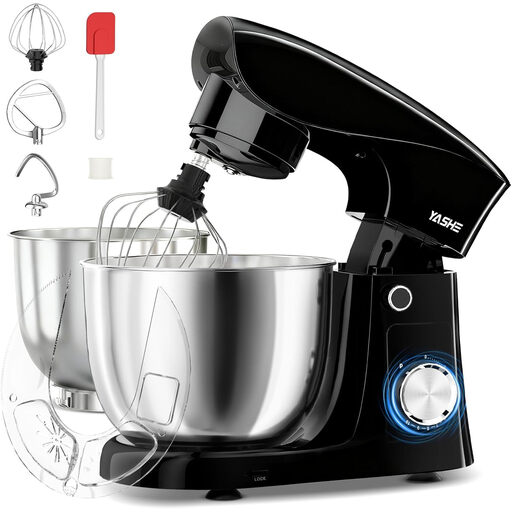 No image available
The two bowls may be useful for successive preparations; check that the bowl size suits your recipe.
The product name lists a tilt head and dough hook.
 No image available
The whisk and mixing beater are suited to mixing and whisking; check the manual for your batter and the quantity you want to make.
The product name lists a 5-litre bowl, 10 speeds, 600 W, a dough hook, mixing beater, whisk and splash guard.
 No image available
The listed whisk and beater are relevant for whisking and mixing; check whether the instructions are suitable for thin batter.
The product name lists a 5-litre bowl, 10 speeds, a tilt head, dough hook, whisk, beater, splash guard and 400 W.
 No image available
The listed K-beater and whisk may suit mixing and whisking; compare the bowl with the quantity in your own recipe.
The product information lists a bowl capacity of 6.70 litres and three included attachments.
 No image available
The compact Go set-up may suit a smaller worktop; check the space available around the machine and the amount of batter you’ll make per round.
Kenwood lists the Go KZM35.000GY as 30 cm tall, with a 4-litre bowl. The product information also lists a K-beater and whisk.
Check the instructions for your model. The Consumentenbond uses a whisk in its test with thin pancake batter and assesses the mixing result, among other things. That test method doesn’t guarantee a particular result for every model or recipe.
Compare the quantity in your recipe with the guidance for the exact bowl and preparation. The stated bowl capacity isn’t automatically the usable quantity of thin batter.
Not without checking the instructions for each part. Bosch lists dishwasher-safe accessories for the MUMS2VM00; that guidance doesn’t automatically apply to other models or parts.
Follow the manufacturer’s instructions for your model. For suitable attachments, Kenwood recommends checking the adjustment so that the attachment just clears the bottom of the bowl; unplug the machine before adjusting it.
It depends on how the workshop is run. Ondernemersplein outlines hygiene requirements and the use of an HACCP plan or approved hygiene code for professional food preparation or sales. The NVWA states that customers must be given allergen information when unpackaged products are sold or supplied to them; simply calling something a workshop doesn’t determine which obligations apply to every organiser.