
Batter maker with limited space
You want to make smooth batter, but have little room on your worktop or in your cupboards. First, measure up to see whether a machine with a mixing bowl will fit and remain accessible when in use.


If you only make a small amount of thin batter now and then, a hand whisk may be enough: Albert Heijn’s basic recipe uses a whisk to beat the batter until smooth. A stand mixer with a mixing bowl is worth considering if you want to keep your hands free or use it for other baking tasks too. If so, check the available worktop and storage space, the whisk attachment and the cleaning involved. A larger bowl alone doesn’t prove that a machine will mix small batches better.
You want to make smooth batter, but have little room on your worktop or in your cupboards. First, measure up to see whether a machine with a mixing bowl will fit and remain accessible when in use.
You make other mixtures as well as crêpes. A stand mixer and its included attachments could come in handy, provided you have room to store and clean the extra parts.
You mainly make small or occasional batches and want to weigh up whether a machine, accessories and extra washing-up are worth it for the convenience this task offers.
Best for: anyone who makes thin batter occasionally and doesn’t have a permanent spot for an appliance.
Trade-off: you do the mixing yourself and won’t have your hands free, but you won’t need to find storage space for a machine and mixing bowl.
Best for: anyone who wants to mix electrically but can’t fit a freestanding stand mixer with a mixing bowl.
Trade-off: you need to hold the mixer while mixing. Also check that suitable beaters and a mixing bowl are available.
Best for: anyone who mixes regularly or wants to use the machine for other baking tasks, and has enough space.
Trade-off: you’ll need space to store and clean the machine, bowl and attachments. Check how much room it needs when in use.
| What to consider | What to check | Who should pay particular attention? |
|---|---|---|
| Positioning and storage | Measure the space you have both when the machine is in use and when it’s stored away. Allow for access to the bowl, adding ingredients and any moving parts. | I want to know first whether the machine will fit on my worktop and can be stored away; around 36% of consumers say positioning is their top priority. |
| Smooth batter | Check whether the model comes with a whisk and whether the instructions cover use with your batch size. The Consumentenbond uses a whisk for thin pancake batter in its test method; this isn’t a test result for every individual model. | What matters most to me is whether it can mix thin batter well, not just how big the bowl is; around 29% of consumers prioritise smooth batter. |
| Other baking tasks | Compare which whisk, beater and dough hook are included with the model you’re considering. Also think about where you’ll store the separate attachments. | If I make other mixtures too, I want to know which attachments I’ll actually use; around 21% of consumers say versatility is their top priority. |
| Use and maintenance | Compare the option with a hand whisk or hand mixer, and check the cleaning instructions for each part. Consider any extended warranty alongside your statutory rights. | If I only make crêpes occasionally, I want to know whether extra equipment and washing-up make sense for me; around 14% of consumers prioritise cost and maintenance. |
A maximum bowl capacity or motor specification doesn’t tell you how well a model mixes a small amount of thin batter. The Consumentenbond assesses thin pancake batter separately in its test method.
Check whether the model has a whisk and what the instructions say about small quantities. Don’t treat motor specifications as a measure of mixing performance.
The stated external dimensions don’t necessarily tell you how much clear space you’ll need to add ingredients, reach the bowl or operate the machine.
Measure the space with the machine in the position you plan to use it, and check access to the bowl and any moving parts too.
You need to hold a hand mixer while mixing; a stand mixer with a mixing bowl works on its own. The Consumentenbond also distinguishes between stand mixers and food processors, which are designed for different main tasks.
Check the type of appliance and what’s included in the box, not just the search category.
With a hand mixer, you’ll need to keep one hand on the appliance while mixing; a stand mixer with a mixing bowl needs more space for the machine and its attachments.
There’s no fixed statutory guarantee period in the Netherlands. According to the Dutch government, what you’re entitled to depends in part on what you could reasonably expect from the product.
Ask what additional rights paid-for cover provides and compare them with your statutory rights with the seller.
Extended cover costs extra, so consider what specific protection you’ll get in return.
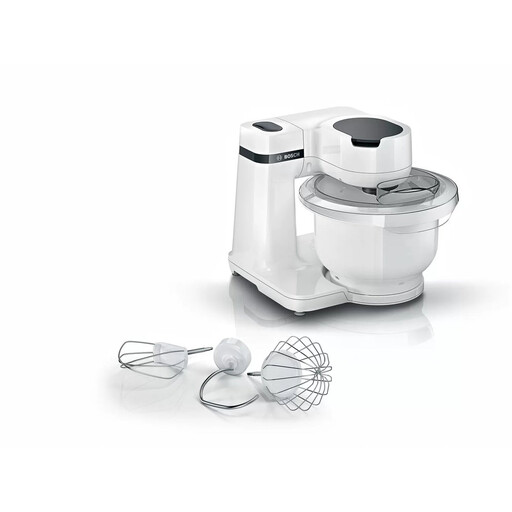
The MUM Serie 2 is a useful reference if you’re considering a compact stand mixer with a mixing bowl and several attachments.
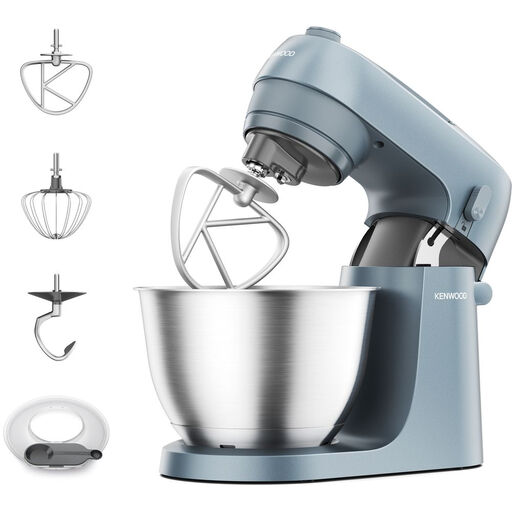
The Go KZM35.000RD is a stand mixer with its own bowl for anyone who also needs to consider storage height. Kenwood also makes hand mixers, which are a different type of appliance.
The MX-4817 is a stand mixer with its own mixing bowl to compare if you also want to make larger recipes and have the storage space.
The Artisan 5KSM125 is a useful reference if you want a stand mixer for other baking tasks too; this isn’t a recommendation to choose a compact machine.
These Joybuy products are stand mixers with a mixing bowl for anyone who wants to mix thin batter and may also use the machine for other baking tasks. Check the dimensions, included attachments and instructions for each model.
 No image available
An option to compare if you want to mix batter with a whisk and use the machine for other baking tasks too.
The product name lists 1000 W, a 5.5 l bowl and a planetary mixing system.
The description lists a whisk, beater and dough hook. Check the product specifications and instructions for the model you choose.
 No image available
An option to compare if you want a mixing bowl and whisk, and may also use the machine for other baking tasks.
The product description lists a 4 l stainless steel bowl and dimensions of 33.5 × 18 × 30 cm.
The listed attachments are a whisk, K-beater and dough hook. The description also mentions six speeds and a pulse function.
Check the instructions for your model. In the Consumentenbond’s test method, a whisk is used to mix thin pancake batter in stand mixers; this doesn’t mean every individual model achieves a good test result.
This varies by model and component. Bosch says the accessories for the MUMS2EW01 are dishwasher-safe; Tristar says the parts for the MX-4817 aren’t dishwasher-safe. Follow the instructions for the model you buy.
No. According to the Dutch government, there’s no fixed statutory guarantee period in the Netherlands; the length depends on what you could reasonably expect from the product. The retailer is your point of contact if there’s a problem. Compare paid-for extended cover with your statutory rights and check what additional protection it offers.
According to the Dutch government, a 14-day cooling-off period applies to many distance purchases, but there are exceptions. Check the seller’s information for the specific purchase.
The European Commission explains that the EU Low Voltage Directive applies to equipment within the range of 50–1,000 V AC or 75–1,500 V DC. Where the directive applies, official EU information describes requirements including CE marking and safety information. This doesn’t confirm that an individual item complies; check the model documentation and electrical specifications for that.