
Bakers making several batches
If you mix dough regularly, compare the capacity for the type of dough you’re making, the bowl and the attachment you need, rather than looking only at the number of litres.


For several batches of cookie dough, a stand mixer with a suitable flat beater is worth considering. Compare the weight of your recipe with the capacity stated by the manufacturer for that type of dough, as bowl capacity alone won’t tell you how much cookie dough it can handle. For a small, one-off baking session, using a hand mixer or mixing by hand may be more practical than buying and cleaning a stand mixer. Also plan for good hygiene and allergen information for the school bake sale.
If you mix dough regularly, compare the capacity for the type of dough you’re making, the bowl and the attachment you need, rather than looking only at the number of litres.
If you plan to put your mixer away after the school bake sale, compare its external dimensions with the space available on your worktop and the size of the batches you’ll be making.
If you only use it from time to time, the purchase price, included attachments and cleaning time may matter more than the convenience of a stand mixer.
First, decide how much dough you’ll be making and what type. Then compare the suitable attachment, the storage space available and how much cleaning you’re prepared to do after baking.
| What to consider | What should you check? | Who is this important for? |
|---|---|---|
| Capacity per batch | Compare the weight of your recipe with the stated capacity for the same type of dough for the exact model. Don’t treat a limit for cake batter or yeast dough as a proven limit for cookie dough. | If I want to make several batches for the sale one after another, I want to know how much my recipe can handle in each mixing round. Around 28% of consumers put capacity first. |
| Suitable mixing attachment | Check whether a flat beater or beater suitable for cookie dough is included. A whisk may be intended for light sponge mixture instead; Philips makes this distinction for the HR7962 models. | If my recipe calls for cookie dough, I don’t want to assume I should use a dough hook just because the recipe includes the word ‘dough’. Around 22% of consumers prioritise having the right attachment. |
| Cleaning between recipes | Check which parts can be removed and follow the cleaning instructions for each one. Don’t assume every attachment is dishwasher-safe. | If I’m making different recipes for the sale, I want to be able to clean food-contact parts thoroughly. Around 17% of consumers put ease of cleaning first. |
| Worktop and storage space | Measure the space available and check how much room you need to lift the mixer head. Kenwood lists dimensions of 38 × 23 × 30 cm and a weight of 6,3 kg for the Go KZM35.000RD. | If my kitchen is short on space, I want to be able to leave the mixer out or put it away without losing valuable worktop space. Around 17% of consumers put space first. |
| Buying for occasional use | Check which attachments are included and how often you expect to use the mixer in future. Compare any additional warranty with your statutory rights. | If I’m only preparing for one school bake sale, I don’t want to buy a machine or extra accessories that I’ll hardly use. Around 16% of consumers put the purchase cost first. |
Manufacturers sometimes give separate capacities for flour, cake batter or yeast dough. These figures aren’t automatically a reliable guide to how much cookie dough the mixer can handle.
Compare the weight of your recipe with a stated capacity for the same type of dough. Don’t use limits for other doughs as proof of the maximum amount of cookie dough the mixer can handle.
If your recipe is too large for a suitable batch, you may need to divide the dough into more mixing rounds.
Cookie dough and light sponge mixture don’t necessarily need the same mixing action. For the HR7962 models, Philips specifies the beater for cookies and the whisk for sponge mixture.
Check exactly what your recipe calls for and consult the manual for the specific model before choosing an attachment.
You won’t need every included part for cookie dough, and cleaning instructions may vary from one part to another. The Dutch Consumers’ Association points out that mixer accessories aren’t always dishwasher-safe.
Compare what’s in the box with the recipes you’ll make, and check how each part should be cleaned before buying.
Extra bowls and attachments can mean more cleaning after use; any additional accessories you need may have to be bought separately.
The NVWA (Dutch Food and Consumer Product Safety Authority) distinguishes between the rules for repeated sales and the requirement to prepare, sell and store food safely.
Agree with the school who will organise good hygiene and provide allergen information. Don’t automatically apply the requirements for repeated sales to a one-off event.
The Go KZM35.000RD and kMix KMX750ABK are worth comparing if size, bowl capacity and stated flour capacity are important to you.
MUM5 models are worth comparing by their specific features and the information that matters for your recipes.
The Artisan 5KSM175PSEFL may be worth considering if you want to compare the different bowls and mixing attachments included.
The HR7962 series is worth comparing if you want to distinguish between the attachments for cookies, yeast dough and light sponge mixture.
These product picks are stand mixers whose product information mentions cookies, mixing or dough preparation. Check which attachment and batch size are suitable for your recipe.
 No image available
The product information lists cookies as one of its uses; check that the included attachments are suitable for your recipe.
5,5-litre bowl, 11 speeds and a 4,5-inch touchscreen, according to the product name.
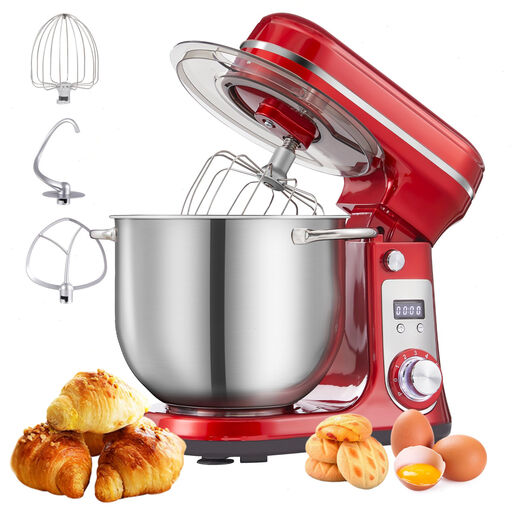 No image available
The product information mentions mixing and kneading; check the manual and attachments for the type of cookie dough you plan to make.
6-litre bowl, six speeds and a pulse function, according to the product name and product information.
 No image available
The product information lists the K-beater for cookie dough. Check whether it’s included with the version shown.
The product information also lists a whisk and dough hook for other preparations.
 No image available
The product information lists a K-beater for cookie dough. Compare the batch size you want to make with the capacity for the right type of dough.
The product information lists a 4-litre bowl and dimensions of 33,5 × 18 × 30 cm.
 No image available
The product information lists a flat beater for cookies. Check which attachments are included with this version.
5-litre bowl, flat beater and eight speeds, according to the product name and product information.
For cookies, Philips specifies the beater for the HR7962; for light sponge mixture, it specifies the whisk. So first check which type of mixture your recipe calls for.
According to the NVWA’s guidance, you need to register if you sell food several times a year; registration isn’t needed if you sell food once a year. You must still prepare, sell and store food safely, even for a one-off sale. Agree with the school who is responsible for this.
According to the NVWA, allergen information for unpackaged food must be available verbally or in writing before purchase. If you provide the information verbally, customers must be clearly told that they can ask for it. Agree with the school who will provide this information.
Clean any parts that come into contact with food and follow the instructions in the manual for each part of the exact model. The Dutch Consumers’ Association points out that mixer accessories aren’t always dishwasher-safe.
No. According to the Dutch government, the Netherlands doesn’t have a fixed statutory warranty period of two years. The manufacturer’s warranty and any additional warranty are separate from your right to a product that is fit for purpose; if something goes wrong, contact the seller.