
Bakers with limited worktop space
You want to mix coconut cake batter without the machine taking up all the space you need for ingredients and a cake tin. Check the machine’s external dimensions, as well as the space needed to access the bowl.


Start by working out how much clear space you need to add ingredients and position the bowl; a low-profile design doesn’t tell you how much worktop space will be left. Then compare the maximum cake batter capacity in kilograms for the exact model and check which attachments are included.
You want to mix coconut cake batter without the machine taking up all the space you need for ingredients and a cake tin. Check the machine’s external dimensions, as well as the space needed to access the bowl.
You usually make a modest amount of batter and want the bowl and included mixing attachments to suit your recipe.
You sometimes make more batter at once, so you compare the stated maximum cake batter capacity rather than just the bowl’s volume in litres.
| What to consider | What should you check? | Who is this important for? |
|---|---|---|
| Usable worktop space | Measure the available width, depth and height. Leave room to add ingredients and to put the bowl in or take it out. | If you need space beside the machine for ingredients and a cake tin, usable worktop space matters most. Around 36% of consumers put this first. |
| Small batches of batter | Compare the stated maximum cake batter capacity for the exact model and check which beater and whisk are included. | If you usually make small cakes, you’ll want the stated capacity and attachments to suit your recipe. Around 29% of consumers prioritise a capacity suited to smaller batches. |
| Larger bakes | Compare the maximum cake batter capacity in kilograms and consider the bowl volume in litres as a separate measurement. | If you occasionally make more batter at once, you’ll want to know whether the stated cake capacity suits the batch size you need. Around 21% of consumers give larger batches top priority. |
| Cleaning and accessories | Check what’s included, the cleaning instructions and whether any attachments you buy later are compatible. | If you want to know in advance about washing up, storage and adding accessories, these practical details matter. Around 14% of consumers prioritise maintenance and additional costs. |
The stated height doesn’t tell you how much width and depth the appliance takes up, or how much room you need to add ingredients and remove the bowl. For the Kenwood Go KZM35.000GY, Kenwood lists dimensions without clearly stating their order; the Dutch Consumers’ Association gives 31 × 39 × 23 cm for this model, in the order height × width × depth.
Check the dimensions of the exact version and measure the space you’ll need while preparing your batter, too.
Manufacturers sometimes state a separate maximum cake batter capacity in kilograms. Bowl volume in litres alone therefore doesn’t tell you how much cake batter you can make according to the model’s specifications.
Compare your recipe with the stated maximum cake batter capacity of the exact version.
Compatibility can vary by model. KitchenAid excludes its mixers with a 3.3-litre bowl from compatibility with an ice cream accessory that fits many other tilt-head mixers.
Before you buy, check the full model code in the attachment’s compatibility information.
For the Dutch-market Serie 2 MUMS2AW01, Bosch lists a 3.8-litre bowl and a maximum cake batter capacity of 2.4 kg. This version is also available with slicing attachments.
For the Go KZM35.000GY, Kenwood lists a 4-litre bowl and a maximum cake capacity of 1.8 kg. The model comes with a K-beater, whisk and dough hook, among other attachments.
KitchenAid describes its 3.3-litre tilt-head mixer, model 5KSM3311X, as an option for smaller kitchens. For this model, KitchenAid states a maximum cake batter capacity of 1.8 kg.
This selection is suited to mixing and whisking batter. Before buying, check that the external dimensions and access to the bowl work with your worktop setup.
 No image available
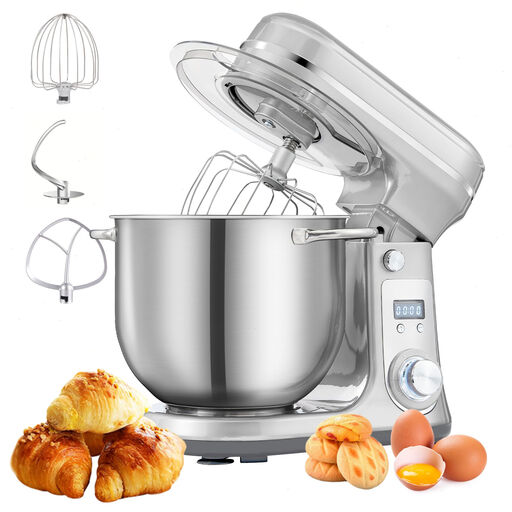
The product information lists mixing and whisking as uses, and includes a whisk, mixing beater and stirrer.
The machine has a tilt-head design, six speeds and a pulse function. The product title lists a 6-litre bowl, while the product description gives a capacity of 4.5 litres; confirm the capacity of the exact version before buying.
Also check the external dimensions and whether the exact version meets Dutch requirements for CE marking and food contact materials.
If mixing, whisking and making cake batter are your main priorities, a stand mixer is the more suitable choice. According to the Dutch Consumers’ Association, a food processor is mainly designed for slicing, grating and chopping; you should also consider how much space you have in your kitchen.
Don’t just measure the appliance’s height. Check that you can tilt the head and remove the bowl without moving the machine. KitchenAid explains how much clearance is needed for its tilt-head mixers.
Check the manual for the exact version and each individual attachment. Bosch lists dishwasher-safe accessories for the MUMS2AW01; this doesn’t automatically apply to every brand or part.
No. According to the Dutch Government, there is no fixed statutory warranty period in the Netherlands: you’re entitled to a product that works properly, and its reasonable lifespan depends on the product. A manufacturer’s or seller’s warranty comes on top of those statutory rights; if there’s a fault, the seller is your point of contact.
According to the Netherlands Food and Consumer Product Safety Authority, CE marking is mandatory for electrical products. Parts intended to come into contact with food must also meet the requirements for food contact materials. Before buying, check the CE marking and food contact materials information for the exact version.