
Baker making several batches of biscuits
You want to mix dough repeatedly for the school bake sale and are comparing the usable amount per mixing session, rather than just the bowl’s capacity in litres.


Choose a stand mixer with a suitable beater or flat beater; a whisk isn’t the right tool for biscuit dough. Next, decide how much dough you want to make at a time and compare your recipe with the capacity for the exact model. A compact appliance takes up less space, while an extra bowl is useful mainly if you’ll be baking several batches in a row.
You want to mix dough repeatedly for the school bake sale and are comparing the usable amount per mixing session, rather than just the bowl’s capacity in litres.
You’re happy to make smaller batches, but want the mixer to fit on your worktop and be easy to store.
You want to use the mixer for batters and other baking tasks too, so you’re checking which compatible attachments are actually included.
Best for: a small kitchen, if you don’t mind mixing smaller batches. Kenwood lists the Go KZM35.000RD as 30 cm tall, with a 4-litre bowl.
Trade-off: Kenwood states a maximum of 0.5 kg of flour for pastries. Check the capacity for the exact model against your recipe, rather than treating this as a fixed limit for all biscuit dough.
Best for: anyone who wants to tackle other baking tasks as well as biscuits. Bosch lists the MUM58L20 with a 3.9-litre bowl, beater, whisk and dough hook.
Trade-off: Bosch’s stated capacity for cake batter isn’t a tested capacity for cinnamon biscuit dough. Also consider whether you’ll use the other included accessories.
Best for: frequent baking, when you’ll use two bowls and both a standard and a flexible flat beater. KitchenAid lists 4.7- and 3-litre bowls for the Artisan 5KSM175PSEAC.
Trade-off: extra equipment needs storage space and adds little if you’re only making one small batch. KitchenAid’s figure of 108 standard 5.1 cm biscuits applies to the listed Artisan models, not every recipe or size.
| What to consider | What should you check? | Who should pay particular attention? |
|---|---|---|
| Amount of dough | Compare the weight of the ingredients in your recipe with the capacity stated for the specific model and its manual. Don’t treat a maximum for cake or yeasted dough as a proven limit for biscuit dough. | For the school bake sale, I want to know whether my recipe will fit in one mixing session, so I don’t unexpectedly need several rounds. Around 36% of consumers prioritise the amount of dough per mixing session. |
| Mixing attachment | Check which attachment comes with the exact model and what the manufacturer recommends using it for. Start mixing gently, following the instructions. | I want the ingredients for my cinnamon biscuits to mix properly with the right attachment. Around 29% of consumers make mixing suitable dough their main reason for buying. |
| Space | Measure the available worktop and storage space, including room to operate the mixer head, and compare it with the model’s dimensions. | If my kitchen has limited worktop space, I want to know in advance whether the mixer will fit and where I’ll store it afterwards. Around 21% of consumers put the space it takes up first. |
| Use after the bake sale | Check which accessories come with the exact model and whether you’ll use them for other baking tasks too. | I want to keep using the mixer after the school bake sale, so I weigh up the included set against my other baking plans. Around 14% of consumers focus mainly on value for future use. |
Bowl volume alone doesn’t tell you how much of your recipe the mixer can handle. Manufacturers give capacities for different types of mixtures and use different units.
Compare your recipe with the manual for the exact model and make smaller batches if needed.
Attachments are designed for different mixing tasks. KitchenAid recommends the flat beater for cookie dough.
Before buying, check which beater is included and what the manufacturer recommends using it for on your model.
A model with extra bowls or attachments may go unused if you don’t need them for other recipes after the sale.
Choose the full model based on what you’ll genuinely want to bake in future too.
Unused accessories also take up cupboard space.
The Go KZM35.000RD is a compact model with a K-beater, while the kMix KMX750AWH has a larger bowl.
The Serie 4 MUM58L20 combines a bowl with several included kitchen accessories.
The Artisan 5KSM175PSEAC comes with two bowls and both a standard and a flexible flat beater.
This selection includes stand mixers for mixing and baking, as well as a dough maker for mixing and kneading. Check whether each appliance’s instructions cover your biscuit dough and the batch size you want to make.
 No image available
The product information lists biscuits and dough among its uses. Check that your recipe and batch size are within the instructions for this model.
The product name specifies a 5.5-litre bowl, 11 speeds and a 4.5-inch LED touchscreen.
According to the product information, the bowl and accessories aren’t dishwasher-safe, and the appliance must not be used by children.
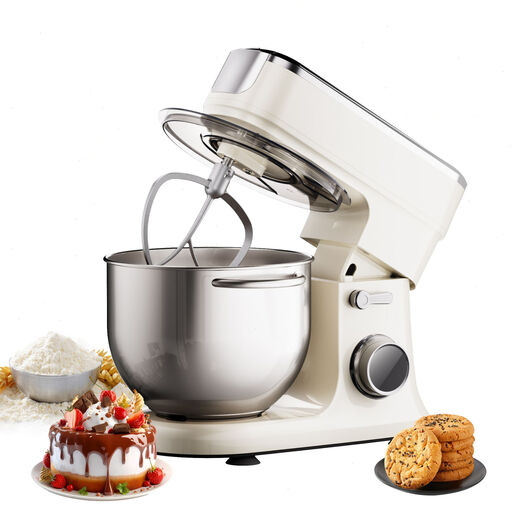 No image available
The product information lists mixing and kneading dough among its functions. For cinnamon biscuits, check which types and quantities of dough the instructions allow.
The product name specifies a 7-litre bowl, a 1200 W DC motor, adjustable speeds and a digital OLED touchscreen.
 No image available
The product information lists the included beater for batters. Check whether the manufacturer also recommends it for your biscuit dough.
The product name specifies a 5-litre bowl, 10 speeds, a tilting head and a 400 W motor. The listed attachments are a beater, whisk and dough hook.
 No image available
According to the product information, this dough maker has automatic mixing and kneading functions. Check whether the instructions cover your type of biscuit dough.
The product name specifies a dough capacity of 2.5 kg. Bear in mind the limit for this specific model.
 No image available
The listed K-beater makes this model worth considering for biscuit dough. Check the instructions against your recipe and the batch size you want to make.
The product information lists a maximum dough capacity of 1.4 kg. For larger batches, expect to mix in smaller sessions.
Choose a suitable flat beater or mixing beater to combine the biscuit ingredients. KitchenAid recommends the flat beater for cookie dough and advises starting on a low speed with its mixer. For another brand, check the attachments and instructions for the exact model.
Work this out using your recipe and the capacity stated for the exact model. KitchenAid lists 108 standard 5.1 cm biscuits for certain Artisan models; for the MUM58L20, Bosch gives a maximum for cake batter, not specifically for cinnamon biscuit dough. These figures aren’t interchangeable.
Keep the bowl, attachments and any other surfaces that come into contact with food clean. For sales at a market or event, the Netherlands Food and Consumer Product Safety Authority stresses the importance of clean equipment and hygienic food preparation. Also follow your mixer’s cleaning instructions.
No. According to ACM ConsuWijzer, your statutory rights apply alongside any manufacturer’s or seller’s guarantee. If a product breaks during normal use sooner than you could reasonably expect, the seller must offer an appropriate solution at no cost. There isn’t one fixed statutory guarantee period for every appliance.
If the sale counts as selling at a market or event, the Netherlands Food and Consumer Product Safety Authority says that private individuals must also prepare, sell and store food safely and hygienically. For unpackaged biscuits, information about any allergens present must be available before purchase; for pre-packed products, this information should be on the label. The NVWA says that anyone who prepares and sells food several times a year needs a food safety plan. Don’t assume that one school bake sale meets this condition.