
The baker preparing for a larger coffee morning
You want to prepare several batches of cheese crackers and need to plan how much dough to mix each time. Bowl capacity and suitable dough capacity are not the same thing.


Start with a stand mixer that has a suitable mixing attachment and an adjustable low speed. KitchenAid Netherlands’ cheese cracker recipe uses a flat beater or dough hook on speed 2. If you regularly make larger batches, the capacity for a comparable type of dough is more useful than bowl capacity alone. For occasional baking, storage space, cleaning and the attachments you actually need may matter more.
You want to prepare several batches of cheese crackers and need to plan how much dough to mix each time. Bowl capacity and suitable dough capacity are not the same thing.
You want to use the same mixer for other bakes too, so you’ll want to consider the included beaters, bowl size and cleaning involved.
You make smaller batches and weigh up the effort of storing and washing up the mixer against the convenience it offers.
First, check which attachment is suitable for the dough and how much you want to mix at a time. Then compare the space required, the cleaning involved and which accessories you’ll actually use.
| What to consider | What should you check? | Who is this important for? |
|---|---|---|
| Suitable mixing attachment | Check whether the exact model comes with a flat beater or a suitable dough hook. KitchenAid Netherlands’ cheese cracker recipe uses speed 2; check your own mixer’s manual too. | I want to mix butter, flour and cheese with a suitable attachment, rather than relying on a whisk being included. Around 36% of consumers put suitable mixing first. |
| Batch size | Compare the amount of dough in each recipe batch with the model specifications for the most comparable type of dough you can find. Bowl capacity in litres does not, on its own, tell you how much cracker dough the mixer can handle. | For a coffee morning, I want to know how much dough I can prepare each time so I can plan my batches. Around 29% of consumers put batch size first. |
| Space and cleaning | Measure the available storage and worktop space, and check the cleaning instructions for each part. | If I only use the mixer occasionally, I want to be able to store it easily after baking and clean the parts according to their instructions. Around 21% of consumers put space and cleaning first. |
| Accessories and aftercare | Check what comes with the exact model and review the seller’s terms alongside your statutory rights. | I don’t want to pay for attachments I don’t need, and I want to know in advance who to contact if something goes wrong. Around 14% of consumers put accessories and aftercare first. |
Manufacturers state capacities for different mixtures. Bowl volume is not a set maximum amount of cheese cracker dough.
Plan your recipe batch and compare the specifications for a relevant type of dough. Don’t base your choice on the number of litres alone.
Wattage alone doesn’t tell you how a mixer will perform with this particular dough. Kenwood’s product information for the Chef XL also lists different power ratings.
Compare the suitable mixing attachment, speed control and capacity for a relevant type of dough, rather than ranking mixers by wattage alone.
The included set varies by model. A manufacturer’s warranty is also separate from the statutory guarantee that applies in the Netherlands.
Check the contents of the exact box and review the warranty terms before choosing any extra options.
According to KitchenAid Netherlands, the Artisan 5KSM175PS model reviewed has a 4.7 l bowl and an extra 3 l bowl.
The models reviewed range from the Chef XL KVL4100S, with a 6.7 l bowl, to the compact Go KZM35.000GY, with a 4 l bowl.
According to Bosch, the MUM58L20 model reviewed has a 3.9 l bowl and comes with a patisserie set and accessories for other kitchen tasks.
According to Smeg, the SMF04CREU model reviewed has a 4.8 l bowl and comes with a flat beater.
These stand mixers are marketed for dough preparation and baking. Bowl capacity and product titles can help you compare models, but they don’t prove how much cheese cracker dough each mixer can handle at a time.
 No image available
The product title describes it as a stand mixer and dough mixer. Bowl capacity is a point of comparison, not a confirmed capacity for cheese cracker dough.
The title lists a 5.5 l bowl and 11 speeds.
 No image available
The product title presents this model as a dough mixer. Check which mixing attachments are included with the exact model.
The title lists a 4.5 l bowl, 1300 W and 6 speeds plus pulse.
 No image available
The title describes this model as a stand mixer and dough mixer. Match your batch size to the product specifications and recipe.
The title lists a 5.5 l bowl, 11 speeds and 5 presets. The product information says the appliance must not be used by children.
 No image available
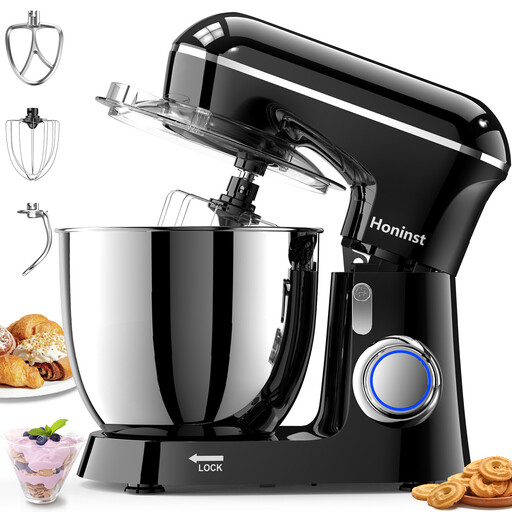
The product title lists both a dough hook and a mixing beater. Check that the included set is suitable for your recipe.
The title lists a 5 l bowl, 10 speeds, a dough hook, a whisk and a mixing beater.
 No image available
The title lists attachments for dough and mixing. The product information states that this appliance is intended for domestic use only.
The title lists a 6.5 QT bowl, 10 speeds, a dough hook, a whisk and a mixing beater.
KitchenAid Netherlands’ cheese cracker recipe specifies a flat beater or dough hook and uses speed 2. So don’t choose a mixer based only on whether it comes with a whisk; check your mixer’s manual and the recipe too.
In the KitchenAid Netherlands recipe reviewed, the shaped dough is chilled for at least 1 hour before rolling out. This is a recipe instruction, not a general storage time for every cheese dough; store ingredients according to their own guidance.
It depends on the part and model. The Consumers’ Association (Consumentenbond) warns that food processor accessories are not always dishwasher-safe; follow the cleaning instructions for the exact model.
For a consumer purchase in the Netherlands, statutory rights apply alongside any manufacturer’s warranty. If the product does not perform as you could reasonably expect when used normally, the seller is responsible for providing an appropriate solution. According to ACM ConsuWijzer, this does not mean there is a fixed statutory warranty period of exactly two years in the Netherlands.
For this coffee morning, it depends on who is organising it, how often food is sold and whether food is being sold or provided. The NVWA says registration is required if you sell food several times a year, but not if you sell it once a year. Businesses and organisations offering unpackaged food must provide allergen information. Establish the circumstances before deciding which requirements apply, and keep ingredients such as cheese and flour clearly labelled.