
Weekend baker making cake batter
You want to mix butter and sugar, then gently incorporate the flour. Whether a stand mixer is useful also depends on how often you bake.


For a single weekend cake, you don’t always need a stand mixer: King Arthur Baking publishes a coffee cake recipe that doesn’t require one. If you bake more often or want hands-free mixing, focus on the beater supplied, a bowl that suits your needs and how much space the machine takes up. Before buying, also check the exact model and that it carries the required CE marking.
You want to mix butter and sugar, then gently incorporate the flour. Whether a stand mixer is useful also depends on how often you bake.
You want to mix ingredients hands-free, but you also need somewhere to keep the machine and bowl. Measure the space where you’ll use and store the mixer.
You make cakes, but might also want to whisk or knead. Check which attachments are actually included with the model.
A good fit if: you occasionally make one coffee cake and don’t need hands-free mixing.
The trade-off: you do the mixing yourself, but don’t need to store an extra appliance and bowl. Follow your recipe’s method.
A good fit if: you make cake batter regularly and have limited worktop or storage space. Kenwood lists the Go KZM35.000GR as 30 cm high.
The trade-off: check whether the stated cake capacity of 1.8 kg and the included K-beater suit your recipe; these figures are provided by the manufacturer.
A good fit if: you want to whisk or knead as well as make cake batter; Bosch lists a whisk, beater and dough hook for the MUMS2AW01.
The trade-off: check the exact model and version, as stated capacities and included parts can vary between products.
For cake batter, the right beater and a bowl that suits the quantity in your recipe are more important to check than motor power alone. Consumentenbond lists cake batter as a use for a whisk and beater; King Arthur Baking also features a coffee cake recipe that doesn’t require a mixer.
| What to consider | What should you check? | Who should pay particular attention? |
|---|---|---|
| Mixing cake batter | Check which beater is included and whether the bowl suits the size of your recipe. | If I mainly want to mix butter, sugar and eggs, then gently incorporate the flour, I want to know whether the beater suits my recipe. Around 36% of consumers give mixing cake batter their highest priority. |
| Worktop and storage space | Measure the available worktop space, cupboard height and clearance needed to operate the mixer head. | If I’m short on space, the machine needs to fit where I use it and where I store it. Around 29% of consumers give the space it takes up their highest priority. |
| Cleaning up after baking | Check the manufacturer’s guidance for each exact model to see which parts are dishwasher-safe. | If I want to do as little washing-up by hand as possible after mixing, I check the care instructions for the bowl and attachments. Around 21% of consumers give cleaning their highest priority. |
| Other baking tasks | Compare the whisk, beater and dough hook for each version; check which parts are included. | If I want to whisk or knead as well as make cake, I need the right attachments for those tasks. Around 14% of consumers give versatility their highest priority. |
The stated power doesn’t tell you which attachments are included, how much batter the manufacturer says the model can handle or whether the mixer will fit in your kitchen.
Compare the exact version in terms of its attachments, bowl, stated capacity and dimensions. Don’t treat a manufacturer’s figures as an independent performance test.
The Joybuy product title for the Bosch MUMS2AW00 lists 1000 W and 5.5 litres, while the product description on the same page lists 700 W and 3.8 litres.
Before buying, ask for confirmation of the version, rating plate, bowl and attachments before treating the listing as an identical product.
According to the Rijksoverheid, there is no fixed statutory warranty period in the Netherlands; your rights against the seller are separate from any warranty you buy.
First compare what additional cover is actually offered, and keep it separate from your statutory rights.
For the Serie 2 MUMS2AW01, Bosch lists a baking set with a whisk, beater and dough hook, plus a 3.8-litre bowl.
Kenwood describes the Go KZM35.000GR as a compact mixer and lists it as 30 cm high, with a 4-litre bowl.
According to KitchenAid, the Artisan 5KSM125EER has a tilt-head design, a 4.7-litre bowl and three mixing attachments.
For the SMF03DGEU, Smeg lists planetary mixing action, ten speed settings and a 4.8-litre bowl.
These picks are stand mixers for cake batter and related baking tasks. Before buying, check that the specific electrical product carries the required CE marking; the NVWA says this is compulsory for electrical consumer products covered by the applicable rules.
 No image available
The product description lists cake batter as a suitable use, and the bowl capacity may be useful if you want to mix a larger batch.
 No image available
The product description mentions cake making and a mixing beater, as well as attachments for whisking and kneading.
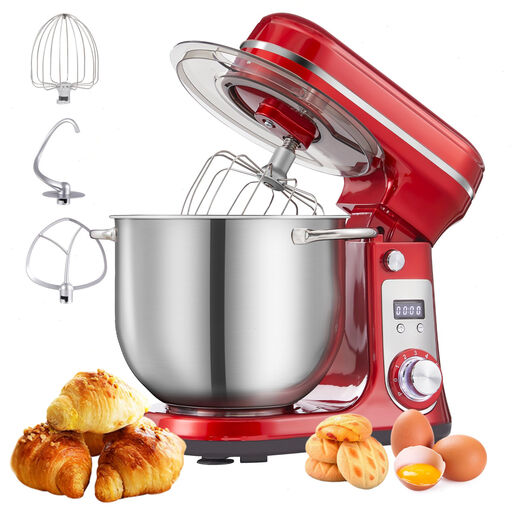 No image available
The product information mentions mixing and whisking; the bowl capacity may be worth considering if you’re making a larger batch of batter.
 No image available
The product information lists a beater for batter, as well as a whisk and dough hook for other mixing tasks.
 No image available
The product information lists a K-beater for batter, plus a whisk and dough hook for other baking tasks.
No, some coffee cake recipes don’t need a mixer. King Arthur Baking also publishes a recipe that mentions both a large bowl and the bowl of a stand mixer; follow the method in the recipe you’re using.
Follow your recipe’s mixing instructions; the recipe reviewed says to mix in the flour gently. Check which attachment is designed for your exact mixer, and don’t assume that a dough hook can replace a beater.
It varies by model and part. Bosch lists dishwasher-safe attachments for the MUMS2AW01; for other versions, check the relevant instruction manual.
According to the Rijksoverheid, there is no fixed statutory warranty period in the Netherlands; online purchases usually come with a 14-day cooling-off period. A manufacturer’s warranty or an optional warranty you buy is separate from your statutory rights against the seller.
The NVWA says that CE marking is compulsory for electrical consumer products covered by the applicable Dutch CE rules. The marking is not an independent test of baking performance; before buying, check that the specific product carries the required marking.