What should you look for when buying?
Start with the amount of mixture per batch, then check that the attachment is suitable, how to clean the machine and whether it can keep up with your planned pace of work.
| What to consider |
What should you check? |
Who should pay particular attention to this? |
| Batter per batch |
Compare the recipe quantity with the capacity for batter specified for the exact model. Don’t assume the bowl capacity or dough limit also applies to cake batter. |
If I want to avoid making lots of separate batches, I first check how much batter the exact model can handle for this recipe. Around 34% of consumers prioritise batch size. |
| Suitable mixing attachment |
Check whether the model comes with a whisk or flat beater, and which speed settings the manual recommends for batter. |
When I’m helping beginners, I want a suitable attachment and controls that let me adjust the mixing steps. Around 33% of consumers prioritise mixing cake batter with a suitable attachment. |
| Cleaning between batches |
Check the cleaning instructions for each bowl and attachment; dishwasher-safe parts don’t mean the whole machine is dishwasher-safe. |
When the mixer is shared, I want to be able to clean the bowl, attachments and workspace between batches according to the instructions. Around 20% of consumers put cleaning first. |
| Space and operating time |
Check the dimensions, weight and maximum continuous operating time specified for the exact model. |
If the mixer is on a shared worktop or will run for several batches in a row, it needs to suit the workspace and schedule. Around 13% of consumers look at this first. |
Stand mixers at Joybuy
These stand mixers are options to compare for guided mixing steps and individual workshop batches. Bowl capacity isn’t confirmed batter capacity; for the specific model, also check the documentation on food-contact materials and electrical compliance.
 No image available
Stand mixer, 5 l, 10 speed settings
An option to compare if you want to mix batter in separate batches.
The product name specifies a 5 l bowl, 10 speed settings and 600 W.
The listed attachments are a dough hook, beater and whisk; bowl capacity isn’t a stated cake batter capacity.
Joybuy
 No image available
AUCMA stand mixer, 5 l, 10 speed settings
This model is an option to compare for mixing batter in workshop batches.
The product name specifies a 5 l bowl, 10 speed settings and 400 W.
The listed attachments are a dough hook, whisk and beater. Bowl capacity doesn’t indicate a cake batter limit.
Joybuy
 No image available
Kenwood Go KZM35
A stand mixer option to compare for a workshop set-up with guided mixing steps.
Check which beater is included with the exact model and the cleaning instructions for the bowl and accessories.
Joybuy
 No image available
Monsga SM100, 5.0 l, 8 speed settings
This model is worth comparing if you want to set up several mixing steps.
The product name specifies a 5.0 l bowl, 1000 W peak power and eight speed settings.
The listed attachments are a whisk and dough hook. The stated bowl capacity isn’t confirmed batter capacity.
Joybuy
 No image available
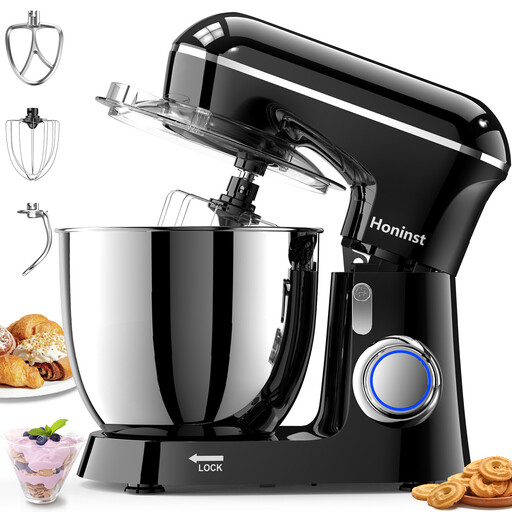
Honinst stand mixer, 6.5 QT, 10 speed settings
The product information describes this stand mixer as suitable for domestic use; consider whether that suits the type of workshop you have in mind.
The product name specifies a 6.5 QT bowl and 10 speed settings.
The listed attachments are a dough hook, whisk and beater. Check the model-specific instructions for use.
Joybuy
Frequently asked questions
Which beater should you use for cinnamon cake batter?
Choose the whisk or flat beater that’s designed for the exact model, rather than automatically using the dough hook. For cake batter, KitchenAid recommends starting on a low speed with its flat beater and gradually increasing the speed; follow the manual for other models.
How do you keep a shared mixing area clean?
Clean the bowl, attachments and work area between uses, following the instructions for each part. For food businesses, the Netherlands Food and Consumer Product Safety Authority also advises cleaning after use and taking steps to prevent cross-contamination. One dishwasher-safe part doesn’t mean the whole machine is dishwasher-safe.
Can participants taste raw cake batter?
This isn’t recommended. The Netherlands Nutrition Centre warns that raw eggs and flour may contain bacteria, and advises washing your hands before and after handling raw batter.
Do you need an additional warranty for a mixer used in a workshop?
If you buy as a private individual in the Netherlands, a manufacturer’s or extended warranty is in addition to your statutory rights. According to the Dutch Government, the seller must offer a solution if a product is faulty; check separately whether the terms cover the type of workshop you have in mind.
Which rules apply if a workshop prepares food as a business?
If the organiser runs a food business that prepares, processes or sells food, the Netherlands Food and Consumer Product Safety Authority says they need an HACCP food safety plan or an applicable hygiene code. The mixer must also meet the relevant requirements for electrical equipment and food-contact materials; check the documentation for the specific model.


