
Baking for friends
You make cake batter for friends and want the right mixing attachment and a stated capacity that suits your recipe. Bosch and Kenwood list a cake batter capacity for specific models.


For cake batter, choose a stand mixer with the beater or mixing attachment recommended by the manufacturer for that model. Compare the stated cake batter capacity with the amount in your recipe, rather than looking only at the bowl’s capacity. A compact model may suit occasional baking for friends. Larger batches or other types of preparation may call for extra capacity or attachments, but could also mean paying for features you don’t need.
You make cake batter for friends and want the right mixing attachment and a stated capacity that suits your recipe. Bosch and Kenwood list a cake batter capacity for specific models.
You want to put the mixer away after use and would rather not choose based solely on a large bowl or extra features. Compare the dimensions of the exact model with the space where you plan to use or store it.
You bake for friends now and then and want the included attachments to suit what you’ll actually make. The Consumers’ Association recommends considering the tasks you plan to use a food mixer for when choosing one.
Start by checking the attachment for cake batter, then compare the capacity with your recipe. After that, consider how much space you have and which extra features you need.
| What to consider | What should you check? | Who will find this important? |
|---|---|---|
| Attachment for cake batter | Check which beater or mixing attachment comes with the model and what the manufacturer recommends using it for. | If I’m making cake batter, I want an attachment suited to the task. Around 36% of consumers prioritise a suitable mixing attachment. |
| Capacity for your batch | Compare the amount of batter in your recipe with the model’s stated cake batter capacity. | If I’m making one batch for friends, I want to know whether my recipe is within the stated batter capacity. Around 29% of consumers prioritise batch size. |
| Worktop and storage space | Measure the space available and compare it with the dimensions of the exact model. | If I need to put the mixer away after baking, I want to be sure it will fit in my cupboard or on my worktop. Around 21% of consumers say space is their main consideration. |
| Features and usage | Check which attachments are included and whether you’ll use the extra features for other types of preparation. | If I only bake occasionally, I want to choose attachments that suit what I actually make. Around 14% of consumers put this consideration first. |
A bowl’s capacity in litres is different from the maximum weight of cake batter a manufacturer specifies for a model. Bosch and Kenwood list these figures separately for specific models.
Compare the amount in your recipe with the stated cake batter capacity of the exact model you’re considering.
If your recipe exceeds the stated capacity, you may need to mix the batter in several batches.
The recommended attachments vary by model and type of preparation. KitchenAid recommends the flat beater for cake batter, while Philips recommends the beater for cakes.
Check the manual and the attachments supplied with the exact model, rather than relying on the general term ‘dough’.
Kenwood says that a standard K-beater isn’t designed to touch the sides of the bowl. Ingredients may therefore remain around the edge.
Follow the instructions for your model and, if needed, scrape the mixture down with a spatula while mixing. Switch off the machine before reaching into the bowl or adjusting an attachment.
A flexible edge beater may be a separate accessory; check that it’s compatible with your model before buying.
The MUM58W20 is worth considering if you want to compare the manufacturer’s stated cake batter capacity with your recipe.
The Go KZM35.000GY and kMix KMX750ARD have different stated bowl and cake batter capacities to compare with your recipe and available space.
The Artisan 5KSM125 is worth considering if you’re looking for a medium-sized mixer with baking attachments included.
The HR7962/21 is worth a look if you’ll use the additional preparation features listed, as well as baking.
The Assistent Original AKM6230 is another option to consider if you regularly make larger quantities of dough as well as cakes.
These are stand mixers with a stated bowl capacity or mixing attachment. Compare the details with the amount of batter you need to make and the space you have available.
 No image available
The product information mentions cake preparation and mixing attachments; check whether the stated capacity for this model suits your recipe.
Bowl: 5.5 litres. Speeds: 11.
 No image available
The patisserie set mentioned may be useful for baking preparation; the product information doesn’t state a maximum weight of cake batter for this model.
Bowl: 3.9 litres. The stated 2.7 kg refers to kneaded dough, not cake batter.
 No image available
The product description mentions a mixing beater for batter; check the instructions for using it with cake batter.
Bowl: 5 litres. Speeds: 10. Power: 400 W.
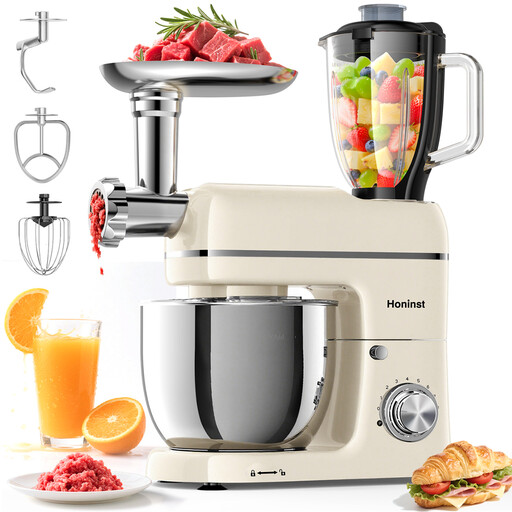 No image available
The title mentions a beater for mixing, along with attachments for other types of preparation; check which ones suit your plans.
Bowl: 6.5 QT. Speeds: 8. Listed attachments include a dough hook, beater, whisk, meat mincer and blender.
Use the attachment the manufacturer recommends for cake batter with your model. KitchenAid recommends the flat beater for cake batter; Philips recommends the beater for cakes and the whisk for things such as egg whites and sponge mixture. A dough hook isn’t automatically the right choice.
Compare the amount in your recipe with the stated cake batter capacity of the exact model. For example, Bosch lists a 3.9-litre bowl for the MUM58W20 and separately states a maximum of 2.7 kg of cake batter. Litres and kilograms aren’t interchangeable.
Follow the instructions for your model and, if needed, scrape the mixture down with a spatula while mixing. Kenwood says that a standard K-beater isn’t designed to touch the sides of the bowl. Switch off the machine before reaching into the bowl or adjusting an attachment.
In addition to any manufacturer’s warranty, you’re covered by statutory consumer rights. ACM ConsuWijzer explains that if a product breaks during normal use sooner than you could reasonably expect, the seller must offer an appropriate remedy at no cost. There isn’t one fixed statutory warranty period for every mixer.
For a standard online consumer purchase, you’ll usually have a statutory cooling-off period, with some exceptions. ACM ConsuWijzer says this period ends 14 days after delivery. Check the seller’s terms and any additional returns period they offer.