
Vandaag of morgen in huis

Kwaliteit gegarandeerd

Welkomstaanbiedingen ontgrendelen: GRATIS bezorging | Tot 80% korting | Gratis 30 dagen JoyPlus-proefperiode
Download de app
A stand mixer can make preparing bread, cake, pizza, sauces and whipped cream easier. However, a large bowl or high wattage does not automatically make a mixer the right choice for your kitchen. Anyone who focuses solely on marketing claims could end up with an unstable mixer, a motor that overheats quickly or accessories that are barely used.
This buying guide helps home bakers, keen cooks and families choose a suitable stand mixer, electric kitchen mixer or multifunctional food mixer.
A higher wattage sounds appealing, but it does not tell you everything about performance. The drive system, overheating protection, maximum dough quantity and operating time also matter. A stand mixer for heavy bread dough should be used according to the instructions. Some models may only run for a few minutes at a time when handling heavy yeast dough.
Therefore, always check:
This helps prevent you from buying a dough mixer that looks powerful on paper but is not suitable for your baking routine.
A 5- or 6-litre bowl provides plenty of space, but it cannot be filled completely. On some models, the permitted quantity of batter or dough is considerably lower than the stated bowl capacity. A smaller bowl may also be more practical if you usually make one cake mixture or a limited amount of pizza dough.
So pay attention to the difference between:
A mixer with a whisk, beater and dough hook is more versatile than a model with just one accessory. However, also check how the parts need to be cleaned. According to the product information for some models, certain aluminium or cast components are not dishwasher-safe.
A splash guard, tilt head and non-slip feet are practical features. They do not prevent every splash, but they can make using and cleaning the mixer more manageable.
For cake batter and whipped cream, smooth speed control is more important than maximum power alone. For bread and pizza, low-speed torque, a sturdy drive system and a dough hook are more relevant. A mixer for bread and cake should also remain stable on the worktop.
Look for:
According to the product description, the Honinst 6.5QT has a copper motor, ten speeds, planetary mixing action, non-slip suction cups and overheating protection. The manufacturer also states that heavy yeast dough must not be processed continuously for more than ten minutes, followed by at least fifteen minutes of cooling.
A mixer with a mixing bowl takes up permanent space. So measure not only the worktop, but also the height when the head is raised. A tilt head makes it easier to fit the bowl and accessories, but requires additional space above the machine.
According to the product information, the AUCMA ASM1559 has a 6-litre stainless-steel bowl, 450 watts of power, six speeds and a pulse function. Its stated dimensions are 40.7 × 26.8 × 33.2 centimetres. This is important information for a Dutch kitchen with limited cupboard space.
The standard baking accessories usually consist of:
A multifunctional food mixer may also come with a blender or meat grinder. This is useful if you want to combine several appliances, but check in advance where you will store the accessories and whether they genuinely suit your cooking routine.

Why it suits this profile: This model offers a 5-litre stainless-steel bowl, ten speeds and three standard accessories for everyday baking, without additional features that not everyone needs.
The product information states a maximum operating time and overheating protection. Check the manual for the exact limits before making heavy dough.
400 watts, 5-litre stainless-steel bowl, ten speeds plus pulse setting, and three accessories: whisk, beater and dough hook.
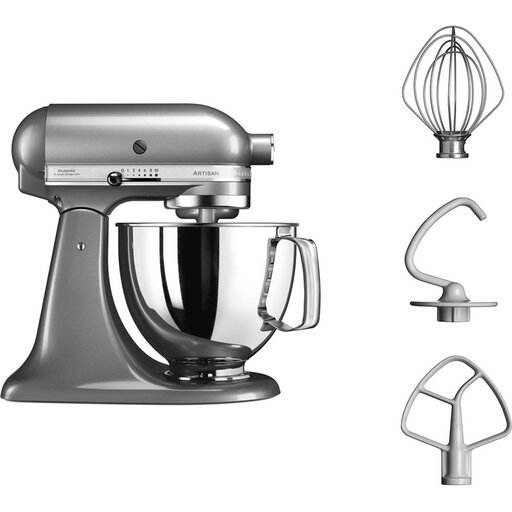
Why it suits this profile: Suitable for anyone who values a metal housing, direct drive and a widely available accessory platform.
The product specification explicitly states 300 watts and warns that it is not suitable for heavy dough. This makes the usage limit clearer than general power claims.
4.8-litre stainless-steel bowl, ten speeds, direct drive, and supplied whisk, beater and dough hook.
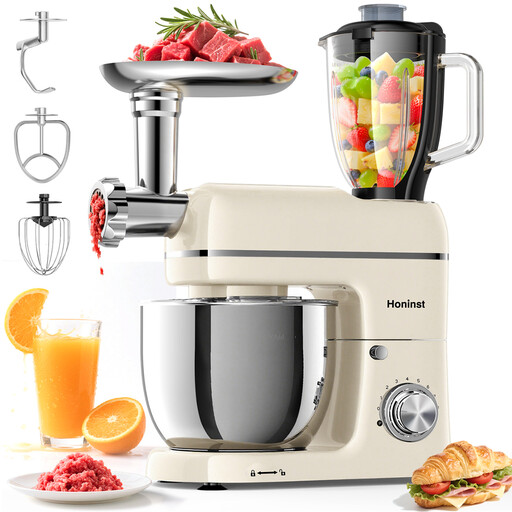
Why it suits this profile: This model is designed for users who want to blend and mince meat as well as knead and whisk.
The product information mentions a safety lock when the head is raised. Only use approved accessories and do not exceed the stated quantities.
According to the product description: up to 1300 watts, a 6 QT bowl, eight speeds plus pulse setting, blender and meat grinder.
We have put together a complete, up-to-date list of products that fully meet these strict selection criteria and the applicable European safety regulations.
Before use, read the manual and check that the machine is suitable for normal household use. Also bear the following points in mind:
A model with a powerful motor may also produce more noise. For example, AUCMA states a noise level of 68 to 72 dB within one metre, while Honinst states less than 60 dB according to its own product information. These are stated product specifications, not a universal guarantee of how loud the appliance will seem in every kitchen.
Yes, a stand mixer with a dough hook can handle bread and pizza dough, provided you follow the maximum quantity and operating time. Pay particular attention to the instructions for heavy yeast dough. Wattage alone does not determine whether a model is suitable.
For regular family baking, a bowl of around 5 to 6 litres is often practical. If you usually make small quantities, a more compact model may be easier to store. Always check the permitted working capacity, as the bowl’s total volume cannot be used in full.
The cost depends on the power, operating time and your electricity tariff. For example, a 400-watt mixer running for a short time uses less energy than a more powerful model used for an extended period. Use the lowest suitable speed and do not leave the appliance running unnecessarily.
