
Vandaag of morgen in huis

Kwaliteit gegarandeerd

Welkomstaanbiedingen ontgrendelen: GRATIS bezorging | Tot 80% korting | Gratis 30 dagen JoyPlus-proefperiode
Download de app
A stand mixer can take a lot of the hard work out of making bread dough, cake batter, whipped cream and meringue. But it’s not wise to focus only on the wattage or the size of the mixing bowl. If you’re looking to buy a stand mixer, there are three common pitfalls to watch out for: a stated power rating that tells you little about long-term kneading, a bowl capacity that doesn’t reflect how much you can actually use, and accessories that are less versatile than the product photo might suggest.
This guide helps you compare models using specifications you can check. That way, you can make a more informed choice between a stand mixer with a mixing bowl, a stand mixer or a food mixer for everyday use.
A higher wattage doesn’t automatically mean a machine can handle every heavy dough with ease. The motor type, gearing, maximum dough capacity and recommended running time are just as relevant. A mixer for dough should run steadily at a low speed without overheating or becoming overloaded.
So, look out for:
For example, the AUCMA 5L is listed with a power rating of 400 W and a maximum noise level of 75 dB. The AUCMA 6L is listed at 450 W and 68–72 dB at a distance of one metre. These are product specifications; on their own, they don’t tell you how well each recipe will work in your kitchen.
A 5-litre or 6-litre stand mixer doesn’t always have that much usable space for dough. Maximum capacity depends on the recipe and its ingredients. A large bowl is useful for batter or multiple batches, but adding too much flour or using stiff dough can put a strain on the motor.
Always check:
The Monsga SM100 is listed with a 6-litre bowl and a recommended usable capacity of 5 litres. This difference matters if you regularly make bread, pizza or brioche.
A stand mixer for baking should be suitable for at least three different tasks:
Also check whether the accessories are dishwasher-safe and whether you can replace or add to them later. According to the product information, extra accessories are available for various Kenwood models, but always check they’re compatible with the specific model.
Variable speed control gives you more control than a set number of fixed speeds. When making dough, start at a low speed and increase it only if the recipe allows. A pulse function can be useful for short bursts of mixing, but it’s no substitute for a good low speed when kneading for longer periods.
A powerful stand mixer is particularly useful if you often make heavy dough. For cake batter, whipped cream and smaller quantities, a more compact model may be enough.
Measure the available space on your worktop before ordering. A large model can be around 40 cm tall or wide, and it also needs to fit under your kitchen cupboards. Check the weight and look for non-slip feet, too. A machine that moves around while kneading is awkward to use and could cause damage.
A metal body generally feels sturdy, but it also makes the machine heavier. A plastic body can be more practical if you put the machine away frequently.
A tilt-head design makes it easier to change the bowl and accessories. Built-in scales can be useful if you want to weigh ingredients directly into the bowl. The Kenwood Titanium Chef Baker KVC65 and KVC85 are listed with built-in scales. The KVC85 is also listed with an extra DuoBowl.
Before buying, check:
The statutory guarantee doesn’t mean every part will last indefinitely. Keep your proof of purchase and follow the manufacturer’s care instructions.

Why it suits this profile: The 5-litre stainless steel bowl, ten speeds and three essential accessories make it a good choice for everyday baking without taking up space with a large appliance.
The product information lists not only the 400 W motor power, but also the bowl capacity, speeds, pulse function and overload protection.
10 speeds plus pulse function, 5-litre stainless steel bowl, whisk, dough hook and beater.
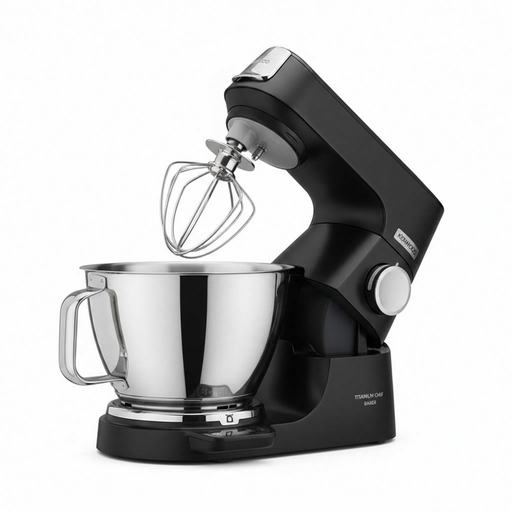
Why it suits this profile: This model is designed for home bakers who want to weigh ingredients directly into the bowl and regularly prepare a variety of recipes.
The relevant details are specific: 1200 W, a 5-litre bowl, built-in scales and an extra DuoBowl, according to the product description.
1200 W motor, built-in scales, extra bowl, whisk, dough hook and K-beater.

Why it suits this profile: The XL bowl and 1200 W power are designed for people who often prepare larger quantities of dough or batter.
The product details list the power, automatic speed control and a 7-litre capacity. Always check the maximum dough quantity in the instructions before use.
1200 W, XL capacity, built-in scales and automatic speed control.
We’ve put together a complete, up-to-date list of products that meet these strict selection criteria and comply with the applicable European safety regulations.
Yes, but the maximum quantity and running time vary by model. When working with heavy dough, use a low speed, don’t exceed the capacity and let the motor rest as directed in the instructions. A dough hook is designed for kneading; use a whisk for light, airy mixtures.
For a household that bakes occasionally, 4 to 5 litres is often practical. A 6-litre stand mixer or larger is a better fit if you regularly make several loaves, large cakes or family-sized portions. As well as the bowl capacity, always check the recommended amount of dough.
Energy use depends on the power rating and how long you use the mixer. A 1200 W appliance running for ten minutes theoretically uses around 0.2 kWh. In practice, the motor doesn’t always run continuously at full power. The purchase price, maintenance costs and available accessories all contribute to the overall cost.
