
Vandaag of morgen in huis

Kwaliteit gegarandeerd

Welkomstaanbiedingen ontgrendelen: GRATIS bezorging | Tot 80% korting | Gratis 30 dagen JoyPlus-proefperiode
Download de app
A stand mixer can take a lot of the work out of making bread dough, cake batter, whipped cream and pizza. But an attractive design or a high wattage doesn’t guarantee that the appliance will suit your kitchen and recipes. If you focus only on the motor, you could end up with a mixer that’s too small, unstable or difficult to clean.
So look out for these three common pitfalls:
A lower-powered model is often sufficient for cake batter and whipped cream. Heavy bread or pizza dough puts more strain on the motor. As well as checking the stated power, look at the instructions for the maximum quantity of dough and the permitted operating time.
Some models specify a cooling period. According to the product information, the Honinst 6.5 QT stand mixer should not be used for more than 10 minutes at a time with heavy yeast dough, after which the motor needs to cool for at least 15 minutes. The Aucma 6L has a stated maximum continuous operating time of 6 minutes. That difference matters if you regularly make several loaves in a row.
An electric stand mixer with overheating protection can switch off the motor if the load becomes too high. Treat this as a safety feature, not as permission to exceed the maximum quantities or operating time.
A stand mixer with a mixing bowl of 5 to 7 litres is a good choice for families or larger baking recipes. In a small kitchen, the space it takes up on the worktop matters just as much. Measure the available space in advance, including the height needed to open a tilting head.
Pay attention to the difference between total bowl capacity and working capacity. The Kenwood Go has a 4-litre bowl and lists a maximum dough quantity of 1.4 kg. The Bosch MUMS2AW00 has a 3.8-litre bowl, with a capacity of 1.7 kg of dough and 2.4 kg of batter. Always use the manual as your guide.
A stand mixer with a dough hook usually comes with three basic attachments:
A planetary mixer moves the attachment around the bowl, bringing in ingredients from different areas. Bosch and Honinst’s product information refers to a planetary or three-dimensional mixing action. This can help with even mixing, but the result also depends on the recipe, quantity and speed.
Also check the non-slip feet, weight and bowl lock. A powerful dough mixer can move during kneading if its base doesn’t grip the surface well enough. A splash guard is useful when working with flour and liquid batter. Stated noise levels are only meaningful if the measuring distance and conditions are clear. Honinst lists less than 60 dB for one model; Aucma lists 68–72 dB at one metre, and Monsga lists a maximum of 75 dB, according to the brands’ product information.

Why it suits this type of user: This compact model is designed for everyday mixing, whisking and kneading in smaller households and for beginner home bakers.
The product information gives specific capacities for dough and batter. Do check the specifications when buying, as some listings show different bowl and power ratings.
3D planetary mixing action, non-slip feet, and a whisk, beater and dough hook included.

Why it suits this type of user: The large bowl and automatic speed control are ideal for keen bakers who regularly prepare larger quantities.
The product listing states a power rating of 1200 W and a 7-litre bowl. This gives you more to go on than a deal that only lists peak power.
Stainless steel construction, integrated scales and automatic speed control, according to the product details.
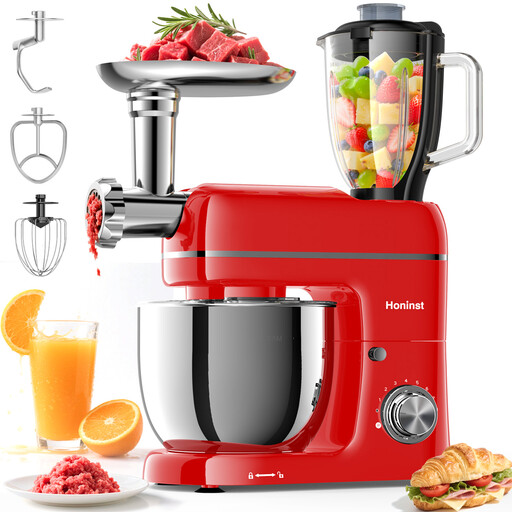
Why it suits this type of user: This model is a good fit for households that want to use a blender or mincer as well as mix and knead.
The extra functions are clearly specified: the product information lists a 6 QT bowl, a motor rated up to 1300 W, eight speeds, and accessories for mincing and blending.
Tilting head, safety switch, and dough hook, whisk and beater included; blender and mincer accessories are part of the described version.
We’ve put together a full, up-to-date list of products that meet these strict selection criteria and the applicable European safety regulations.
Yes, provided the model has a dough hook and can handle the quantity of dough you need. Start at a low speed and follow the cooling periods in the manual. A large bowl doesn’t automatically mean you can knead a large quantity of heavy dough.
A lower power rating is often sufficient for cakes, pancake batter and whipped cream. If you regularly make bread and pizza dough, the combination of motor power, drive system, maximum capacity and operating time is what matters most. So don’t compare models by looking only at the highest wattage on the packaging.
Always unplug the appliance before removing any accessories. According to the product information, many bowls and attachments are dishwasher-safe, but this varies from one part to another. For example, the Ariete 1588 listing says that the bowl and whisk are dishwasher-safe, while the beater, dough hook and lid must be washed by hand. Check the instructions for each model and clean the motor housing with a lightly damp cloth only.
