
Vandaag of morgen in huis

Kwaliteit gegarandeerd

Welkomstaanbiedingen ontgrendelen: GRATIS bezorging | Tot 80% korting | Gratis 30 dagen JoyPlus-proefperiode
Download de app
A stand mixer can make bread dough, cake batter, biscuit dough and whipped cream much easier to prepare. Yet many people choose a model based solely on its wattage or an attractive product photo. The result can be a mixer that’s too small, difficult to clean or unstable when handling heavy dough.
As a Joybuy Product Recommendation Officer, I start by checking verifiable specifications. Not every stand mixer is suited to the same tasks. A compact hand mixer can be handy for cake batter, while a stand mixer with a dough hook is a better choice for making bread or pizza dough regularly.
A high peak power rating sounds impressive, but it doesn’t tell you everything about performance during prolonged kneading. Check the rated power, recommended operating time and maximum dough capacity too. For example, the Monsga SM100 is listed with a peak power of 1000 watts, alongside a rated power of 600 watts. This distinction gives you a more realistic idea of how it will perform in everyday use.
A 6-litre bowl may look large, but its full capacity isn’t necessarily the amount you can mix safely. The Monsga SM100 has a maximum bowl capacity of 6 litres, with a recommended capacity of 5 litres. Yeast dough in particular needs room to move properly without spilling over the edge.
A quiet stand mixer is useful in an open-plan kitchen, but always check whether the noise level is actually stated and under what testing conditions. According to the product information, the AUCMA ASM1559 has a noise level of 68–72 dB at one metre. The Monsga SM100 is listed as producing less than 75 dB. These figures are more useful than a marketing term such as “quiet” on its own.
An electric mixer with a lower power rating is often sufficient for cakes, whipped cream and light batters. For heavy bread or pizza dough, a stable drive, a suitable dough hook and a clearly stated maximum dough capacity are particularly important.
Look out for the difference between:
It’s best to use a mixer on a low to medium speed when working with dough. Always follow the instructions and don’t exceed the recommended quantity.
A mixer with a bowl holding 5 litres is a practical middle ground for many households. If your family regularly makes several loaves of bread or large batches of biscuit dough, you may need more space. Also check:
The models mentioned often come with stainless steel bowls and splash guards. Check each product page to see exactly which accessories are included.
A versatile stand mixer for baking usually comes with:
More speed settings don’t automatically mean better results, but they make it easier to start slowly and gradually increase the speed. A pulse function can be useful for short bursts of powerful mixing.

Why it suits this profile: This hand mixer takes up little space and has a 3-litre bowl that rotates automatically. It’s suitable for cake batter, whipped cream and smaller quantities of dough.
The product information lists 450 watts, 6 speed settings and a specific bowl capacity of 3 litres. This makes it clearer what the model is designed for.
450 watts, 6 speed settings, a bowl that rotates automatically, and beaters and dough hooks included.
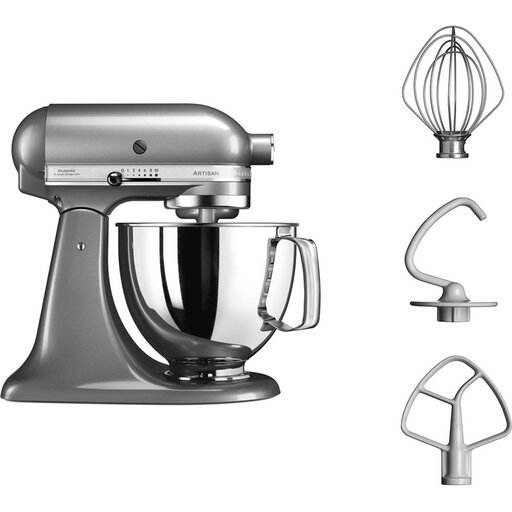
Why it suits this profile: Its metal construction and direct drive make it a good fit for people looking for a robust stand mixer for regular use.
The product information clearly states that it has a metal housing, 10 speed settings and a 4.8-litre bowl. It also explains that 300 watts isn’t intended for heavy dough.
Metal housing, direct drive, 10 speed settings and a range of accessories.

Why it suits this profile: With 8 speed settings, a recommended capacity of 5 litres and a dough hook, this mixer is well suited to home bakers who regularly make bread, pizza or larger batches.
The product description distinguishes between 1000 watts of peak power and 600 watts of rated power. It also states the recommended bowl capacity and the specified noise level.
Stainless steel bowl, 8 speed settings, non-stick dough hook, splash guard and tilting motor head.

Why it suits this profile: According to the product information, the 6-litre bowl has room for family-sized batches. With a dough hook, whisk and beater, this model can handle a range of tasks.
Specific details are provided for 450 watts, 6 speeds plus pulse, a maximum operating time of 6 minutes and a noise level of 68–72 dB.
6-litre bowl, 3-in-1 accessories, pulse function, tilting head and non-slip suction feet.
We’ve put together a complete, up-to-date list of products that meet these strict selection criteria and the applicable European safety regulations.
Yes, but choose a model with a dough hook, a stable base and clear instructions on the maximum dough quantity. When kneading, you’ll usually want to use a low to medium speed. Let the motor rest when the instructions say to.
A 5-litre stand mixer is often a practical choice for a household making cakes, biscuits and medium-sized batches of bread dough. A 6-litre bowl offers more room for family-sized batches, but always check the recommended filling capacity. Don’t fill the bowl to the brim.
Its lifespan depends on how often you use it, how well you maintain it and how hard you work it. A mixer that regularly handles heavy dough will be under more strain than one used only to whip cream from time to time. Clean the accessories according to the instructions, keep the ventilation clear and never use more dough than recommended. This helps prevent unnecessary strain on the motor and drive.
