
Vandaag of morgen in huis

Kwaliteit gegarandeerd

Welkomstaanbiedingen ontgrendelen: GRATIS bezorging | Tot 80% korting | Gratis 30 dagen JoyPlus-proefperiode
Download de app
A stand mixer with a bowl can make mixing, whisking and kneading much easier. However, the differences between models go beyond wattage and bowl capacity. A large bowl, for example, may have a more limited usable capacity, while a powerful motor doesn’t automatically mean the machine can handle heavy dough for long periods.
For home bakers, families and cooking enthusiasts, three common pitfalls are worth looking out for: marketing claims without a clear way to measure them, unclear maximum quantities and accessories that are less practical than expected. Read on to find out which specifications to check and which models suit different needs.
A higher wattage sounds appealing, but it doesn’t tell you everything about a stand mixer’s performance. The drive system, speed, overheating protection and permitted running time all play a part. A motor may be powerful, but still be less suited to prolonged kneading if the manual recommends short operating cycles.
So, check:
According to the product specifications, heavy yeast dough should not be processed in the Honinst mixer for more than 10 minutes at a time, followed by a cooling period. The Aucma ASM1559 has a stated maximum continuous running time of 6 minutes. These are practical limitations to bear in mind before you buy.
A 5 or 6-litre bowl doesn’t always have room to be filled to the top. Ingredients need space to move around, and dough can expand during kneading. The Monsga SM100, for example, has a 6-litre bowl but a recommended usable capacity of 5 litres.
If you regularly bake large batches, a bowl of around 5.5 to 7 litres and a sturdy base are worth considering. If you usually make one cake or a small batch of biscuits, a more compact model may be more practical and take up less worktop space.
A mixer with a dough hook, whisk and beater covers the most common baking recipes. Check that these accessories are included as standard and find out how they should be cleaned. Some parts are dishwasher-safe, while aluminium or coated accessories need to be washed by hand.
A splash guard helps contain flying flour and batter, but won’t make the bowl completely splash-proof. Also check whether the head locks into place and whether the bowl is easy to remove. A tilt-head design is handy when changing accessories, but you’ll need enough clearance above the machine.
For cake batter and whipped cream, an electric mixer with several speeds is usually enough. For bread dough, low speeds, a good dough hook and a stable housing matter more than maximum power alone.
Ideally, a stand mixer for kneading and mixing should have:
Watch out for conflicting information in product titles and descriptions. The Bosch MUMS2AW00 product title states 1000 W, while the product information lists 700 W. So, check the current specifications and manual before you buy.
A mixer with a stainless steel bowl is easy to wipe clean and suitable for many everyday baking tasks. Stainless steel is less prone to discolouration than plastic, but a metal bowl can be heavier. A metal housing often helps make the appliance more stable, but can also make it harder to move.
Also consider:
A stated noise level is only useful for comparison when the distance and conditions used for the measurement are the same. The Honinst specifications state less than 60 dB, the Aucma ASM1559 is rated at 68–72 dB within 1 metre, and the Monsga SM100 at 75 dB. Treat these figures as a guide, not a guarantee of a completely quiet stand mixer.

Why it suits this need: The 5-litre stainless steel bowl, 10 speeds and three standard accessories make this a straightforward choice for cakes, biscuits and regular dough-making.
The product specifications list 400 W, 10 speeds, a pulse function and a noise level of up to 75 dB. This makes it clear what the machine does and doesn’t claim to offer.
5-litre stainless steel bowl, dough hook, whisk, beater, splash guard and non-slip suction cups.

Why it suits this need: This model is designed for people who bake often and value an integrated scale and a large bowl.
The stated specifications include 1200 W, a 7-litre bowl and an integrated scale. This makes the key practical features easy to check.
Large stainless steel bowl, automatic speed control and weighing directly in the bowl, according to the product description.
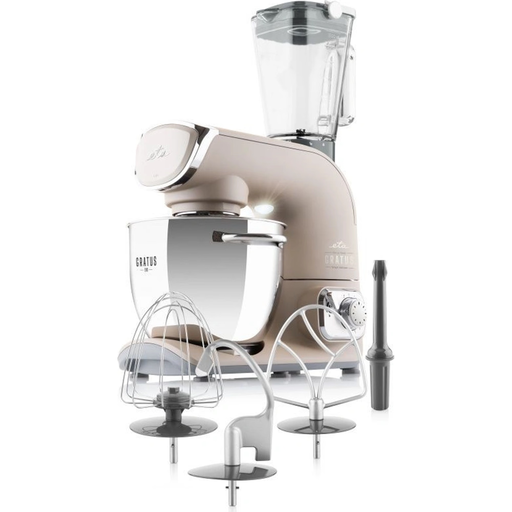
Why it suits this need: The machine combines a metal construction with a 5.5-litre bowl and a stated maximum dough capacity of 2.5 kg.
The manufacturer lists not only the bowl capacity, but also the maximum dough capacity, safety features and continuous speed control. Check these figures against the supplied manual too.
Stated power of 1500 W, planetary mixing action, pulse function and a 1.5-litre glass blender jug.

Why it suits this need: This compact stand mixer is designed for everyday jobs such as making batter, light doughs and whipped cream.
The stated maximum quantities are 1.7 kg of dough and 2.4 kg of batter. This helps you match what you’re making to the machine’s actual capacity.
3.8-litre bowl, 3D planetary mixing and dishwasher-safe accessories, according to the product information.
We’ve put together a complete, up-to-date list of products that meet these strict selection criteria and the current European safety requirements.
For a family, models with a capacity of around 5 to 7 litres are often practical, especially if you regularly make bread, pizza or several cakes. Also check the maximum quantity of dough or batter. This figure is more useful than the bowl’s total capacity.
Its lifespan depends on how it’s used, maintained and loaded. Always stick to the recommended quantities, let the motor cool down after heavy kneading, and only change accessories when the machine is switched off and unplugged. Many models come with a statutory warranty of at least two years, but check the terms for the specific product and seller.
Energy consumption depends on both the power rating and how long the mixer runs. A 1200 W mixer running for a few minutes won’t necessarily use more electricity than a lower-powered model that needs to run for longer. For everyday use, short operating cycles, choosing the right speed and avoiding overloading the machine matter more than maximum wattage alone.
