
Vandaag of morgen in huis

Kwaliteit gegarandeerd

Welkomstaanbiedingen ontgrendelen: GRATIS bezorging | Tot 80% korting | Gratis 30 dagen JoyPlus-proefperiode
Download de app
A stand mixer with a mixing bowl can knead bread dough, mix batter and whip cream or egg whites, so you don’t have to spend ages stirring by hand. Yet many models look similar. A high wattage or a large bowl doesn’t automatically mean a machine is right for your kitchen and recipes.
Watch out for these common pitfalls:
For regular baking, a steady motor matters more than a high wattage on the box alone. A 1000W stand mixer may be suitable for batter and medium-weight dough, but also check the stated rated power, maximum operating time and recommended dough capacity.
Multiple speeds give you more control:
A stand mixer with a dough hook should stay firmly in place while kneading. Non-slip feet, suction cups or a heavy base can help. For bread dough, use a low to medium speed as indicated in the product instructions.
A stand mixer with a 5-litre bowl offers a practical balance of capacity and worktop space for many households. Don’t look only at the total volume; check the recommended fill level too. For example, the Monsga SM100 is listed with a 6-litre bowl, while 5 litres is given as the recommended usable capacity.
A stainless steel bowl:
A handle is useful when you need to move heavy dough or batter. Also check that the bowl locks securely into place and that there’s enough room around the motor housing to add ingredients.
With planetary mixing, the attachment rotates on its own axis while also moving around the edge of the bowl. According to Monsga and Bosch product descriptions, this is designed to move ingredients more evenly around the bowl. The result also depends on the quantity, recipe proportions and speed selected.
At a minimum, look for:
A supposedly quiet stand mixer isn’t completely silent. The Monsga SM100 lists a noise level below 75 dB. This is a verifiable product specification, but the noise you hear can vary depending on the surface, speed and type of dough.

Why it suits this type of user: This stand mixer combines a stainless steel bowl, eight speeds and three essential attachments. It’s a good option if you want to make bread, cakes and whipped cream at home without buying several appliances straight away.
The product information distinguishes between 1000W peak power and 600W rated power, and gives 5 litres as the recommended bowl capacity. This makes it easier to assess the figures realistically.
5-litre recommended capacity, eight speeds, planetary mixing, splash guard and dishwasher-safe attachments according to the product description.
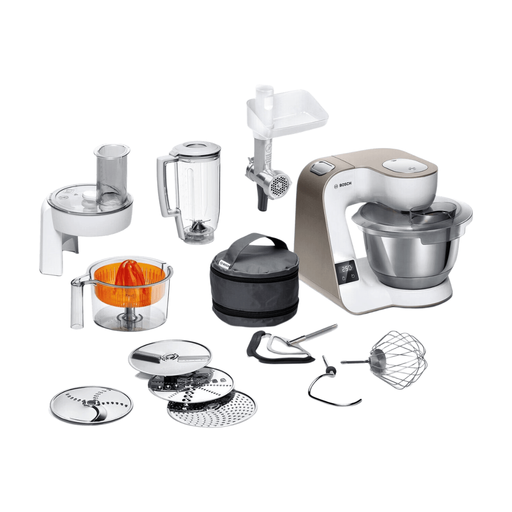
Why it suits this type of user: Ideal for households that want to combine mixing and kneading with weighing, grating, slicing, blending and juicing citrus fruit in one system.
The product specifications list seven speeds, planetary action and a maximum capacity of 2.7 kg. This makes the limit for larger batches clearer than a high wattage alone.
Integrated scales, timer, 1.25-litre blender jug and attachments for tasks including dough preparation, meat processing and juicing citrus fruit.
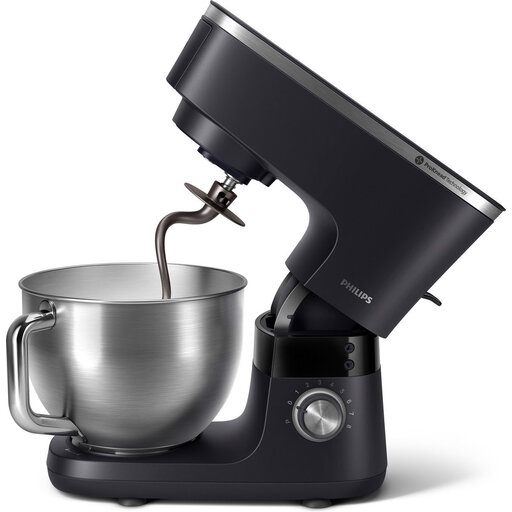
Why it suits this type of user: This stand mixer is aimed at keen bakers who want to combine a generous bowl with extra features for dough preparation, blending and grinding.
As well as the power rating, the product information lists a 5.5-litre bowl, eight speeds and a splash guard. Always check the latest manual for the maximum dough quantities.
1000W, eight speeds, 5.5-litre bowl, 1.5-litre glass blender and meat mincer according to the product specifications.
Place your stand mixer on a flat, dry and stable worktop. Before use, check that the bowl and attachment are locked securely in place. Start on a low speed when adding flour, sugar or other dry ingredients. This helps reduce splashes and strain on the motor.
To help your machine last longer:
A stand mixer with a splash guard is especially useful for thin batter and icing sugar. However, the guard won’t prevent all splashes if you switch to a high speed too quickly.
We’ve put together a complete, up-to-date list of products that meet these strict selection criteria and the applicable European safety regulations.
It depends on the recipe, quantity and rated power. A machine with 1000W peak power may be suitable for many household baking tasks, but always check the recommended dough capacity and use a low to medium speed for heavy dough.
For a household, 4 to 5.5 litres is often a practical size. A larger bowl is useful for family-sized batches, but check whether the whisk and dough hook can reach smaller quantities too. The maximum capacity isn’t the same as the recommended fill level.
Power consumption depends on the actual power rating and how long you use the machine. A 1000W machine running for ten minutes theoretically uses a maximum of around 0.167 kWh if it operates continuously at full power. In practice, consumption varies depending on speed and load. So don’t look at wattage alone; also consider how long you typically use the machine.
