
Vandaag of morgen in huis

Kwaliteit gegarandeerd

Welkomstaanbiedingen ontgrendelen: GRATIS bezorging | Tot 80% korting | Gratis 30 dagen JoyPlus-proefperiode
Download de app
A stand mixer can make baking and cooking much easier. However, it’s not wise to focus only on wattage, the number of speed settings or an attractive product photo. A stand mixer that looks versatile on paper may be too large in practice, unstable on your worktop or unable to handle as much dough as you expect.
For home bakers, families and keen cooks, there are three pitfalls in particular to watch out for:
A stand mixer with a bowl of around 4 litres is often a good fit for smaller households and everyday quantities of cake batter. For families or baking several loaves, a 5 to 7-litre bowl is more practical. Don’t just look at the volume: check the maximum quantity of dough or batter it can handle too.
According to the product information, the Kenwood Go KZM35 has a 4-litre stainless steel bowl and a maximum dough capacity of 1.4 kg. This is worth considering if you bake bread regularly. However, a larger bowl doesn’t automatically mean it can mix small quantities well. Check whether the manufacturer specifies a minimum quantity too.
A stand mixer with multiple speeds gives you more control over different recipes:
Pay attention to the difference between peak power and continuous power. The Monsga SM100, for example, is listed with a peak power of 1000 watts and a rated power of 600 watts. According to its product specifications, the AUCMA 5L has a 400-watt motor and 10 speeds with a pulse function. These figures are only directly comparable when they have been measured in the same way.
Rest time is important when making heavy yeast dough. The Honinst product specifications advise against working with heavy dough for more than 10 minutes at a time, followed by a rest of at least 15 minutes. Always follow the manual and don’t exceed the maximum quantity.
A mixer for bread and cakes should sit firmly on your worktop. Non-slip feet, suction cups and a secure tilt-head lock can help prevent movement and splashing. According to the product information, the AUCMA models have four suction cups and a vibration-absorbing design. The Honinst 6.5QT is listed with non-slip feet and overheat protection.
Also check:
Claims about noise levels or mixing technology come from the relevant product descriptions. For example, Honinst lists less than 60 dB and AUCMA a maximum of 72 to 75 dB, but testing conditions may vary.

Why it suits this type of user: The 5-litre bowl and three basic accessories make this a straightforward option for cakes, biscuits and smaller loaves.
The product specifications list 10 speeds, a pulse function, overheat protection and a recommended mains voltage of 220–240 V.
5-litre stainless steel bowl, tilt head, whisk, dough hook and beater.

Why it suits this type of user: This model is designed for larger batches and users who value automatic speed control and a built-in scale.
The product details list a 7-litre bowl, 1200 watts, automatic speed control and a built-in scale.
Large capacity, stainless steel housing and a 2-year warranty.
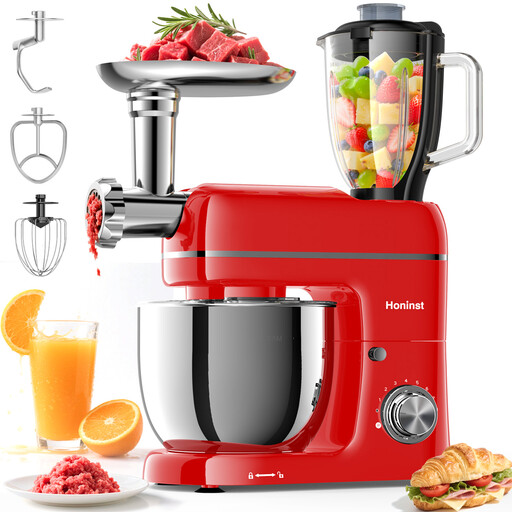
Why it suits this type of user: The combination of mixing, kneading, blending and mincing makes it a good choice for households looking to use one appliance for a range of tasks.
The product description lists a safety switch that activates when the head is lifted, plus 8 speeds and a pulse function. Use approved accessories only.
6 QT stainless steel bowl, blender and meat mincer, as well as a dough hook, whisk and beater.
Place any electric mixer on a flat, dry and stable worktop. Start dough at a low speed and add the ingredients gradually. Switch off the appliance before changing accessories. Never immerse the motor housing in water.
Check the cleaning instructions too. On some models, the bowl and whisk are dishwasher-safe, while the dough hook or beater must be washed by hand. Follow the recommended rest time when working with heavy dough to avoid putting unnecessary strain on the motor.
We’ve put together a complete, up-to-date list of products that meet these strict selection criteria and the applicable European safety regulations.
For regular baking for several people, a 5 to 7-litre bowl is often a practical choice. Always check the permitted quantity of dough and batter, as the bowl’s full capacity isn’t the same as its maximum working capacity.
It depends on how you plan to use it. A medium-powered model may be enough for cake batter and whipped cream. For heavy bread dough, the motor design, recommended dough capacity, rest time and low-speed control are at least as important as wattage.
Energy use depends on the power rating and how long you use the appliance. A 1000-watt appliance running for 10 minutes uses around 0.167 kWh theoretically. In practice, consumption is often lower when the motor isn’t running continuously at full power. Check your current electricity rate for an accurate calculation.
