
Vandaag of morgen in huis

Kwaliteit gegarandeerd

Welkomstaanbiedingen ontgrendelen: GRATIS bezorging | Tot 80% korting | Gratis 30 dagen JoyPlus-proefperiode
Download de app
A stand mixer can take much of the work out of kneading bread dough, mixing cake batter and whipping cream. However, not every stand mixer is suited to the same recipes. A compact kitchen mixer may be perfectly capable of making cakes but struggle with heavy pizza dough. And a large bowl does not automatically mean that you can safely process large quantities of dough.
So don’t focus only on the wattage or the number of accessories. These three pitfalls are particularly common:
The wattage gives you an initial idea of the motor, but it does not tell you everything about performance. Check whether the figure refers to peak power, rated power or another manufacturer specification. A dough mixer for bread and pizza primarily needs sufficient torque at low speed.
Also check the permitted operating time. For example, the AUCMA ASM1559 states that the appliance must not be used continuously for more than 6 minutes without a break. For the Honinst 6.5QT, a maximum of 10 minutes of continuous use is specified for heavy yeast dough, followed by a cooling period. Always follow the instructions for the model you choose.
A mixer with bowl of 5 or 6 litres provides space for larger portions of batter, cream or dough. You should also check:
The Bear Intelligent Dough Maker has a capacity of 5 litres and specifies a maximum dough capacity of 2.5 kilograms. The Monsga SM100 lists a maximum bowl capacity of 6 litres, but a recommended usable capacity of 5 litres. This difference is important if you regularly make bread or pizza.
An electric mixer should remain stable while kneading. Check whether the model has non-slip feet, suction cups or another form of anchoring. A tilting head makes it easier to change the bowl and accessories, but the head must lock securely during use.
The following accessories are practical for a multifunctional kitchen mixer:
Also check whether the accessories are dishwasher-safe. With some models, metal or coated parts must be washed by hand to limit wear or oxidation.

Why this suits the profile: This model is aimed at home bakers looking for a stand mixer for cakes, bread, pizza and pastries without needing a large collection of separate appliances.
The product description specifies 450W, 6 speeds plus a pulse setting, and a maximum operating time of 6 minutes without a break. This makes the operating time clearer than judging the appliance by wattage alone.
6-litre stainless steel bowl, dough hook, whisk, mixing beater, splash guard and tilting head.
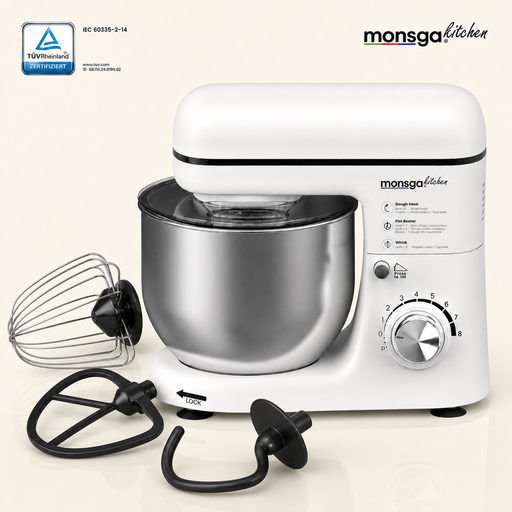
Why this suits the profile: Suitable for households that bake regularly and value multiple speeds, a spacious bowl and easy cleaning.
The specification distinguishes between 1000W peak power and 600W rated power. It also lists 5 litres as the recommended usable volume for a maximum bowl capacity of 6 litres.
8 speeds, stainless steel bowl, splash guard, tilting head and, according to the product description, a noise level below 75 dB.
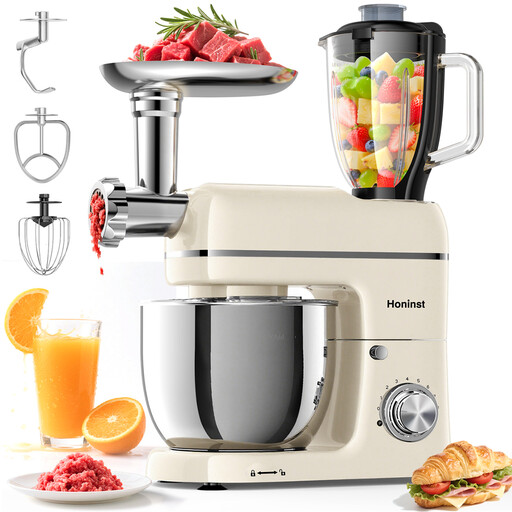
Why this suits the profile: An interesting option for keen home cooks who want to use a blender and meat grinder alongside kneading and mixing, all in one appliance.
The functions are clearly specified: mixing, kneading, whisking, grinding and blending. However, check the maximum quantities beforehand and use only approved accessories.
1300W maximum motor power according to the product description, 6QT stainless steel bowl, 8 speeds plus a pulse setting, and additional blender and meat grinder accessories.
We’ve put together a complete, up-to-date list of products that fully meet these strict selection criteria and the applicable European safety regulations.
Yes, provided the model has a dough hook and its maximum dough capacity is suitable for your recipes. Bread and pizza dough generally place greater demands on the motor than cake batter. Use a low to medium speed and take the recommended operating time into account.
For cakes, whipped cream and small portions, 4 to 5 litres may be sufficient. Families that regularly make bread, pizza or several cakes may want to consider a 6-litre stand mixer. Always check the usable capacity and maximum dough weight, rather than just the figure shown on the packaging.
Consumption depends on the power rating and operating time. An appliance with a higher peak power does not automatically use that power continuously. A short mixing time at low speed may use less energy than kneading at high speed for a long period. The product specification and instructions provide the most useful information for your model.
