
Vandaag of morgen in huis

Kwaliteit gegarandeerd

Welkomstaanbiedingen ontgrendelen: GRATIS bezorging | Tot 80% korting | Gratis 30 dagen JoyPlus-proefperiode
Download de app
A stand mixer can take much of the effort out of making bread dough, cake batter, whipped cream and biscuit dough. But there are big differences between models. A glossy finish, high wattage or large bowl doesn’t automatically mean a mixer is right for the way you bake.
Here are three common pitfalls to watch out for:
For a household that regularly makes bread, cakes or pastries, a stand mixer with a bowl of around 4 to 7 litres is often practical. A smaller bowl takes up less space, but can be awkward for double batches. A larger bowl is especially useful for families and anyone making several loaves at once.
A stand mixer with a stainless steel bowl is easy to wipe clean and can withstand regular use. However, be sure to distinguish between the bowl’s total capacity and its recommended working capacity. For example, the Monsga SM100 has a 6-litre bowl, but lists a recommended capacity of 5 litres. The Bosch MUMS2AW00 is listed with a 3.8-litre bowl, a maximum capacity of 1.7 kg of dough and 2.4 kg of batter.
A stand mixer with multiple speeds gives you more control. Low speeds are suitable for mixing and kneading, while higher settings are generally used for whisking ingredients until light and fluffy. A pulse function can be handy for short bursts of power.
Compare wattages only in the context of the product. The Honinst stand mixer lists a copper motor, 10 speeds and a 6.5 QT bowl. The AUCMA ASM1559 lists a 450 W motor, 6 speeds and a pulse function. That doesn’t automatically make the AUCMA less suitable: the right choice depends on the quantities and recipes you make.
When making heavy bread dough, the recommended operating time matters. Honinst advises not to process heavy yeast dough continuously for more than 10 minutes, followed by a cooling period. AUCMA recommends a maximum of 6 minutes of continuous use. Follow these instructions carefully to prevent overheating.
A mixer with a dough hook, mixer with a whisk and mixer with a beater will cover most baking recipes:
Also check how stable the mixer is. Non-slip feet or suction cups help stop it moving across the worktop. A tilting head makes it easier to change accessories and remove the bowl. Check which parts are dishwasher-safe too. On some models, metal accessories need to be washed by hand to prevent discolouration or oxidation.

Why it suits this type of user: This model has the essentials for home baking: a 5-litre stainless steel bowl, 10 speeds and three commonly used accessories.
The product details list 400 W, a clear bowl capacity and 10 speeds. That means you can look beyond marketing claims about motor power alone.
5L stainless steel bowl, 10 speeds, pulse function, dough hook, whisk, beater and non-slip suction cups.

Why it suits this type of user: The built-in scales, automatic speed control and 7-litre bowl make this a good fit for people who bake regularly and want precise results.
The specifications highlight features you can use straight away: weighing ingredients in the bowl and automatic speed control. So you’re not paying only for extra accessories.
1200 W, 7L stainless steel bowl, built-in scales, LightLift head and a minimum 2-year statutory guarantee, according to the product information.
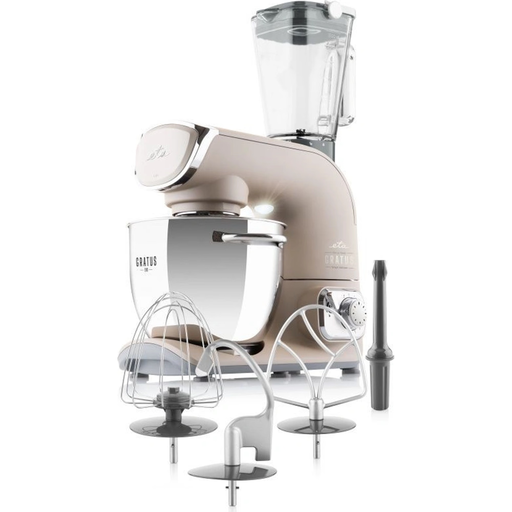
Why it suits this type of user: This model is designed for versatile use, with a blender jug, pulse function and a stated maximum dough capacity of 2.5 kg.
The product details give both the 5.5-litre bowl capacity and the maximum dough capacity. This helps you distinguish portion size from working capacity.
1500 W, metal body and gears, planetary mixing, 5.5L stainless steel bowl, 2.5 kg maximum dough capacity and 1.5L glass blender jug.
We’ve put together a complete, up-to-date list of products that meet these strict selection criteria and the applicable European safety requirements.
Yes, as long as the model has a dough hook and you stick to the maximum quantity and recommended operating time. Start on a low speed when working with heavy dough. Stop if the motor noticeably slows down or gets warm, and follow the cooling instructions in the manual.
For regular family baking, 5 to 7 litres is often practical. If you mainly make small batches of cake or whipped cream, around 4 litres should be enough. Always check the maximum dough capacity; it matters more than the bowl’s total capacity.
It varies by model, speed and ingredients. According to their own product information, AUCMA lists a maximum noise level of 75 dB, while Honinst lists less than 60 dB. These figures are only directly comparable when measured under the same conditions. Place the mixer on a flat, sturdy worktop and use the right speed to reduce vibration.
