
Vandaag of morgen in huis

Kwaliteit gegarandeerd

Welkomstaanbiedingen ontgrendelen: GRATIS bezorging | Tot 80% korting | Gratis 30 dagen JoyPlus-proefperiode
Download de app
A stand mixer can mix batter, whip cream and knead bread dough. But not every stand mixer is suited to the same recipes. A high wattage on the packaging, for example, doesn’t automatically tell you how much dough a machine can handle, how stable it is or how long it will last. A large mixing bowl may also be less useful in practice if the attachments don’t reach the bottom properly.
For home bakers, keen cooks and families, there are three main pitfalls to watch out for:
A stand mixer with a mixing bowl of 4 to 5 litres is often suitable for everyday tasks such as cake batter, whipped cream and smaller quantities of dough. For families or making several loaves in a row, a 5.5 to 7-litre bowl may be more practical.
As well as the bowl capacity, check:
Stainless steel, such as SUS304 or 304 stainless steel as stated in the product information, is easy to clean and doesn’t absorb odours. However, bowl capacity says nothing about the quality of the motor or attachments.
A stand mixer with multiple speeds gives you more control over different preparations. A low setting is suitable for mixing flour and liquid or gradually bringing dough together. Higher settings are designed for whisking and aerating.
Compare the stated power carefully:
These figures aren’t directly comparable, as manufacturers may present peak and rated power differently. Check the instruction manual too. The AUCMA ASM1559, for example, states that the machine shouldn’t be used continuously for more than six minutes without a break.
With a planetary mixing action, the attachment rotates on its own axis while also moving around the inside of the bowl. This can help mix ingredients more evenly, but the results also depend on the shape of the bowl and the distance between the attachment and the base.
Three attachments are usually useful for baking:
Non-slip feet or suction cups help prevent the mixer from moving on the worktop. They won’t eliminate vibration altogether. Always place the mixer on a level, dry and sturdy surface.

Why it suits this profile: The 5-litre bowl, ten speeds and three essential attachments make this a straightforward choice for cakes, bread, cream and pizza, without extra features you may not use.
The product information lists 400W, ten speeds, a pulse function, overheat protection and four suction cups. Be sure to check the maximum dough quantity in the instruction manual.
5L stainless steel bowl, dough hook, whisk, beater and pulse function.
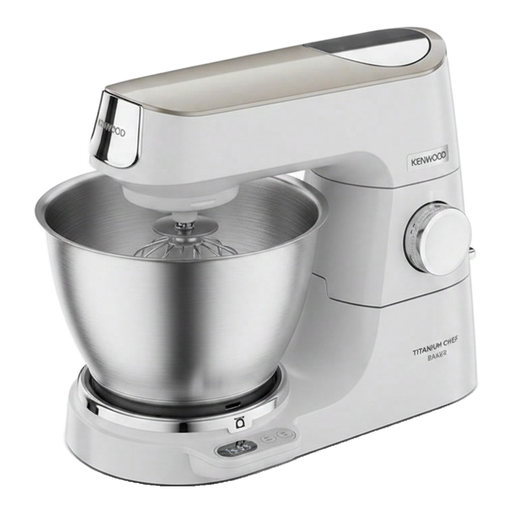
Why it suits this profile: If you bake often and want to weigh ingredients directly into the bowl, this model offers a built-in scale, a metal body and a 5-litre stainless steel bowl.
The product description clearly sets out its features: a built-in scale, digitally controlled motor, LightLift head and variable speed with pulse.
Stated power of 1200W, built-in scale, dough hook, whisk and K-beater.
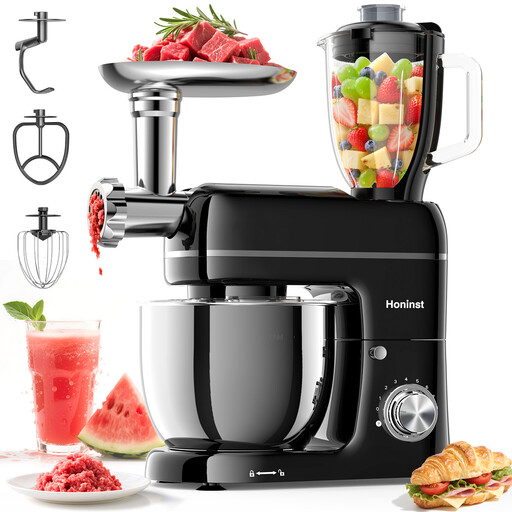
Why it suits this profile: This food processor and mixer is designed for households that want to blend and mince as well as knead and whisk.
The product information lists a safety lock, automatic shut-off when the head is raised, and eight speeds with pulse. Use only the approved attachments.
Maximum stated motor power of 1300W, 6QT bowl, blender and meat grinder alongside the mixer functions.

Why it suits this profile: Its compact dimensions of 33.5 × 18 × 30 cm make it easier to fit on a kitchen worktop. The 4-litre bowl is designed for smaller batches.
The stated maximum dough capacity is 1.4 kg, making it easier to decide in advance whether the machine is right for your recipes.
800W, six speeds plus pulse, 4L stainless steel bowl and three baking attachments.
We’ve put together a complete, up-to-date list of products that meet these strict selection criteria and the applicable European safety regulations.
Yes, if the model has a dough hook and the quantity of dough stays within the stated limit. Bread dough puts more strain on the motor than cake batter. Start at a low speed and follow the maximum running time in the instruction manual.
A 4-litre bowl may be enough for one-person households and smaller batches. A 5 to 6-litre bowl gives you more room for family-sized portions and dough. Always check the usable capacity, not just the total number of litres.
Consumption depends on the stated power and how long you use the machine. A 1000W machine running for one hour would theoretically use a maximum of 1 kWh, but in practice a stand mixer usually runs for less time and not continuously at full power. The actual cost depends on your electricity tariff and usage.
