
Vandaag of morgen in huis

Kwaliteit gegarandeerd

Welkomstaanbiedingen ontgrendelen: GRATIS bezorging | Tot 80% korting | Gratis 30 dagen JoyPlus-proefperiode
Download de app
Buying a stand mixer seems straightforward until you start comparing the specifications. One mixer boasts a high wattage, while another highlights a large bowl or a wide range of speeds. But those figures don’t tell you everything about how it will perform day to day. Your stand mixer should suit your recipes, kitchen space and cleaning routine.
For home bakers, keen cooks and families, some questions matter more than others: can it knead bread dough, will it stay steady on the worktop, and is the bowl large enough for the portions you make? Read on to find out what to look for and which models suit different needs.
A high quoted wattage sounds appealing, but it doesn’t automatically tell you how well an electric mixer will handle heavy dough. Check the motor type, maximum dough capacity and recommended running time too. Some product descriptions list a peak power alongside a lower rated power. The Monsga SM100, for example, is listed as having 1000 watts peak power and 600 watts rated power.
For yeasted dough, use a low to medium speed and follow the instruction manual. A motor can overheat if you process too much dough for too long.
A 6-litre bowl doesn’t mean you can safely mix 6 litres of ingredients every time. The bowl’s shape, the attachment and the type of dough all affect how much you can actually process. According to its product information, the Monsga has a 6-litre bowl with a recommended usable capacity of 5 litres.
As well as the total capacity, look for a stated maximum dough or batter quantity. This is more useful when you’re looking for a stand mixer for bread and cakes.
A stand mixer with a dough hook, whisk and beater covers the basics. A splash guard also helps stop flour and batter from flying around. Extra attachments, such as a blender or mincer, can be useful, but check whether you really need them and whether they’re included. Some models offer optional extras.
Pay attention to cleaning, too. The product information may say that the attachments are dishwasher-safe, while the motor unit should only be cleaned with a damp cloth.
A stainless-steel bowl is sturdy, doesn’t retain odours and is suitable for regular baking. A plastic bowl may be lighter and can be practical for a compact stand mixer. If you’re choosing a stand mixer with a stainless-steel bowl, check that it has a handle, locks securely into place and is easy to remove.
For a household that mainly makes cake batter, whipped cream and smaller quantities, a bowl of around 4 litres may be enough. For bread dough or family-sized portions, a 5 to 6.7-litre bowl is more practical.
A range of speeds gives you more control when mixing gently, whisking and kneading. A pulse function is useful for short bursts of power, but it doesn’t replace a good low speed for yeasted dough. Planetary mixing moves the attachment around the sides of the bowl and can help combine ingredients more evenly. The Bosch MUMS2AW00, for example, features 3D planetary mixing technology.
A heavy metal body can help keep a mixer stable, but always check its dimensions and weight. A large stand mixer won’t be practical if it has to live permanently on a small worktop. Non-slip feet or suction cups are useful when you’re working at higher speeds.
Noise levels are only comparable when measured under the same conditions. The Monsga product information gives a maximum of around 75 dB, while Honinst quotes a figure of less than 60 dB. Treat these as product specifications, not a guarantee of quiet performance in every kitchen.
The models below have been selected based on their listed specifications, including bowl capacity, attachments, speeds, dimensions and functions. Before buying, check the current product page, included parts and maximum quantities.

Why it suits this user: This model is designed for everyday tasks such as cake batter, whipped cream and lighter dough. Its 3.8-litre bowl takes up less space than those of larger models.
The product information gives more than just the motor’s 700-watt power: it also states a capacity of 1.7 kg of dough and 2.4 kg of batter. This makes the recommended limits clearer.
3D planetary mixing technology, whisk, beater and dough hook; according to the product information, the attachments are dishwasher-safe.

Why it suits this user: With a 7-litre bowl, 1200 watts and built-in scales, this model is well suited to frequent bakers who prepare a variety of recipes.
Rather than focusing only on high power, the product description lists practical features including kneading, mixing, automatic speed control and integrated scales.
7-litre capacity, 1200 watts and integrated scales; the stated EU legal guarantee is at least two years.

Why it suits this user: The 6.7-litre stainless-steel bowl and three included attachments are handy for larger quantities of batter, cream and dough.
The product information specifies the capacity, dimensions and materials, so you can check the space required and bowl size before buying.
K-beater, whisk and dough hook included; Kenwood lists a wide range of optional attachments for adding extra functions.
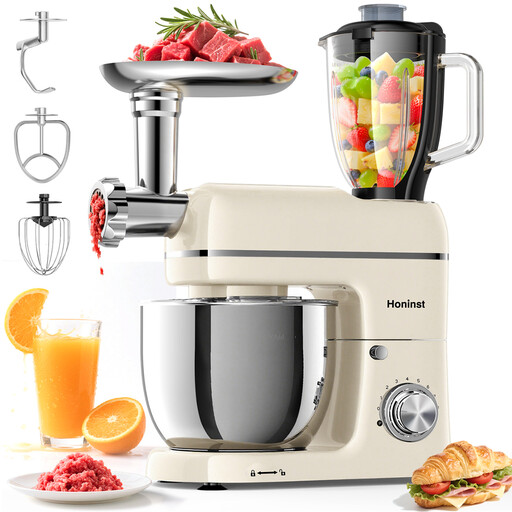
Why it suits this user: As well as mixing, whisking and kneading, the product description lists a mincer and blender attachment for sauces, smoothies and minced meat.
The multifunctional design makes it clear which extra features you get. Just check that you have enough storage space for the separate attachments.
6-quart stainless-steel bowl, eight speeds and a pulse function; the product information lists a motor with up to 1300 watts and a safety switch that activates when the head is lifted.
We’ve put together a full, up-to-date list of products that meet these strict selection criteria and current European safety requirements.
For one-person households or occasional baking, a bowl of around 3.8 to 5 litres may be enough. Families and bread bakers often benefit from a larger 5 to 6.7-litre bowl. Don’t just check the capacity: look at the maximum quantity of dough and batter stated by the manufacturer too.
Yes, provided the model has a dough hook and the instruction manual says it can knead yeasted dough. Start on a low speed, don’t exceed the maximum quantity and take breaks if the manual recommends them. A higher wattage alone doesn’t guarantee that every mixer can handle heavy doughs without limits.
Energy use depends on the power and how long you use the mixer for. A 700-watt mixer running for a short time may use less energy than a lower-powered model that needs to run for longer. Switch the mixer off when you’re finished, use the right speed and avoid overloading it. This is practical both for energy use and for the motor’s lifespan.
