
Vandaag of morgen in huis

Kwaliteit gegarandeerd

Welkomstaanbiedingen ontgrendelen: GRATIS bezorging | Tot 80% korting | Gratis 30 dagen JoyPlus-proefperiode
Download de app
A stand mixer can take a lot of the work out of making bread, pizza, cakes, biscuits and whipped cream. However, not every stand mixer is suited to the same tasks. A high wattage on the box, for example, doesn’t automatically mean a machine can handle heavy dough for long periods. A large bowl may also be less useful if the machine struggles to mix small quantities.
For UK households, three things matter most: capacity, stability and the right attachments. Below, we explain what to look for and which models suit different needs.
Some brands quote peak power, while the rated or assigned power is lower. The Monsga SM100, for example, is advertised with 1000 W peak power and 600 W rated power. So don’t compare wattages alone. Also check:
When choosing a stand mixer for kneading, the combination of motor, transmission and maximum dough capacity matters more than a single power figure.
A 6-litre bowl doesn’t mean you can fill it completely with dough. According to the product information, the Monsga SM100 has a 6-litre bowl but a recommended usable capacity of 5 litres. You’ll also need to leave room for bread dough to rise and move around.
When choosing a stand mixer with a bowl, check:
A quoted noise level is only useful for comparison if it’s clear how and at what distance it was measured. Product information for various models, for example, gives levels of around 60 to 75 dB, but the measurement methods may differ. In practice, an electric mixer with a stable base may feel more pleasant to use, even if its quoted decibel level isn’t the lowest.
A stand mixer with multiple speeds gives you more control over different recipes:
A planetary mixing action moves the attachment around the bowl while it also rotates on its own axis. This can help incorporate ingredients more evenly. Even so, it’s important not to overfill the bowl and to scrape down the sides with a spatula when needed.
A stand mixer with a stainless steel bowl is generally practical for regular use and easy to clean. Check whether the bowl alone is dishwasher-safe or whether the attachments are too. Aluminium, plastic and coated parts may need different care.
A non-slip foot, suction cups or a heavy base can help keep the mixer stable. This is especially important when using a dough mixer for firm bread or pizza dough. A tilting head makes it easier to switch between the whisk, beater and dough hook.
For most home bakers, a basic set is enough:
Extra attachments for chopping, grating or blending are only worth having if you’ll use them. Also check whether additional attachments are specific to your model and need to be bought separately.

Why it suits this type of user: With a recommended usable capacity of 5.0 litres, eight speeds and three basic attachments, this mixer is a good fit for home bakers who want to try different recipes without investing in a large system straight away.
The product information gives both peak and rated power, as well as the recommended usable capacity alongside the total bowl capacity. This makes it easier to compare the specifications clearly.
5.0 litres recommended bowl capacity, eight speeds, whisk, beater and dough hook; the product description also mentions a splash guard and non-slip feet.

Why it suits this type of user: This model is designed for people who bake often and value a larger bowl, a metal finish and built-in weighing functionality.
The specifications list 1200 W, a 7-litre stainless steel bowl and an integrated scale. This makes key features easy to check, rather than leaving them as vague marketing claims.
1200 W, 7-litre capacity, built-in scales and automatic speed control, according to the product information.
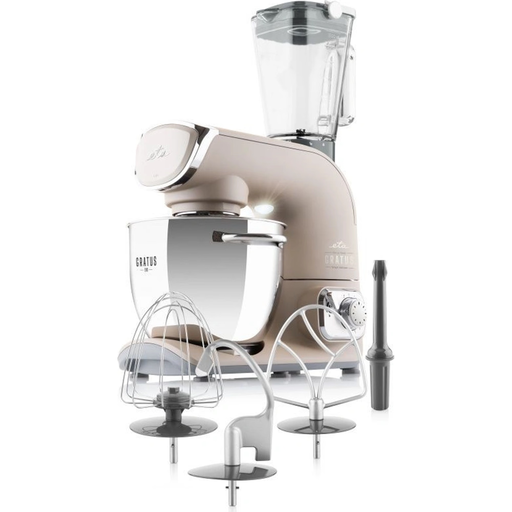
Why it suits this type of user: With a metal housing, 5.5-litre stainless steel bowl, planetary mixing action and a stated maximum dough capacity of 2.5 kg, this model is well suited to larger baking sessions.
The specifications list more than just the motor power: they also give the maximum dough quantity, thermal protection, a safety lock and a non-slip base.
1500 W stated power, 5.5-litre stainless steel bowl, 2.5 kg maximum dough capacity and continuous speed control with pulse function.
We’ve put together a complete, up-to-date list of products that meet these strict selection criteria and the applicable European safety regulations.
Place the mixer on a flat, dry and stable worktop. When kneading, start at a low speed and follow the maximum quantities given in the manual. Switch off the appliance and unplug it before changing attachments or cleaning.
Wipe the motor housing with a slightly damp cloth and never immerse it in water. Check whether the bowl, whisk, beater and dough hook are dishwasher-safe for your particular model. If in doubt, hand-washing is best, especially for coated or aluminium parts.
Yes, provided the model has a suitable dough hook and a stated dough capacity. Use a low to medium speed and don’t exceed the maximum quantity. Heavy dough can put more strain on the motor than cake batter.
For regular home use, around 4 to 6 litres is often practical. Families and bakers making larger batches may want to consider a 5.5- or 7-litre bowl. Always check the usable capacity: the total bowl capacity isn’t necessarily the maximum amount of dough you can mix.
Consumption depends on the power rating and how long you use the mixer. A 1000 W machine running for ten minutes theoretically uses around 0.17 kWh, before allowing for any difference between peak and actual power. Shorter mixing times and choosing the right setting can help keep consumption down.
