
Vandaag of morgen in huis

Kwaliteit gegarandeerd

Welkomstaanbiedingen ontgrendelen: GRATIS bezorging | Tot 80% korting | Gratis 30 dagen JoyPlus-proefperiode
Download de app
A stand mixer with a bowl can take a lot of the work out of making bread, cakes, pizza and biscuits. But there’s a big difference between a handy kitchen mixer and one that ends up unused in the cupboard after a few months. A high wattage or a large bowl doesn’t tell the whole story.
Look out for these three common pitfalls:
For a family or anyone who bakes regularly, a 4 to 6.5-litre mixing bowl is often a practical choice. A stand mixer with a stainless-steel bowl is sturdy, makes it easy to keep an eye on the mix and is generally suitable for everyday use.
Don’t just look at the bowl’s capacity in litres. Check:
A 6-litre bowl is handy for larger batches, but not if there’s little room beneath the mixer head or the machine struggles to mix smaller quantities.
A stand mixer with multiple speeds gives you more control over different recipes. Use a low speed to mix flour and liquid, a low to medium setting for dough, and higher speeds when using a whisk or beater.
The wattage alone doesn’t tell you how much power the machine delivers while kneading. For example, the Kenwood Titanium Chef Baker XL is listed at 1200 W, while the Bosch MUMS2AW00 is described as 700 W in its product details. So compare the whole package: motor power, transmission, maximum dough quantity and recommended operating time.
A stand mixer for bread dough should also have overload and overheating protection. This won’t prevent every problem, but it does give you a useful indication of the machine’s intended use.
A good mixer for baking usually comes with three essential accessories:
Also check whether the feet provide good grip, whether the head tilts easily and whether a splash guard is included. A suction-cup or non-slip base is particularly useful when working with heavy dough.
For care and cleaning, follow the instructions in the manual. Not every metal accessory is dishwasher-safe. The main unit must not be immersed in water. Unplug the appliance before changing accessories or cleaning it.

Why it suits this type of user: This stand mixer comes with a 5-litre stainless-steel bowl, ten speeds and three essential accessories for cakes, biscuits, bread and pizza.
The product specifications list overheating and overload protection, as well as four suction cups for stability. Before buying, check the recommended dough quantity in the manual.
5-litre stainless-steel bowl, 10 speeds plus pulse setting, dough hook, whisk and beater.

Why it suits this type of user: This machine is designed for frequent bakers who want extra convenience when weighing ingredients, mixing and preparing larger batches.
The built-in scales mean you need fewer separate kitchen gadgets. The product specifications list automatic speed control; check the manual to confirm the features you want.
1200 W, 7-litre bowl, stainless-steel body and built-in scales.
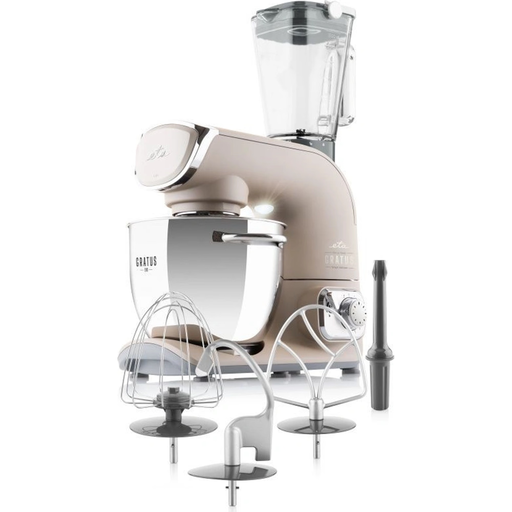
Why it suits this type of user: With its metal body, 1500 W motor, planetary mixing action and additional blender jug, this model is a good fit for users who make more than just cake batter.
The stated maximum dough capacity is 2.5 kg. This gives you a clearer idea of capacity than the 5.5-litre bowl size alone; always adjust quantities to suit the recipe and follow the manual.
1500 W, 5.5-litre stainless-steel bowl, planetary mixing action and 1.5-litre glass blender jug.
We’ve put together a complete, up-to-date list of products that meet these strict selection criteria and the applicable European safety regulations.
For making bread or pizza dough regularly, a bowl of around 5 litres or more is practical. Pay particular attention to the maximum dough capacity, as this can be considerably lower than the bowl’s total volume. For example, a compact machine such as the Kenwood Go has a 4-litre bowl and a stated maximum dough capacity of 1.4 kg.
Noise levels vary depending on the speed, accessory and type of dough. Some product specifications give a figure in decibels, while others don’t. The AUCMA 5L is rated at up to 75 dB, while the Honinst 6.5QT is rated below 60 dB. These figures are only directly comparable if they were measured under the same conditions.
Lifespan depends on how often you use the mixer, how well you maintain it and how hard you work it. When kneading heavy dough, don’t run the motor for longer than the manual recommends, and give the machine breaks. Before buying, also check the warranty terms, accessory availability and instructions for cleaning the bowl and attachments.
