
Vandaag of morgen in huis

Kwaliteit gegarandeerd

Welkomstaanbiedingen ontgrendelen: GRATIS bezorging | Tot 80% korting | Gratis 30 dagen JoyPlus-proefperiode
Download de app
A stand mixer can take a lot of the hard work out of making bread, pizza, cakes, biscuits and pastries. However, not every stand mixer is suitable for every recipe. A large bowl doesn’t automatically mean you can knead large quantities of heavy dough. And a high wattage rating alone tells you little about the motor, drive system or maximum running time.
Joybuy’s Product Recommendation Officer highlights the key things to consider. This will help you compare a stand mixer, electric mixer or mixer with a bowl based on verifiable features, rather than relying on marketing claims alone.
A 6-litre bowl or larger may seem spacious, but the maximum amount of dough it can handle may be considerably lower. For heavy bread dough, the type of flour, hydration and design of the dough hook all matter. So always check the stated maximum dough capacity, not just the bowl’s volume in litres.
A 5-litre stand mixer is often enough for smaller households. For families or making several loaves, a 6-litre stand mixer or larger may be more practical, as long as the manual confirms it can handle that quantity.
Power ratings aren’t always given in the same way. Some product pages list peak power, while others give rated power. So a 1,000-watt machine isn’t automatically more powerful in everyday use than a 700-watt model.
Also look for overheating protection, the drive system, speed control and recommended breaks. For heavy dough, manufacturers often recommend short periods of use followed by a cooling break. For example, Honinst advises that heavy yeast dough should be processed for no more than 10 minutes at a time, followed by at least 15 minutes to cool down.
Noise levels are useful for comparison, but the measuring distance and conditions can make a difference. Aucma, for example, lists a noise level of 68 to 72 dB at a distance of one metre. Monsga states less than 75 dB. Honinst lists less than 60 dB in its own product description. Treat these as manufacturer specifications, not as a guarantee of the same experience in every kitchen.
Look for three separate details:
A spacious stainless steel bowl is handy for batters, whipped cream and larger quantities. For bread dough, the machine’s construction is just as important. Non-slip feet, a locking head and a sturdy base help keep it stable on the worktop.
A versatile stand mixer for baking usually needs three accessories:
Check whether these are included as standard. A machine may be compatible with additional accessories, but they aren’t always included. Kenwood lists extra optional accessories for various models, so check which parts are actually included with each product.
A stand mixer with multiple speeds gives you more control, from gentle mixing to more vigorous whisking. A pulse function is useful for short bursts of power. A planetary mixer moves the attachment around the bowl, helping to incorporate ingredients more evenly, according to the product description.
More speeds aren’t automatically necessary. For everyday cake batter and whipped cream, six settings are often useful. If you make different kinds of dough, eight, ten or more settings may be beneficial, as long as the lowest speed still provides enough power.

Why it suits this user: The 5-litre bowl and ten speeds make this a good choice for beginner home bakers who want to make cakes, biscuits, bread and pizza without choosing a larger model straight away.
As well as the bowl capacity, the product description lists 400 watts, ten speeds, a pulse function and overheating protection. That gives you more to go on than a wattage claim alone.
5-litre stainless steel bowl, dough hook, whisk, flat beater and non-slip suction cups, according to the product information.

Why it suits this user: This model is designed for bakers who value a large bowl, an integrated scale and automatic speed control.
The specifications list 1,200 watts, a 7-litre bowl, a built-in scale and automatic speed control. Be sure to check you have enough room, though: the stated dimensions are 37 × 22,5 × 40 cm.
Stainless steel body, 1,200 watts, 7-litre bowl and built-in scale, according to the product details.

Why it suits this user: This dough mixer is designed for people who mainly make bread dough and want to use an automatic kneading and resting programme.
The stated maximum dough capacity is 2,5 kg. This gives you a clear point of reference, rather than just a large bowl capacity.
5-litre family capacity, touchscreen controls, automatic kneading function and a stated dough limit of 2,5 kg.
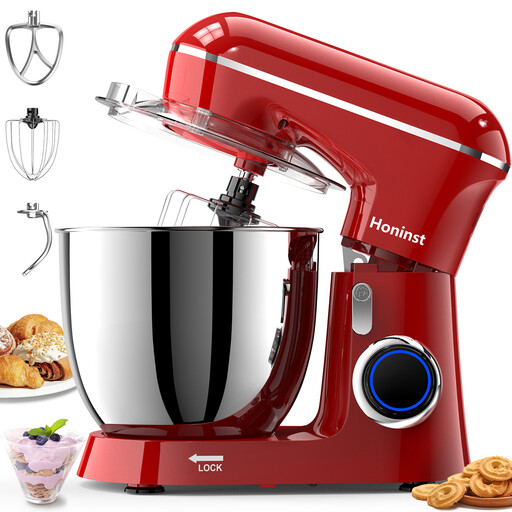
Why it suits this user: The combination of a large stainless steel bowl, ten speeds and three accessories makes this a good fit for families who regularly make a variety of recipes.
As well as the capacity, Honinst lists ten speeds, overheating protection, a splash guard and non-slip feet. Its own product description gives a noise level of less than 60 dB.
6.5-QT stainless steel bowl, dough hook, whisk, flat beater and tilt-head design, according to the product specifications.
We’ve put together a complete, up-to-date list of products that meet these strict selection criteria and the applicable European safety regulations.
Read the manual before use and don’t exceed the stated quantities. Place the machine on a flat, dry surface and make sure the bowl and accessories are securely locked in place. Start on a low speed when working with heavy dough. Keep your hands, hair and kitchen utensils away from moving parts.
Switch off the machine and unplug it before changing a whisk, flat beater or stand mixer dough hook. Never immerse the motor unit in water. Also check whether the accessories are dishwasher-safe; metal or coated parts may need to be washed by hand.
Choose a model with a dough hook, sturdy base, low-speed setting and clearly stated maximum dough capacity. If you regularly make bread or pizza dough, a dedicated bread dough mixer or dough mixer is a practical choice. Always follow the maximum running time in the manual.
For everyday use by one or two people, 4 to 5 litres may be enough. Families and bakers making larger batches may want to consider a 6- or 7-litre model. As well as the bowl capacity, check the maximum amount of dough and batter it can handle.
Energy use depends on the power rating, how long you use the mixer and the speed you select. A higher wattage doesn’t automatically mean higher energy use for every recipe. Mixing briefly at the right setting can be more efficient than running the mixer for a long time at too low or too high a speed.
