
Vandaag of morgen in huis

Kwaliteit gegarandeerd

Welkomstaanbiedingen ontgrendelen: GRATIS bezorging | Tot 80% korting | Gratis 30 dagen JoyPlus-proefperiode
Download de app
A stand mixer can make preparing bread dough, cake batter and whipped cream much easier. However, it can be tricky to compare models fairly. A high wattage, for example, doesn’t tell you everything about performance, while a large bowl doesn’t automatically mean you can process large quantities of dough.
For home bakers, keen cooks and families, there are three main pitfalls to watch out for:
A stand mixer should start gently and give you plenty of control while mixing. For cake batter, you’ll usually use a low to medium speed. Bread dough often calls for a low speed and a suitable dough hook. Whipping cream and egg whites, on the other hand, requires a higher setting.
So don’t just look at the stated power. Check:
Some models list both peak power and rated power in their product information. The Monsga SM100, for example, is listed as having 1000 watts of peak power and 600 watts of rated power. That gives you a clearer picture than a large wattage figure on the packaging alone.
A stand mixer with a stainless steel bowl is practical for everyday use, as stainless steel is sturdy and relatively easy to clean. Do bear in mind the difference between total capacity and usable capacity. The Monsga SM100 has a 6-litre bowl, but the recommended capacity is 5 litres.
A 4 to 5-litre bowl may be enough for a smaller household. Families and anyone who regularly makes bread, pizza or several cakes may find a 5.5 to 7-litre bowl more useful. Check the dimensions too. A stand mixer with a large bowl can take up a lot of space in a kitchen.
A versatile stand mixer with accessories usually comes with:
A stand mixer with planetary mixing action moves the attachment around the bowl while also rotating it on its own axis. This can help incorporate ingredients more evenly, but the results also depend on the shape of the bowl, the quantity of ingredients and the speed you select.
If you’re looking for a food processor with a mixing bowl, check the product description carefully too. A stand mixer is mainly designed for mixing, whisking and kneading. A food processor can also slice, chop or grate, but these functions aren’t standard on every stand mixer.
A stand mixer for baking doesn’t automatically need to be large or heavy. If you only make cakes and biscuits occasionally, a compact model with three basic attachments may be the more sensible choice. If you regularly make bread dough, focus on a sturdy build, a suitable dough hook and a clearly stated maximum dough capacity.
Also consider these practical details:

Why it suits this user: This model offers the essentials for cakes, biscuits, cream and standard bread dough without being an oversized appliance. Its 5-litre bowl is well suited to everyday home use.
The product information lists 400 watts, 10 speeds, a pulse function and a recommended 5-litre stainless steel bowl. This makes the key details easier to assess than a peak power figure alone.
5-litre stainless steel bowl, 10 speeds, dough hook, whisk, beater and splash guard.

Why it suits this user: A spacious stand mixer with a 7-litre capacity, 1200 watts and built-in scales. It’s designed for people who bake often and want to weigh ingredients straight into the bowl.
The stated specifications include the power, bowl capacity and built-in scales. Do check that you have enough room, though: this is a large, heavy appliance.
7-litre stainless steel bowl, 1200 watts, built-in scales and automatic speed control.
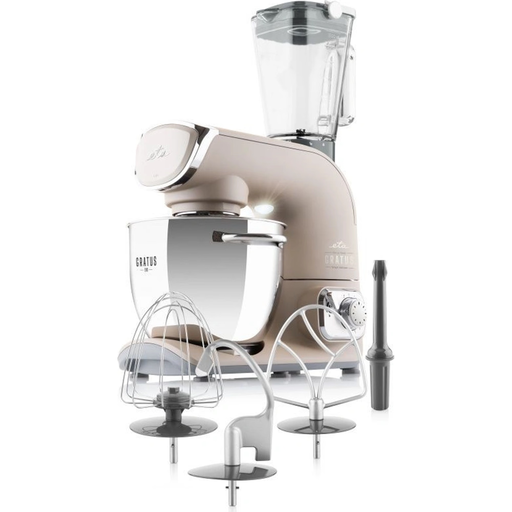
Why it suits this user: According to the product information, this model combines planetary mixing action with a metal housing, a 5.5-litre bowl and a stated maximum dough capacity of 2.5 kilograms.
The listing gives more than just the 1500-watt figure. It also states the maximum dough capacity and lists a safety lock, thermal fuse and non-slip base. Before buying, check which accessories are actually included.
1500 watts, planetary mixing action, 5.5-litre stainless steel bowl and a stated dough capacity of 2.5 kilograms.
We’ve put together a complete, up-to-date list of products that meet these strict selection criteria and the applicable European safety regulations.
Yes, provided the model has a dough hook and the instructions say it can knead yeasted dough. Start at a low speed and don’t exceed the maximum dough capacity. A motor can heat up more quickly with heavy dough than with a light cake batter.
For one-person households and smaller batches, 4 to 5 litres is often a practical choice. For families or making several loaves at once, 5.5 to 7 litres may be more convenient. Always check the recommended filling level, not just the total capacity.
Energy use depends on the motor’s power, the speed you select and how long you use the mixer. A 1000-watt appliance doesn’t automatically use 1000 watts for a whole hour: when mixing for a short time, the total time in use is what matters. Switch the mixer off when your recipe is ready, and don’t use a higher speed than necessary.
