
Vandaag of morgen in huis

Kwaliteit gegarandeerd

Welkomstaanbiedingen ontgrendelen: GRATIS bezorging | Tot 80% korting | Gratis 30 dagen JoyPlus-proefperiode
Download de app
A stand mixer can knead bread dough, mix cake batter and whip cream without you having to hold the bowl the whole time. But an expensive or powerful-looking model isn’t automatically right for your recipes. A stand mixer for the occasional cake is very different from a dough mixer for making several loaves a week.
So don’t focus solely on the wattage or the number of attachments. These are some common pitfalls to watch out for when choosing a stand mixer:
For cake batter, egg whites and whipped cream, good speed control is particularly important. For bread, pizza and pasta dough, torque, drive system and recommended maximum dough capacity matter more than the highest wattage alone.
A stand mixer with several speeds gives you more control: low for flour and liquid, medium for batter and high for whipping. A pulse function is useful for short bursts of power, but it doesn’t replace a continuous kneading setting.
Look out for the difference between:
For example, the product description for the Monsga SM100 lists 1,000 watts of peak power and 600 watts of rated power. This distinction makes the specification clearer.
A stainless steel mixing bowl is suitable for everyday mixing and is generally easy to clean. Look beyond the capacity shown on the packaging. A 5-litre bowl won’t necessarily have room for 5 litres of dough or batter in every situation. Follow the maximum quantities in the manual to help prevent overloading and spills.
For a household that regularly makes bread or cakes, a handle, splash guard and tilt-head are practical features. A mixer with a bowl also needs enough clearance under your kitchen cupboards when the head is raised.
A stand mixer with a dough hook usually comes with:
Also check whether the attachments are dishwasher-safe and whether replacement parts are available. A tilt-head makes it easier to change the bowl and attachments. A locking mechanism, overheat protection and automatic shut-off when the head is lifted are safety features you can check for.
Use only approved attachments, unplug the mixer before changing them and never immerse the motor housing in water. CE marking is relevant to the European market, but it doesn’t prove that an appliance can handle every heavy-duty task without limits.

Why it suits this profile: This stand mixer is designed for everyday batters, bread, pizza and cakes, with a straightforward set of essential attachments.
The product description lists 10 speeds, a pulse function, a 5L stainless steel bowl, non-slip suction cups and overheat protection.
400W motor, dough hook, whisk, beater and splash guard; according to the product information, the noise level is a maximum of 75 dB.

Why it suits this profile: A good fit for households that value a generous mixing bowl and an expandable system for regular cooking and baking.
The 6.7L bowl offers more space than compact models, while the included dough hook, whisk and K-beater cover the essentials.
Automatic speed control, metal housing and, according to the product information, more than 20 optional attachments.
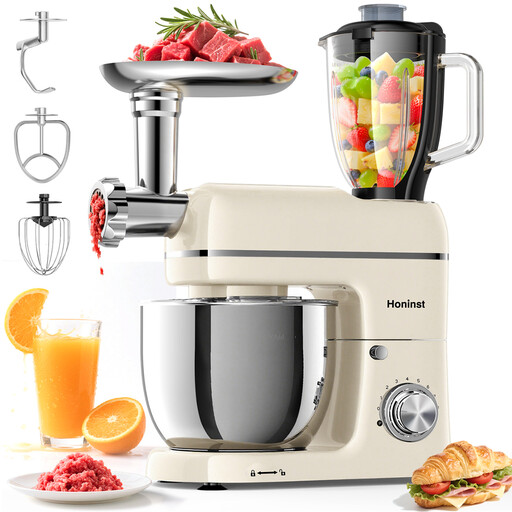
Why it suits this profile: An option for anyone who wants to make smoothies or mince meat as well as knead and mix, using one main appliance.
The product description lists a 6QT bowl, tilt-head, safety switch and tool-free fitting for the blender and meat grinder attachments.
According to the product information: up to 1,300W, 8 speeds plus pulse, and functions for mixing, kneading, blending and grinding.

Why it suits this profile: The combination of a generous bowl, dough hook and several speeds suits families who regularly make bread, cakes and biscuits.
According to the product description, the recommended bowl capacity is 5.0L, with a maximum capacity of 6.0L. This gives you a more realistic idea of how full to fill it.
5L stainless steel mixing bowl, 8 speeds, splash guard and, according to the product information, four silicone suction feet.
We’ve put together a full, up-to-date list of products that meet these strict selection criteria and current European safety requirements.
A bowl of around 4 to 5 litres may be enough for a one-person household or occasional baking. Families and bread makers often choose a bowl of 5 to 6.7 litres. Always check the recommended working capacity, particularly for dough. The bowl’s stated capacity isn’t the same as the amount you can safely process.
There’s no one wattage that’s right for every type of bread dough. Compare the rated power, maximum dough capacity and rest period specified in the manual. A high peak power alone doesn’t guarantee that the mixer can knead for a long time. Use a low to medium speed for heavy dough and don’t exceed the recommended quantity.
Energy use depends on the power rating and how long the mixer is running. A 400-watt appliance running for ten minutes uses less energy than a 1,000-watt model running for a long time. For normal home use, the total running time is usually limited. Switch the mixer off when the recipe is ready and follow the recommended breaks to avoid unnecessary strain.
