
Vandaag of morgen in huis

Kwaliteit gegarandeerd

Welkomstaanbiedingen ontgrendelen: GRATIS bezorging | Tot 80% korting | Gratis 30 dagen JoyPlus-proefperiode
Download de app
A stand mixer can take much of the work out of making cake batter, whipped cream, biscuit dough, bread dough and pizza dough. But the differences between models are greater than product photos might suggest. A large bowl doesn’t automatically mean you can knead large quantities of dough. And a high wattage doesn’t always tell you enough about how well a mixer performs under heavy use.
In this buying guide, you’ll find out what to look for, which marketing claims to treat with a little caution, and what type of stand mixer suits the way you cook and bake.
A motor rated at 1,000 or 1,200 watts sounds impressive, but manufacturers don’t always use the same measurement method. Some give the peak power, while others state the rated power. So also compare the maximum dough capacity, recommended running time and whether the mixer has overheating protection.
A stand mixer for bread dough and cake batter also needs different features from one that’s mainly used to whisk cream and egg whites.
A 6-litre bowl might seem spacious, but you can’t always fill it to the brim. For example, Monsga lists a maximum capacity of 6 litres, with a recommended usable capacity of 5 litres. Bosch’s bowl holds 3.8 litres, with a stated capacity of up to 1.7 kg of dough or 2.4 kg of batter.
So check the difference between total bowl capacity and the maximum quantity of ingredients. This helps prevent overloading, spills and uneven mixing.
A manufacturer might quote a low noise level, but always check whether it was measured under load and at what distance. According to its product description, Honinst states a noise level below 60 dB. Monsga quotes less than 75 dB, while Aucma gives a figure of 68 to 72 dB at a distance of one metre. These figures aren’t directly comparable.
Several speed settings are useful for light batters and whipped cream. For yeast dough, you mainly need enough torque at a low speed. An electric mixer with 6 to 10 settings will generally give you more control than a model with just a few. A pulse function is handy for short bursts of powerful mixing.
Also check the safety features. An automatic shut-off in the event of overheating or overloading can help protect the appliance and its motor. Always use the mixer according to the instructions and don’t exceed the maximum quantities.
A stand mixer with a bowl becomes more versatile with three essential attachments:
With planetary mixing, the attachment moves around the bowl while rotating on its own axis. According to their product descriptions, Bosch, Honinst and Monsga use a version of this technology. It can help incorporate ingredients more evenly, but the results also depend on the quantity, speed and recipe proportions.
A stainless-steel bowl is sturdy, absorbs few odours and is usually easy to clean. Check whether the attachments are dishwasher-safe; this varies by part and model. Some mixers have a bowl that can go in the dishwasher, but the hook or beater may need to be washed by hand.
Measure the space available before you buy. A large stand mixer will often stay on the worktop, and needs enough room for the head to tilt back. Non-slip feet or suction cups are useful when mixing heavy dough.

Why it suits this type of user: This compact model is designed for everyday baking, with a 3.8-litre bowl and three essential attachments. Its specifications are easy to understand if you’re buying a stand mixer for the first time.
The product information states both the motor power and the maximum quantities of dough and batter. So you don’t have to rely on a high wattage alone.
700 W motor, 3D planetary mixing, whisk, beater and dough hook; the product description states that the attachments are dishwasher-safe.

Why it suits this type of user: This model is aimed at keen home bakers who make larger quantities and value added convenience.
The 7-litre capacity is clearly specified. Still, check the instructions for the quantities allowed for each recipe.
1200 W power, 7-litre capacity, automatic speed control and integrated scales, according to the product specifications.
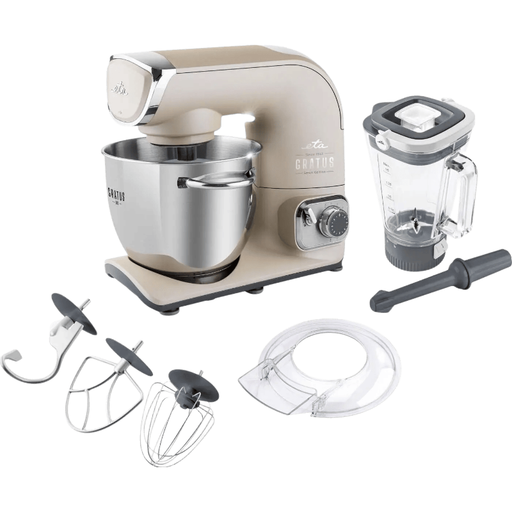
Why it suits this type of user: This model is designed for people who want to use extra features such as blending, as well as kneading and mixing.
The specifications state a maximum dough capacity of 2.5 kg. That gives you a more useful guide than the word “professional” alone.
1500 W, planetary mixing, 5.5-litre bowl, pulse function and 1.5-litre glass blender jug, according to the product information.

Why it suits this type of user: The spacious bowl and simple dial make this a good fit for families who regularly make bread, pizza, cakes or other bakes.
The stated motor power is 450 W, rather than an unspecified peak power alone. Overload and overheating protection are also listed.
6-litre stainless-steel bowl, 6 speeds plus pulse function, dough hook, whisk, beater and non-slip suction cups.
We’ve put together a complete, up-to-date list of products that meet these strict selection criteria and current European safety regulations.
Yes, many models come with a dough hook for bread and pizza dough. Always check the maximum dough capacity and, as a rule, use a low to medium speed. Heavy dough can put a strain on the motor, so let the appliance cool down as instructed.
For regular baking for several people, a bowl of around 5 to 6 litres is a practical choice. As well as the bowl capacity, check how much it can usefully hold. A large bowl may actually be less convenient for small quantities, as the whisk or beater might not reach the ingredients as effectively.
Electricity use depends on the power rating and how long you use the mixer. A 1,000-watt appliance running for ten minutes theoretically uses around 0.17 kWh. In practice, the motor doesn’t always run continuously at full power. Keeping mixing times short and choosing the right speed helps limit energy use.
