
Vandaag of morgen in huis

Kwaliteit gegarandeerd

Welkomstaanbiedingen ontgrendelen: GRATIS bezorging | Tot 80% korting | Gratis 30 dagen JoyPlus-proefperiode
Download de app
A good stand mixer can be the difference between a chore and pure baking joy. Whether you dream of homemade bread, airy cakes, or perfectly whipped cream, the right mixer makes the work lighter and the results better. But the market is flooded with models that promise the world. How do you find the stand mixer that truly suits you without falling into the common traps?
As a Joybuy Product Recommendation Officer, I'll help you cut through the marketing jargon. We'll look at what really matters, so you can make an informed choice.
Before you buy a stand mixer, it's important to be aware of common deceptions. Many buyers focus on the wrong specifications and end up with an appliance that doesn't meet their expectations.
dough mixer.dough hook can oxidise and leave black residue on your dough. The quality of the essential dough hook and whisk is more important than the quantity of extras.stand mixer.To avoid the traps, focus on the specifications that truly matter for your baking and cooking style.
Look beyond just the wattage. A quiet stand mixer often indicates a more efficient motor and better build quality. For heavy-duty work, like kneading bread dough, torque (rotational force) is more important than pure speed. A machine with a DC motor (direct current) often delivers more consistent power and is quieter than an AC motor (alternating current) with a similar wattage.
The size of the stand mixer with bowl determines how much you can prepare at once.
A stainless steel (SS) bowl is the standard: durable, hygienic, and easy to clean.
A good baking mixer comes with three indispensable attachments:
Below is a selection of models that fit different user profiles, based on their objective specifications.

Why This Fits Their Persona: This is an ideal `hand mixer with bowl` for those looking to upgrade from a simple hand mixer to something more convenient. The combination of a mixer and an auto-rotating bowl takes a lot of work off your hands, without the investment and space required for a full stand mixer.
The 450W motor is focused on efficiency for batters and light dough, not on misleadingly high wattage. The included accessories are functional, and the suction cups provide stability, which counteracts the 'walking' problem.
The auto-driven 3-litre bowl ensures even mixing. According to Philips, the cone-shaped beaters are designed for maximum air incorporation, resulting in fluffier batter.
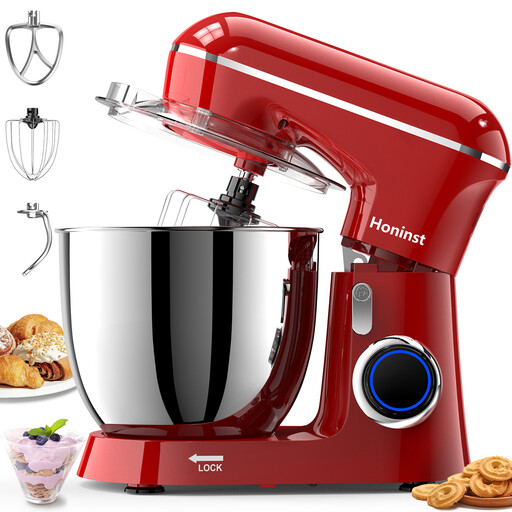
Why This Fits Their Persona: For the hobbyist who does a bit of everything – from bread to cakes and cookies. This `stand mixer` offers a large bowl (6.5QT is approx. 6.1L) and 10 speeds, providing great flexibility for a wide range of recipes.
This model focuses on build quality. The manufacturer claims a noise level of less than 60 dB, which indicates a solid motor and housing. The anti-slip suction cups directly address the stability problem.
The large 6.1-litre bowl capacity is ideal for bigger batches. The tilt-head design makes it easy to add ingredients and change accessories. Includes the three essential attachments.
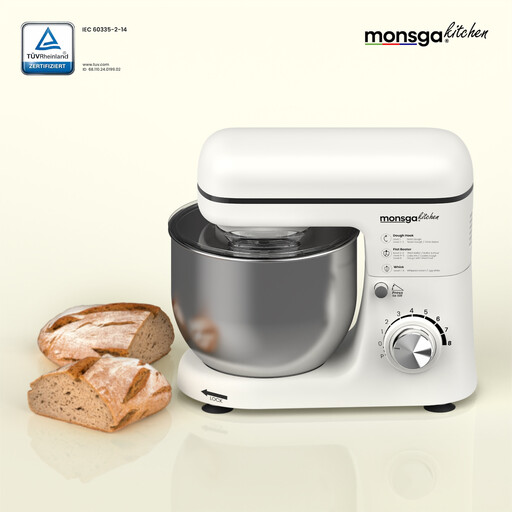
Why This Fits Their Persona: For the home baker who specialises in bread and other heavy doughs, pure power is indeed important. This `dough mixer` combines high power with a robust design, specifically for the toughest kneading tasks.
Here, the high wattage (1000W) is functional, not an empty marketing claim. It's combined with a planetary mixing action for thorough kneading. The Teflon-coated dough hook is a quality upgrade that avoids the 'accessory illusion'.
The powerful copper motor is designed for heavy-duty tasks. The 5.0L stainless steel bowl is a practical size for most bread recipes. The machine is CE certified and has overheat protection.
We've compiled a complete, up-to-date list of products that meet these practical selection criteria.
For light work like cake batter and whipped cream, 250-450 watts is often sufficient. For regularly kneading bread dough, it's wise to look at models from 450 watts upwards with a high-quality motor (like a DC motor) or higher-wattage models (around 1000W) specifically designed as a dough mixer. However, don't fixate on the number; the overall build quality is more important.
This varies by model and part. The stainless steel mixing bowl and whisk are often dishwasher-safe. Be careful with the dough hook and flat beater. If they are made of coated aluminium, the coating can be damaged in the dishwasher. Always check the manufacturer's manual for specific cleaning instructions.
Although the terms are sometimes used interchangeably, they have different functions. A kitchen mixer or stand mixer is primarily intended for mixing, whipping, and kneading (think baking). A food processor is designed for chopping, slicing, grating, and puréeing (think cutting vegetables or making pesto). Some stand mixers have attachments for food processor tasks, but a specialised appliance is often more efficient.
