
Vandaag of morgen in huis

Kwaliteit gegarandeerd

Welkomstaanbiedingen ontgrendelen: GRATIS bezorging | Tot 80% korting | Gratis 30 dagen JoyPlus-proefperiode
Download de app
Dreaming of homemade bread with a perfect crust, fluffy cakes, or silky-smooth dough without the arm-aching effort of kneading? A good stand mixer can do the heavy lifting for you and elevate your baking and cooking skills. But with so many models, specifications, and brands on the market, choosing the right one can be a challenge.
As a Joybuy Product Recommendation Officer, I'm here to help guide you. In this article, we'll cut through the marketing jargon and focus on what really matters: the specifications that match your needs. We'll look at a few popular choices and give you practical tips so you can make an informed decision for your kitchen.
Before we dive into the models, it's helpful to know which features are important. Here are three key points to help you compare.
Power, expressed in watts (W), indicates the strength of the motor. For mixing light batters, a lower wattage is often sufficient. However, if you plan to regularly knead heavy bread or pizza dough, a machine with a more powerful motor (e.g., 700W or more) is recommended.
Also, pay attention to the mixing action. Many modern machines use a planetary mixing action. This means the mixing head spins in one direction while moving in a wider circle around the bowl. This ensures all ingredients from the sides and bottom of the bowl are incorporated for a uniform result.
The capacity of the mixing bowl, measured in liters, determines how much you can prepare at once. For a small household or for someone who bakes an occasional cake, a bowl of around 4 liters is often large enough. If you bake for a large family or like to make large batches of dough, a 5-liter bowl or larger is a better choice. Most bowls are made of stainless steel, which is durable and easy to clean.
A stand mixer typically comes with a set of basic accessories:
Some models can be expanded into a complete kitchen machine with optional accessories like a blender, meat grinder, or pasta maker. Think about the tasks you want to perform beforehand to decide if expandability is important to you.
Based on functionality and specifications, we've selected three interesting models for different types of users.
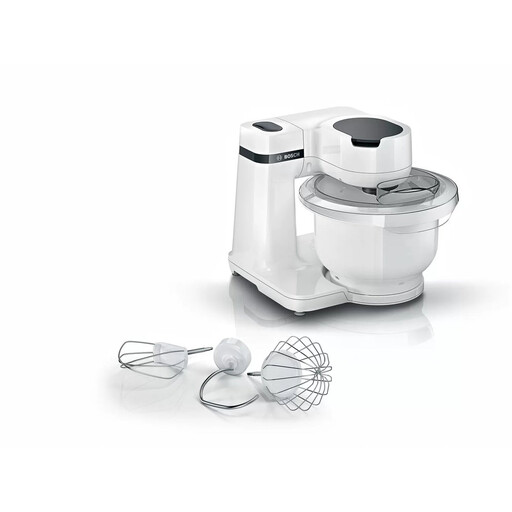
Why this model stands out The Bosch stand mixer MUMS2AW00 is a compact and reliable all-rounder. What's notable is its 3D Planetary Mixing technology, which ensures a very thorough mixing of ingredients. Despite its small footprint, it's designed to work efficiently.
Advantages
Who is this a good choice for? This is an excellent choice for the novice home baker or for anyone looking for a reliable, no-nonsense machine for weekly use. It's perfect for making cakes, pastries, and lighter doughs.

Why this model stands out The Kenwood stand mixer Titanium Chef Baker is designed for the serious home chef. The built-in scale is a unique feature that lets you weigh ingredients directly in the bowl. This saves time and reduces cleanup. Its powerful motor and the included dual mixing bowls make it highly versatile.
Advantages
Who is this a good choice for? For the passionate home baker who bakes regularly, isn't afraid of complex recipes, and values precision and convenience. If you're investing in a durable machine that can grow with your ambitions, this is a strong contender.

Why this model stands out The Aucma stand mixer stands out with its very spacious 6-liter mixing bowl and its quiet motor. According to the manufacturer, the 450W DC motor provides efficient power transfer with a lower noise level. This model focuses on capacity and core functionality.
Advantages
Who is this a good choice for? This model is suitable for bakers who primarily want to process large volumes and prioritize capacity over extra features or a big-name brand. If you often bake for a large group and need a machine with a spacious bowl, this model offers great value for money.
This selection is just a starting point. The ideal stand mixer depends on your personal needs, your kitchen, and your budget. There are many more models available with different specifications and in various price ranges.
Want to compare more options? Check out our full range on the category page.
View all stand mixers and kitchen machines here
This depends on its intended use. For light batters and whipping, 300-500W is often enough. For regularly kneading heavy bread dough, a motor of 700W or more is recommended. However, note that the type of motor (like a DC motor) and the efficiency of the drive train are just as important as the wattage alone.
The terms are often used interchangeably. A stand mixer (or mixer with a bowl) is specifically designed for mixing, whipping, and kneading. The term kitchen machine (or food processor) can also refer to a multifunctional appliance that can chop, slice, or blend with additional attachments. The models discussed here are essentially stand mixers.
